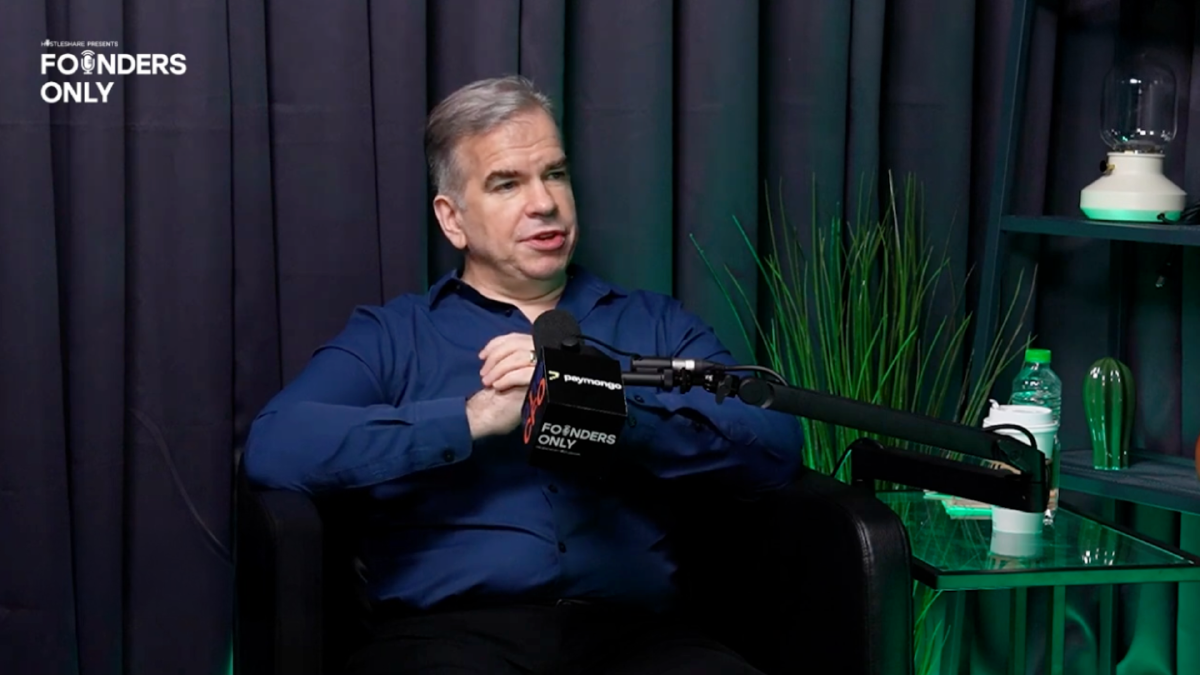

Recently, I had the privilege of returning to the Founders Only podcast to sit down with host Ron for an incredibly deep and wide-ranging conversation. We covered a lot of ground, from my journey building UBX and the realities of venture capital, to the fundamental necessity of energy abundance in the Philippines and the evolving nature of leadership.
If you are a founder, an investor, or simply someone passionate about the future of technology and infrastructure in Southeast Asia, I highly encourage you to watch the full episode.
How do you know when to pass the baton?#
We began by rolling the clock back to 2018, a time when only 27% of the Philippine population had a bank account, yet everyone had a smartphone and was active on digital platforms. The genesis of UBX was built on a simple bet: financial services were not just going to be digitized, but embedded directly into the non-banking platforms where customers already spent their time.
Over the years, we grew UBX into a market leader with six consecutive years of year-over-year growth. We also ran a highly successful corporate venture capital (CVC) fund that backed incredible founders, like Dick Chiang of Dragonpay, and ultimately returned all of its capital while achieving top-decile 3x returns on paper.
But a crucial part of a founder’s journey is recognizing when the company is ready for its next phase. After we successfully raised capital from Japan’s SBI Group, the largest financial technology conglomerate in Asia, I knew the balance sheet was strong and our market position was validated. Surrounding yourself with talent smarter than yourself allows you to bake succession directly into your company’s DNA, and it made passing the baton a natural and confident decision.
Why is energy abundance non-negotiable for innovation?#
After taking some much-needed time off to recharge and spend time with my family in Canada, I found myself drawn to a new, monumental challenge. I began working closely with 1882 Energy Ventures, the energy venture studio backed by the Aboitiz conglomerate.
My foray into the energy space is driven by a stark realization: all modern innovation, whether it’s e-commerce, fintech, or logistics, has a hard dependency on energy. If you look at the macro data, a country’s energy use per capita is directly correlated to both its GDP and its Human Development Index (HDI). Put simply, there are no low-energy rich countries in the world. Unfortunately, the Philippines currently sits on the wrong side of that equation.
To solve this, 1882 Energy Ventures is building solutions to drive energy security and abundance. We are currently scaling two phenomenal ventures:
- Voltai: A B2B electric vehicle company providing two-wheel EVs to fleet operators. To overcome range anxiety, they have built the largest battery swap network in Metro Manila, allowing drivers to swap batteries faster than pumping gas.
- Solviva: Democratizing residential rooftop solar through a zero-downpayment, rent-to-own model. By removing upfront friction, Solviva empowers households to generate their own clean energy.
Will AI force a return to hardware and energy?#
Of course, we couldn’t ignore the elephant in the room: Artificial Intelligence. AI is aggressively driving the cost of software development down to near zero. Because of this, the primary bottleneck for innovation is no longer software; it is hardware and energy.
For the last decade, venture capitalists have been addicted to high-margin, low-capital-intensity SaaS businesses. However, as data centers scale to meet AI demands, the venture capital model will have to return to its roots and get comfortable investing in capital-intensive, physical-world businesses once again.
How should leadership playbooks evolve for the “Messy Middle”?#
Navigating the “messy middle” of a startup requires a deep understanding of human dynamics. I shared a few frameworks that have guided me:
- Define Your True Core Values: A core value is something that you could legitimately take the opposite stance on, and it is often costly to uphold. It provides your team with a decision heuristic when explicit policies do not exist.
- Feedback Must Be Observable: When delivering candid feedback, leaders must base it on observable behavior rather than internal feelings. You cannot control how someone feels, but you can address specific actions.
- The “What” vs. The “How”: Often, when conflicts arise, one person is arguing about the what (the factual event), while the other is upset about the how (the tone or delivery).