

This week’s signals center on a single architectural reality: intelligence, whether artificial or organizational, only compounds when it is grounded in clear structure, honest feedback loops, and adaptable governance:
- In engineering and education, static artifacts are giving way to dynamic, context-aware systems. Uber’s Context Graph gives AI agents a structured mental map of services, owners, and incidents to slash latency and token waste, while its engineering leaders have abandoned raw PR velocity in favor of categorizing work by business impact. Simultaneously, Google’s LearnLM pipeline demonstrates that static textbooks can be dynamically rebuilt around a student’s comprehension level and interests to drive measurable gains in long-term retention.
- Yet technology alone rarely captures value without structural redesign. Anthropic’s interviews across 58 enterprise customers show that top-down automation triggers resistance and bottom-up tool distribution stalls in silos; the highest-return deployments reorganize workflows around human bottlenecks and empower non-developers with governed data access.
- Finally, the human architecture of leadership remains the ultimate constraint. Whether examining Guido van Rossum’s resignation as Python’s Benevolent Dictator For Life, the preservation of open-licensed deep learning texts under Creative Commons, or the parallels between Wang Laboratories’ collapse and executive succession dynamics at Nvidia, durable institutions depend on separating formal authority from personal loyalty so truth can still reach the top.
Market Observations & Insights#
Uber’s Context Graph: Grounding Agents in Organizational Reality#
- Summary: Uber Distinguished Engineer Uday Kiran Medisetty explains how Uber built its internal Context Graph, spanning over 100 node types and 130 edge types linking engineers, design docs, services, and incidents, to serve as the default grounding layer for its internal AI assistant, Cortana, reducing agent turns, latency, and cost while improving answer quality.
- Why it Matters: Most enterprise AI deployments fail not because the underlying foundation model is weak, but because the agent lacks structured context about how the business actually operates. Without a live map of ownership, dependencies, and institutional history, agents waste tokens wandering through fragmented repositories and Slack threads.
- My Take: Context architecture is the new enterprise moat. Organizations that invest in structured knowledge graphs linking people, systems, and operational history will extract exponentially more value from every model upgrade than peers relying on unstructured vector search.
Killing the Static Textbook with Dynamic AI Pipelines#
- Summary: Google’s “Learn Your Way” system uses LearnLM and Gemini to dynamically transform static textbook PDFs into five interactive formats (including leveled text, narrated slides, zoomable mind maps, adaptive quizzes, and simulated audio lessons) tailored to a student’s grade level and personal interests, achieving an 11-percentage-point gain in long-term retention in a randomized controlled trial.
- Why it Matters: For five centuries, education and corporate training were constrained by the economics of printing: one static document had to serve every learner. Multi-modal AI pipelines applying cognitive science principles like Dual Coding Theory turn passive reference material into adaptive, high-retention learning environments.
- My Take: Static documentation is a legacy printing artifact. Whether in classrooms or enterprise onboarding, the winning knowledge platforms will dynamically re-render core curricula to match each learner’s baseline and context in real time.
Preserving Open Technical Knowledge Under Creative Commons#
- Summary: Andriy Burkov launched a dedicated mirror (
nielsensdeeplearningbook.com) hosting PDF, ePUB, HTML, and LaTeX versions of Michael Nielsen’s classic Neural Networks and Deep Learning under its CC BY-NC 3.0 license, with plans to update its code and outdated sections so the resource remains accessible and functional. - Why it Matters: Foundational technical literature is increasingly vulnerable to link rot, platform shifts, and authorial abandonment. Permissive Creative Commons licensing acts as an institutional insurance policy, allowing practitioners to fork, modernize, and preserve canonical educational works for future builders.
- My Take: Open licensing is knowledge resilience. In fast-moving technical domains, the durability of foundational education depends on communities having both the legal right and the operational discipline to maintain living texts.
Deep Reads from the Library#
Working with AI: How Enterprises Reorganize Around Agents#
Author: Anthropic (Nathan Wilmers, Maxim Massenkoff, Peter McCrory)
- Summary: Based on 66 face-to-face interviews across 58 Anthropic enterprise customers, this field study finds that AI primarily creates value by expanding output and enabling novel products rather than cutting headcount, while demonstrating that both rigid top-down automation and uncoordinated bottom-up adoption hit severe organizational bottlenecks.
- Why it Matters: Distributing AI licenses without redesigning roles produces uneven pockets of productivity alongside security risks and expert resistance. The organizations capturing outsized returns are broadening employee ownership over end-to-end workflows, redeploying staff to non-automatable judgment bottlenecks, and giving non-developers governed access to business data and coding agents.
- My Take: AI value is an organizational design problem, not a procurement problem. Buying model seats is table stakes; durable competitive advantage comes from re-architecting human roles around the shifting boundary between automated execution and human judgment.
Guido van Rossum: The Rise and Fall of Python’s Benevolent Dictator#
Author: Bruce Li
- Summary: Bruce Li chronicles Guido van Rossum’s journey from writing Python over a 1989 Christmas break in Amsterdam to his abrupt 2018 resignation as “Benevolent Dictator For Life” following the bitter community conflict over PEP 572’s walrus operator (
:=). - Why it Matters: Every successful platform eventually outgrows the governance model that enabled its early coherence. While van Rossum’s insistence on readability and single-mindset design propelled Python to become the lingua franca of AI and data science, centralized consensus-seeking at global scale turned architectural stewardship into unsustainable personal attrition.
- My Take: Taste scales faster than governance. Founders and chief architects must deliberately transition from personal arbitration to institutional decision-making frameworks before community scale turns stewardship into burnout.
Why Wang Laboratories Is a Cautionary Tale for Jensen Huang#
Author: Han Qin
- Summary: Han Qin draws a governance parallel between An Wang’s ill-fated decision to install his son Fred Wang as president of Wang Laboratories (which triggered board resignations and preceded the company’s 1992 bankruptcy) and recent reporting on executive friction surrounding Jensen Huang’s daughter Madison’s informal influence at Nvidia.
- Why it Matters: When organizational power is decoupled from formal title and accountability, dissenting executives cannot challenge decisions without appearing to challenge the founder personally. Over time, capable operators quietly exit, leaving leadership surrounded by compliance and starved of the unvarnished operational truth required to navigate inflection points.
- My Take: Unaccountable proximity destroys executive feedback loops. Governance integrity requires that authority map strictly to formal role and measurable performance, ensuring that truth can travel upward without fear of personal reprisal.
Highlights from the Stacks#
A Brief History of Intelligence#
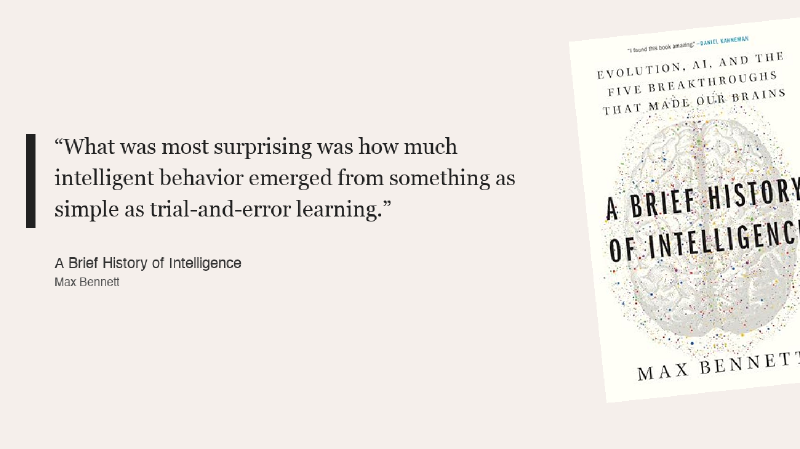
“What was most surprising was how much intelligent behavior emerged from something as simple as trial-and-error learning.”
- Summary: Max Bennett traces the evolutionary breakthroughs of biological brains, from steering and reinforcement learning to mental simulation and language, showing how sophisticated adaptive behavior emerges from simple iterative feedback loops.
- Why it Matters: Leaders often over-engineer grand strategic plans before testing assumptions against reality. Both biological evolution and high-velocity organizations compound intelligence through rapid, low-cost trial-and-error cycles that reward what works and prune what fails.
- My Take: Iteration beats prediction. Building an organization that learns faster through disciplined experimentation is far more resilient than betting the company on a single top-down forecast.
Talk Like TED#
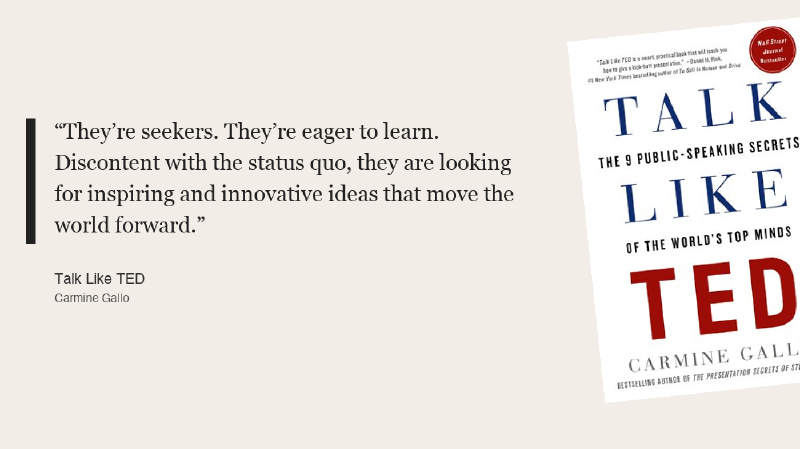
“They’re seekers. They’re eager to learn. Discontent with the status quo, they are looking for inspiring and innovative ideas that move the world forward.”
- Summary: Carmine Gallo distills the communication habits of top TED speakers, emphasizing that audiences (and high-agency teams) are energized not by defensive preservation of the present, but by clear, intellectually curious narratives that challenge the status quo.
- Why it Matters: In periods of rapid technological shift, executive communication cannot be merely informational; it must frame why legacy habits are no longer sufficient and articulate a compelling path forward that rallies builders and skeptics alike.
- My Take: Great leadership narrates the future before it arrives. People follow leaders who pair intellectual curiosity with a restless dissatisfaction for how things are currently done.