

This week’s signals illuminate an accelerating convergence across software engineering, corporate go-to-market, and industrial innovation: as the marginal cost of code generation and digital synthesis drops toward zero, competitive advantage is migrating toward distribution, physical execution, and disciplined capital allocation:
- In product development and market research, the arrival of high-fidelity synthetic consumers and autonomous coding pipelines is dismantling legacy manual workflows. Colgate’s validation of Semantic Similarity Rating proves that LLMs can simulate targeted human purchase intent with 90% reliability in hours rather than months, while software companies are realizing that open-sourcing agent skills and MCP interfaces represents the new free-trial distribution channel for autonomous agent swarms.
- Simultaneously, the downstream friction of unconstrained synthetic generation is becoming apparent. As autonomous software “dark factories” generate code at unprecedented speeds, organizations are running headfirst into the hard compute costs and queuing delays of testing and verification infrastructure.
- In the macro realm, the boundaries of technology continue to collide with physical constraints and sovereign perimeters. Whether analyzing the CFTC’s insistence that on-chain perpetual markets adhere to standard exchange rulebooks, Stark Future’s out-execution of legacy motorcycle manufacturers through uncompromised hardware performance, or the capital reallocation doctrines of master operators, sustainable enterprise value does not come from passive automation. It belongs to leaders who dismantle bureaucratic paralysis, optimize physical unit economics, and align their architectures with verifiable market demand.
Market Observations & Insights#
Synthetic Consumers and the Demise of Traditional Market Research#
- Summary: Colgate published research showing that roleplaying large language models under specific demographic profiles scored via Semantic Similarity Rating (SSR) mirrored real human purchase intent with 90% test-retest reliability across 57 personal care product surveys and 9,300 human responses.
- Why it Matters: Traditional consumer research is expensive, slow, and plagued by social desirability bias. The ability to simulate thousands of targeted customer interviews overnight collapses the product discovery loop from months to hours, allowing teams to stress-test positioning, feature tradeoffs, and price elasticity before investing millions in physical manufacturing or code.
- My Take: Simulation is replacing speculation in product design. When high-fidelity customer feedback can be generated deterministically in seconds, market research ceases to be an intermittent consulting expense and becomes continuous operational telemetry.
Open-Source Skills as the New SaaS Distribution Engine#
- Summary: Greg Isenberg identifies an emerging SaaS go-to-market playbook: turning core customer workflows into open-source agent skills and Model Context Protocol (MCP) integrations compatible with frameworks like Claude Code, Codex, and Cursor, using free execution as the initial customer acquisition vector.
- Why it Matters: When language models allow users to bypass traditional user interfaces entirely, software platforms that gate basic workflows behind seat licenses and clumsy dashboards will be cut out of the agent loop. Distributing open-source skills ensures an application becomes the default programmatic tool for agent swarms, shifting enterprise monetization from UI access to state persistence, team governance, and proprietary data hosting.
- My Take: The skill is the new free trial; the MCP is the new landing page. If your software cannot be executed autonomously by an agent in a terminal, your product does not exist in the next software distribution paradigm.
For why software interfaces are evolving toward headless execution, see Thought Is the Ultimate UI.
Building Products People Love When Software Gets Cheap#
Notes on building products people love when software gets cheap
- Summary: Hiten Shah analyzes Meta’s enduring strategy of treating the broader consumer internet as an external product research lab, systematically adopting validated mechanics like Stories, Reels, and public text, arguing that as software becomes trivial to build, value shifts entirely toward discovering and operationalizing proven human behavioral patterns.
- Why it Matters: The commoditization of code eliminates technical implementation as a durable competitive advantage. In a world where any competitor can clone an application overnight, winning teams stop romanticizing original feature development and focus relentlessly on behavioral retention, distribution leverage, and immediate feedback loops with their core audience.
- My Take: When code is free, behavioral discovery is the only moat. The companies that dominate the post-software era will not be those who pride themselves on bespoke technical complexity, but those who operate with the humility and speed required to capture validated user habits.
For a deeper analysis of defensibility when engineering barriers evaporate, see Moats in the Age of Vibe Coding.
The Boring Company and the Economics of Subterranean Infrastructure#

The Boring Company & the Future Underground
- Summary: David George provides an in-depth operational teardown of The Boring Company’s push to lower tunneling costs through all-electric, continuously boring Prufrock machines, examining how vertical integration and simplified tunnel geometry aim to transform urban transit from a multi-decade public works nightmare into private turnkey infrastructure.
- Why it Matters: Modern civil infrastructure projects suffer from catastrophic cost disease, regulatory inertia, and contractor fragmentation that render major transit expansions financially impossible for municipalities. Driving tunneling costs down from $1 billion per mile toward $10–20 million per mile unlocks a 3D underground transportation network that bypasses surface land-acquisition battles and political friction.
- My Take: Infrastructure innovation requires conquering cost disease at the physical layer. Digitization cannot solve physical congestion; real macro leverage comes from founders willing to rebuild heavy mechanical engineering and civil construction from first principles.
For how venture capital is rotating back toward high-capex physical engineering, see Venture Capital and the Return to Atoms.
Hyperliquid and the Hard Reality of the Regulatory Perimeter#
- Summary: CFTC Chairman Selig clarified that on-chain derivatives exchanges like Hyperliquid seeking to enter the United States must either acquire a registered exchange or partner with an incumbent designated contract market (DCM), underscoring that decentralized settlement architecture does not grant an exemption from standard regulatory obligations.
- Why it Matters: Crypto native founders often confuse technical decentralization with jurisdictional immunity. While decentralized order books and autonomous settlement solve counterparty and custody risk, sovereign regulators regulate access to domestic customer capital, meaning the endgame for high-volume decentralized finance always converges on licensed institutional infrastructure.
- My Take: Decentralized code cannot override sovereign jurisdiction. Long-term financial transformation will not come from evading institutional guardrails, but from upgrading the underlying market plumbing while meeting regulatory standards of investor protection and market integrity.
For why tokenized and cryptographic rails represent the true structural modernization of financial markets, see Tokenization Is the Capital Markets Upgrade.
Deep Reads from the Library#
Steve Yegge on AI Agents and the Future of Software Engineering#
Author: Gergely Orosz
- Summary: Veteran engineer Steve Yegge joins Gergely Orosz to dissect how autonomous coding agents are fundamentally altering engineering workflows, moving beyond simple inline code completion to probabilistic software development where human engineers act as architectural supervisors rather than syntax writers.
- Why it Matters: The mental model of the software engineer as a craftsman writing lines of code is obsolete. Engineering organizations must restructure their talent profiles and CI/CD pipelines around prompt evaluation, continuous specification refinement, and automated regression verification, or risk getting outpaced by leaner, agent-native engineering pods.
- My Take: The compiler has moved to natural language; engineering has moved to system design. The most valuable developers of the next decade will not be syntax specialists, but systems thinkers who can orchestrate agent swarms and rigorously verify probabilistic output against business logic.
Stark vs Livewire: The Definition of Electric Motorcycle Success and Failure#
Author: Michael Uhlarik
- Summary: Michael Uhlarik contrasts Barcelona-based Stark Future’s €150 million funding round at a €1.2 billion valuation with Harley-Davidson’s struggling electric spin-off Livewire, illustrating how purpose-built engineering, uncompromised performance parity with combustion bikes, and direct customer relationships outclassed an incumbent weighed down by legacy dealer friction and corporate brand baggage.
- Why it Matters: Incumbent corporate spin-offs regularly fail because they inherit their parent company’s cost structures, political compromises, and protective channel relationships. Stark succeeded in the grueling hardware arena not by asking consumers to make green compromises, but by building an electric platform that was unequivocally superior to legacy two-stroke engines on power, weight, and handling.
- My Take: Green transitions succeed on performance superiority, not corporate virtue. Consumers and commercial operators will not adopt electric powertrains out of benevolence; enduring clean-tech categories are won by startups that build unmistakably superior hardware at lower total cost of ownership.
For how electric two-wheeler platforms and battery architectures are reshaping transportation markets, see EV Mobility in Southeast Asia.
Making CI Faster and 95% Cheaper#
Author: Vincent Koc
- Summary: Vincent Koc details an aggressive infrastructure engineering campaign inside an autonomous agent coding environment (“dark factory”), explaining how an explosion in agent-generated PRs caused test suite execution and compute costs to skyrocket until the team implemented deterministic test selection, worker cache reuse, and rightsized runners to slash cloud bills by 95%.
- Why it Matters: As autonomous coding agents eliminate the bottleneck of code generation, software organizations will immediately slam into the downstream constraints of testing, linting, and deployment infrastructure. Organizations that do not ruthlessly optimize test execution and environment warm-up will find their productivity gains devoured by exponential CI cloud bills and test queuing delays.
- My Take: When code generation is free, testing is the primary cost center. Unchecked agent productivity will quickly paralyze unoptimized engineering pipelines; operational mastery requires re-architecting feedback loops so validation runs as fast as agents can create.
For why autonomous agents require rigorous external feedback loops and pain signals to avoid runaway failure states, see AI Agents Do Not Feel Pain.
Highlights from the Stacks#
The Outsiders#
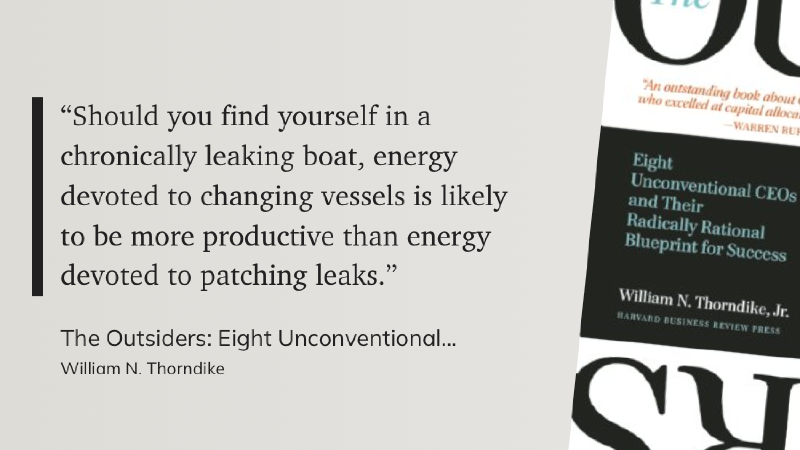
“Should you find yourself in a chronically leaking boat, energy devoted to changing vessels is likely to be more productive than energy devoted to patching leaks.”
- Summary: William Thorndike examines the unconventional capital allocators who radically outperformed the S&P 500, highlighting Warren Buffett’s principle that executive energy is best deployed pivoting to fundamentally advantaged economic models rather than endlessly rehabilitating structurally challenged legacy businesses.
- Why it Matters: Corporate leaders frequently fall into the sunk-cost trap, pouring valuable talent and balance sheet capital into dying business units in a futile attempt to defend legacy profits. Exceptional CEOs recognize when an industry’s macro economics have turned toxic and possess the institutional courage to reallocate cash flows into high-return frontiers.
- My Take: Capital allocation is the supreme executive test. The best operational execution cannot compensate for a deteriorating business model; true strategic leadership lies in knowing when to abandon a leaking ship and allocate capital toward fertile ground.
Creativity, Inc.#
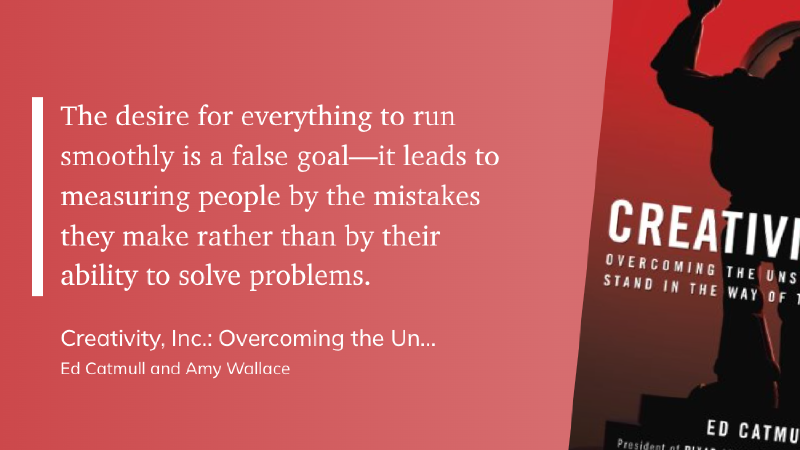
“The desire for everything to run smoothly is a false goal—it leads to measuring people by the mistakes they make rather than by their ability to solve problems.”
- Summary: Pixar co-founder Ed Catmull outlines the operational philosophy necessary to manage creative and technical excellence, arguing that bureaucratic efforts to eliminate risk and prevent all failure inadvertently create a culture of risk aversion that suffocates genuine innovation.
- Why it Matters: As organizations scale, middle management instinctively constructs defensive processes designed to ensure predictable, error-free operations. But in creative and pioneering technology ventures, zero defects means zero experimentation; leaders must actively protect teams from the paralysis of managerial perfectionism and evaluate people on problem-solving capacity rather than spotless conformity.
- My Take: Process optimization without creative friction breeds mediocrity. Operational stability is a tool, not the mission; sustainable category leadership requires creating environments where calculated mistakes are welcomed as the necessary price of breakthroughs.
The Industries of the Future#
“The 21st century is a terrible time to be a control freak; future growth depends on empowering people.”
- Summary: Alec Ross explores the geopolitical and economic frontiers of artificial intelligence, robotics, and genomics, warning that hierarchical, top-down control systems cannot navigate the accelerating velocity of technological disruption.
- Why it Matters: In an era characterized by exponential technological shifts and fluid market boundaries, centralized command-and-control leadership models become crippling operational bottlenecks. Organizations and sovereign states that thrive will be those that push decision-making authority to the edge, trusting autonomous teams and specialized talent to adapt in real time.
- My Take: Velocity demands decentralization. When market conditions shift faster than corporate steering committees can convene, rigid executive hierarchies become existential liabilities; the winning posture is radical decentralized empowerment bound by shared strategic intent.