
This week’s signals highlight a recurring tension across technology architecture, capital deployment, and corporate governance: the widening chasm between raw technical capability and organizational adoption:
- In artificial intelligence and developer infrastructure, the cost of generating software and spinning up autonomous agents is plummeting toward zero. Yet as autonomous agents proliferate, economic value is not pooling in this new-found commodity execution. It is concentrating in entities that can supply scarce accountability, skin in the game, and verified trust.
- Simultaneously, cybersecurity has officially crossed into machine-time, where automated exploit harnesses probe infrastructure at speeds human review committees cannot fathom.
At the macroeconomic level, the race to build infrastructure continues to outpace enterprise implementation. Hyperscalers are deploying record billions into compute clusters, but enterprise adoption metrics remain stubbornly flat, demonstrating that technology investments without organizational redesign merely add expensive administrative overhead.
Whether re-evaluating the lost discipline of low-latency software engineering, mastering the theater of enterprise sales, or rejecting the zero-sum panic of cognitive mercantilism, durable competitive moats do not belong to those who hoard tools or amass passive compute. They belong to leaders who build transparent, low-latency execution and ground their businesses in verifiable, institutional accountability.
Market Observations & Insights#
Enterprise Sales and the Theater of Perception#
- Summary: Alexandr Wang notes that enterprise and government sales operate on narrative insulation rather than objective product benchmarks, arguing that even software giants like Palantir succeed by functioning as theater troupes that give bureaucratic buyers the consensus narratives needed to survive within their institutions.
- Why it Matters: Engineers and technical founders frequently suffer from the delusion that superior code and superior performance metrics will effortlessly sell themselves. In reality, large enterprise procurement is an exercise in institutional risk avoidance; decision-makers optimize for safe, defensible narratives that protect their careers if something goes wrong, making narrative architecture every bit as essential as core product capability.
- My Take: Enterprise software is not bought on benchmarks; it is bought on risk mitigation. Changing technical reality is only half the battle; the founders who build enduring category leaders master the organizational storytelling required to make adoption safe for bureaucratic stakeholders.
Nobody Trusts Your Agent: The Rise of AI Principals#

Nobody Trusts Your Agent
- Summary: Andrew D’Souza argues that while 2026 was the year of autonomous agent swarms, 2027 will belong to principals: entities that possess skin in the game, distinct points of view, and legal accountability. Because an economic system built on trust cannot rely on disposable agents that bear zero downside risk.
- Why it Matters: When language models drop the marginal cost of code generation, content creation, and workflow execution to zero, synthetic output floods the market and trust becomes the scarcest, highest-margin asset. Long-term economic rents will not accrue to generic model wrappers or disposable tool executors, but to accountable principals with reputations, balance sheets, and explicit liability.
- My Take: Agents execute tasks; principals underwrite trust. When synthetic execution is infinite and free, accountability becomes the only scarce asset left in the market; defensibility belongs to those who build reputation, judgment, and balance sheets capable of taking responsibility.
For why human judgment and responsibility remain irreplaceable when orchestrating autonomous systems, see Trust as Infrastructure.
The $780B Infrastructure Race vs the Enterprise Adoption Void#
- Summary: Analysis of Andreessen Horowitz’s State of Markets II highlights a massive structural divergence: hyperscalers are on track to invest $780B in AI capex in 2026 (nearly doubling year-over-year), yet only 2% of S&P 500 corporations track measurable AI performance metrics over time, despite 69% running pilots in production.
- Why it Matters: This massive deployment latency between capital expenditure and enterprise value realization defines the classic productivity J-curve. Until corporate leadership redesigns core workflows and establishes disciplined operational telemetry, massive infrastructure spending remains an expensive subsidy waiting for tangible business utility.
- My Take: Capex without operational telemetry is speculative subsidization. The next decade of enterprise value will not be created by accumulating compute clusters, but by closing the gap between raw model capabilities and ledger-level business productivity.
To understand why enterprise technology deployments regularly stall before delivering bottom-line results, see Pilot Purgatory: Why Enterprise AI Fails to Scale.
The Doherty Threshold and the Lost Discipline of Latency#
- Summary: Revisiting IBM’s 1982 discovery of the “Doherty Threshold” which proved that user productivity rises exponentially when system response times drop below 400 milliseconds. This is a critique on how modern operating systems and bloated software stacks routinely violate this threshold despite having thousands of times more raw hardware performance.
- Why it Matters: Abundant compute power has made software engineering careless, encouraging teams to layer heavy abstractions, synchronous network calls, and bloated frameworks over basic user interactions. Crossing the 400ms threshold breaks user flow states, transforming daily digital interactions into sluggish, friction-laden chores that degrade knowledge-worker productivity.
- My Take: Latency is cognitive friction; speed is an enduring feature. In an era of heavy runtimes and bloated software bundles, true engineering craftsmanship belongs to teams that treat response time as a non-negotiable architectural constraint rather than an afterthought.
For a deeper look at how system response times dictate user engagement and cognitive flow, see Responsiveness.
Deep Reads from the Library#
Incident Report: October 21st Security Attack#
Author: Jacob Cooper, Angelo Saraceno, Sarah Bedell & Luca Casonato
- Summary: Railway publishes an exhaustive post-mortem detailing a sophisticated cyber attack where an adversary exploited an isolation escape in multi-tenant build infrastructure, sparking a machine-speed contest where attackers deployed abliterated models and automated agent harnesses (similar to ARTEX) to hunt and exfiltrate AI provider API credentials for model distillation.
- Why it Matters: This incident marks a structural turning point in cloud infrastructure security: offensive operations are now conducted at machine speed by automated, uncensored model harnesses probing systems in parallel. Human security teams cannot out-react automated exploit chains; survival requires autonomous defenses, zero-trust container isolation, and immediate credential revocation primitives.
- My Take: Cyber warfare has crossed into machine-time. When automated adversaries weaponize uncensored models to probe systems and pivot laterally in milliseconds, manual security triage is obsolete; defensive parity requires automated runtime enforcement and stateful infrastructure self-healing.
For how to engineer resilient software architectures when autonomous agents act on production systems, see AI Agents Do Not Feel Pain.
Digital minimalism#
Author: Vitalik Buterin
- Summary: Vitalik Buterin reflects on translating the principles of physical minimalism into the digital realm, advocating for local-first computing, lightweight text-based tools, reduced dependency footprints, and intentional UI simplicity to reclaim cognitive autonomy and eliminate artificial software latency.
- Why it Matters: Modern software culture routinely equates progress with feature density and mandatory cloud connectivity, burdening users with bloated interfaces, invasive telemetry, and fragile network dependencies. Designing around digital minimalism restores sovereign control to the user and re-establishes speed, reliability, and cognitive clarity as core virtues.
- My Take: Simplicity is the highest form of operational resilience. True leverage comes from eliminating unneeded software intermediaries and minimizing architectural surface area, allowing builders to think and create without cognitive interruptions.
Cognitive Mercantilism#
Author: Venkatesh Rao
- Summary: Venkatesh Rao critiques modern regulatory anxieties and existential dread surrounding artificial intelligence, diagnosing them as a contemporary revival of 17th-century mercantilism: a zero-sum fallacy that views intelligence as a fixed, scarce resource that elites must control and hoard, rather than an expansive, abundant input that unlocks new economic possibilities.
- Why it Matters: When policymakers and corporate incumbents adopt a mercantilist mindset toward cognitive labor, they instinctively erect protectionist moats, licensing regimes, and defensive gatekeeping that stifle experimentation. Viewing machine intelligence as an abundant, generative commodity enables organizations to expand total value creation rather than protecting legacy bureaucratic rents.
- My Take: Abundance breaks mercantilist moats. Treating intelligence as a scarce asset to be hoarded is an incumbent defensive reflex; the founders and operators who win the next decade will embrace cheap cognitive surplus to invent entirely new markets rather than policing old ones.
Highlights from the Stacks#
High Output Management#
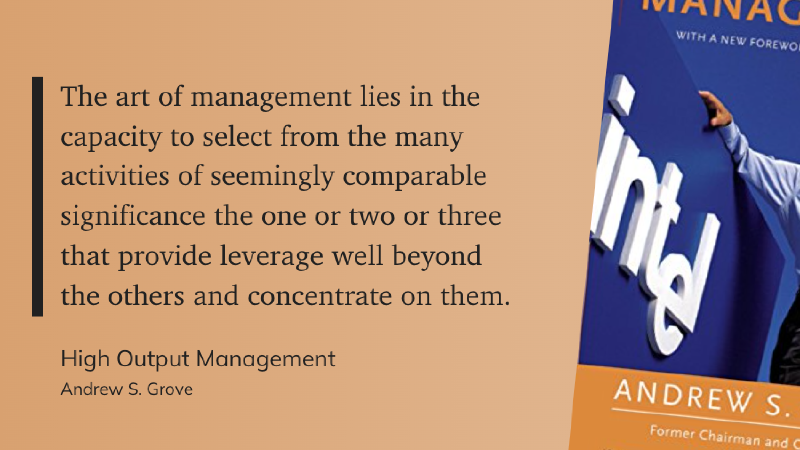
“The art of management lies in the capacity to select from the many activities of seemingly comparable significance the one or two or three that provide leverage well beyond the others and concentrate on them.”
- Summary: Former Intel CEO Andy Grove outlines the foundational operational doctrine of high-leverage management, defining managerial output not as individual activity, but as the collective output of the organization influenced by targeted, high-leverage interventions.
- Why it Matters: In fast-growing organizations, executives frequently drown in trivial operational noise, confusing frantic motion with business progress. Real managerial impact requires identifying the few architectural inflection points where a single decision, training module, or operational standard creates multiplicative output across dozens of teams.
- My Take: Management is leverage, not motion. Activity is easy to fake, but true executive effectiveness requires ruthless prioritization: saying no to the noise to concentrate unrelenting focus on the two or three levers that fundamentally alter the company’s trajectory.
The Hard Thing About Hard Things#
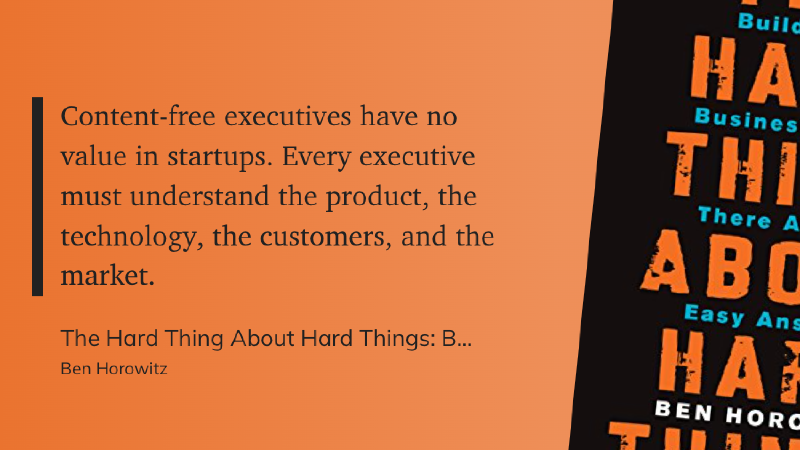
“Content-free executives have no value in startups. Every executive must understand the product, the technology, the customers, and the market.”
- Summary: Ben Horowitz pulls back the curtain on executive leadership in high-stress growth environments, warning against charismatic, generic managers who lack deep domain mastery of their product, technical architecture, and customer realities.
- Why it Matters: As organizations scale, there is a dangerous temptation to hire “professional managers” who speak the polished language of corporate governance but possess zero ground truth about how the technology works or why customers buy. When leadership loses touch with first-principles mechanics, strategic decisions devolve into political posturing and organizational decay.
- My Take: Executive authority requires ground truth. In technology and venture building, you cannot govern what you do not fundamentally understand; leaders who lack technical and customer depth end up presiding over slow, expensive mediocrity.
Broken Money#
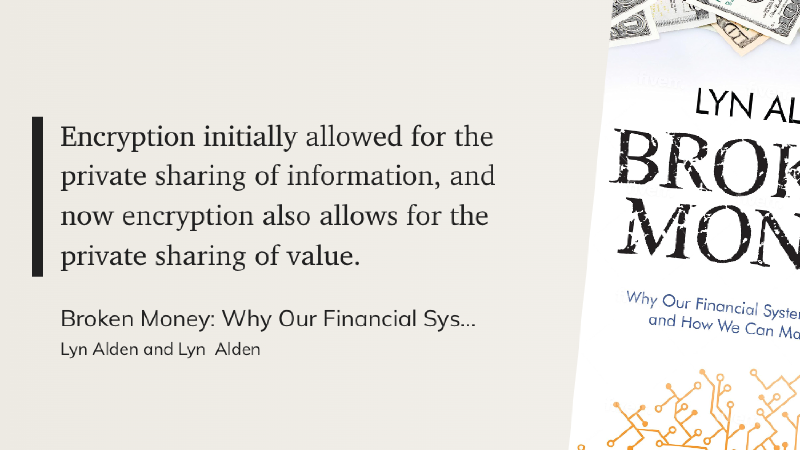
“Encryption initially allowed for the private sharing of information, and now encryption also allows for the private sharing of value.”
- Summary: Lyn Alden traces the historical evolution of ledger technologies and monetary systems, illustrating how public-key cryptography fundamentally transformed money from an institutionally mediated debt record into bearer, cryptographically verifiable digital value.
- Why it Matters: Throughout monetary history, the ledger of value has been held by centralized sovereign and banking intermediaries who extract seigniorage and exercise censorship. Cryptographic settlement rails decouple monetary transfer from trusted third parties, creating the foundational infrastructure required for autonomous agentic commerce.
- My Take: Cryptography turned value into data. Just as the internet decentralized the exchange of speech and information, cryptographic ledgers make value frictionless and sovereign; any financial system built for an autonomous, agent-driven economy must settle on cryptographic rails rather than legacy permissioned ledgers.
For how tokenized ledgers modernize capital markets and monetary settlement, see Tokenization Is the Capital Markets Upgrade.
Further Reading#
- Trust as Infrastructure: Why institutional trust and accountability remain the scarce primitives in a world of automated execution.
- Pilot Purgatory: Why Enterprise AI Fails to Scale: Analyzing why enterprise technology pilots stall and how to restructure workflows to capture bottom-line value.
- Responsiveness: Examining why system response latency dictates cognitive flow and user productivity.
- AI Agents Do Not Feel Pain: Why human engineering judgment remains essential when managing autonomous agent behavior.
- Tokenization Is the Capital Markets Upgrade: Why programmable, permissionless ledgers represent the true future of global asset settlement.