

This week’s signals center on a single recurring truth: whether you are architecting financial infrastructure, orchestrating AI agent workflows, or communicating strategic decisions, durability comes from unyielding structural clarity rather than superficial veneer. At the protocol layer, the ongoing debate over tokenized assets reveals why permissioned enterprise ledgers inevitably devolve into rent-seeking, centralized monopolies and why censorship-resistant, permissionless consensus is the only viable foundation for global settlement.
Meanwhile, at the organizational level, the rapid maturation of AI agents is forcing a fundamental reassessment of management and executive productivity. Far from rendering managers obsolete, autonomous agents raise the stakes on high-level general management: framing ambiguous problems, setting rigorous evaluation harnesses, and communicating with ruthless precision. From Barbara Minto’s four-decade-old Pyramid Principle to the hazards of black-box resume scoring and flawed productivity accounting, compounding advantage belongs to leaders who obsess over process integrity, eliminate gatekeeping noise, and lead with the answer.
Market Observations & Insights#
The Fatal Flaw of Enterprise Blockchains#
- Summary: Omid Malekan breaks down why the recurring narrative of “blockchain, not Bitcoin” and permissioned enterprise networks inevitably fails, arguing that without a censorship-resistant protocol-issued native coin, private chains are merely unregulated clearinghouses laden with gatekeeper monopoly risk.
- Why it Matters: Financial institutions continually attempt to capture the operational efficiencies of distributed ledgers while stripping out permissionless consensus. But a private network with whitelisted validators merely recreates a legacy clearinghouse with total counterparty risk, pricing power over participants, and arbitrary supply manipulation.
- My Take: Permissionless consensus is the feature, not the bug. If you remove censorship resistance and decentralized settlement, you haven’t built a next-generation blockchain; you’ve built an expensive database whose operator will eventually tax your business.
For an analysis of how distributed ledger upgrades transform institutional liquidity, see Tokenization is the Capital Markets Upgrade.
Executive Communication: Leading with the Answer#

The McKinsey Pyramid Principle: 4 Prompts That Make Every Email Impossible to Ignore
- Summary: Nav Toor unpacks Barbara Minto’s iconic Pyramid Principle, illustrating how leading with the recommendation (BLUF) and structuring arguments via SCQA and MECE prompts cuts through executive cognitive overload and dramatically improves decision velocity.
- Why it Matters: Most business communication is structured like a dramatic novel: excessive background context up front, with the punchline buried at the end. In an economy drowning in information, busy leaders skim past the setup; structuring arguments top-down dramatically lowers cognitive load and forces logical rigor.
- My Take: Think bottom-up; communicate top-down. When you lead with the conclusion, you hand the reader the mental scaffolding required to evaluate your supporting arguments.
Structuring arguments top-down is also the foundation of effective slide design and automated presentations. See Margo vs Marp: The Power of Context-Engineered Slides and A Presentation System, Not a Product.
General Management in the Age of Autonomous Agents#
- Summary: David Paola highlights that great managers have never been about executing granular work, but rather about crafting the context, environment, and boundary conditions for exceptional work to occur, making general management more vital in the agentic era.
- Why it Matters: As autonomous AI agents take over rote execution, code generation, and task pipelines, organizational bottlenecks shift upward. The scarce skill is no longer executing a prescribed spec, but defining the system architecture, evaluating trade-offs, and steering heterogeneous teams of humans and models.
- My Take: Agents amplify management leverage; they don’t replace it. An organization with autonomous execution agents and bad management simply makes wrong decisions ten times faster.
To understand how to structure roles and boundaries between agentic systems and tool harnesses, see Agents vs. Skills: Clarifying the AI Architecture.
Automated Security Auditing for Agent Workflows#
- Summary: Jurbed recommends Cloudflare’s open-source security audit skill, highlighting that model-agnostic, deterministic audit harnesses can be integrated across agent workflows to systematically identify vulnerabilities in generated code.
- Why it Matters: Generating rapid code via LLMs without automated, rigorous security harnesses creates massive enterprise vulnerability. Standardizing security checks into reusable, deterministic evaluation skills ensures that agent autonomy does not degrade operational security standards.
- My Take: Never trust unharnessed code generation. High-velocity software delivery in the agentic era requires deterministic gatekeeping skills running continuously against every commit and model output.
For how to construct reliable benchmark harnesses for autonomous skills, see Deterministic Evals for AI Skills.
Deep Reads from the Library#
Charts of the Week: Experience > Skills#
Author: Seema Amble
- Summary: Seema Amble reviews hiring data demonstrating an aggressive industry shift toward prioritizing seasoned operational experience and strategic judgment over narrow technical skillsets, driven by AI’s compression of routine execution tasks.
- Why it Matters: Hyper-specialized technical skills have historically commanded a massive wage premium. As AI commoditizes code syntax, API integrations, and boilerplate creation, value rapidly migrates toward systems thinking, stakeholder management, and architectural wisdom.
- My Take: Judgment is the only non-depreciating asset in an AI world. When execution is free, knowing what to build and why becomes the sole source of enterprise alpha.
For an analysis on hiring for cultural alignment and problem-solving capability, see Acqui-Hiring as a People Strategy.
The Productivity Illusion — Why the Most Important Measure in Economics Might Be Measuring Nothing#
Author: Luke Puplett
- Summary: Luke Puplett examines how traditional economic metrics fail to capture the qualitative improvements, convenience, and non-monetary value generated by digital and cognitive technologies, obscuring true technological gains behind the Solow paradox.
- Why it Matters: Standard economic productivity formulas count only what is easily measured through GDP and revenue receipts. When executives and policymakers rely solely on legacy accounting metrics, they under-invest in transformational foundational technologies whose dividends manifest as friction reduction rather than gross output expansion.
- My Take: You get what you measure, and legacy accounting measures the wrong things. Builders must anchor their strategy on real customer value creation and cycle-time reduction rather than distorted macro proxies.
HackerRank Open Sourced Its ATS. My Resume Scored 90/100. Oh Wait 74/100. No — 88/100. Actually 83/100.#
Author: Dan Kinsky
- Summary: Dan Kinsky audits HackerRank’s open-sourced applicant tracking system resume grader, exposing wild volatility and non-deterministic scoring variances on identical resumes based on arbitrary keyword parsing and heuristic quirks.
- Why it Matters: Millions of job seekers and hiring managers trust automated screening software under the assumption of mathematical neutrality. In reality, poorly constructed algorithmic filters inject opaque, arbitrary randomness into talent pipelines, disqualifying exceptional non-traditional talent.
- My Take: Algorithmic gatekeeping without transparency is organizational poison. Automating resume screening with brittle heuristics doesn’t remove bias; it codifies incompetence into an enterprise filter.
Highlights from the Stacks#
How to Measure Anything#
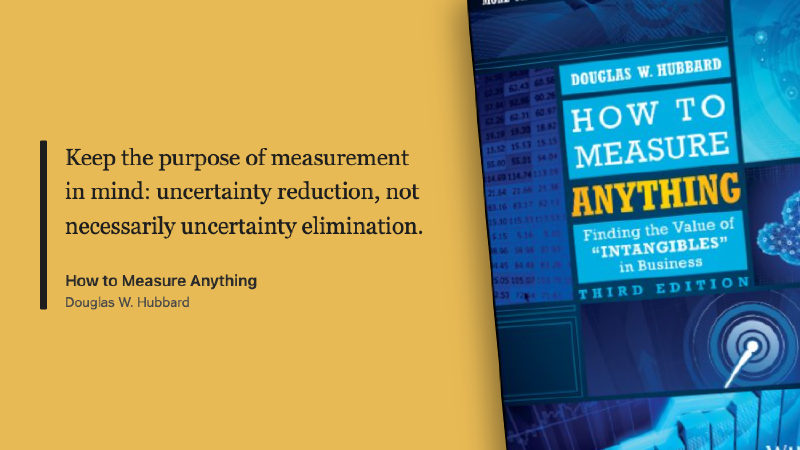
“Keep the purpose of measurement in mind: uncertainty reduction, not necessarily uncertainty elimination.”
- Summary: Douglas Hubbard demonstrates that the goal of quantitative measurement in business is not unattainable mathematical certainty, but reducing uncertainty sufficiently to make superior capital allocation and strategic choices.
- Why it Matters: Executive teams frequently paralyze strategic execution by demanding exhaustive data, failing to recognize that the marginal value of information collapses rapidly once uncertainty is reduced below an actionable threshold.
- My Take: Measurement is an economic decision, not an academic exercise. Spend capital and time on data collection only up to the point where it changes the pending decision.
Moneyball#
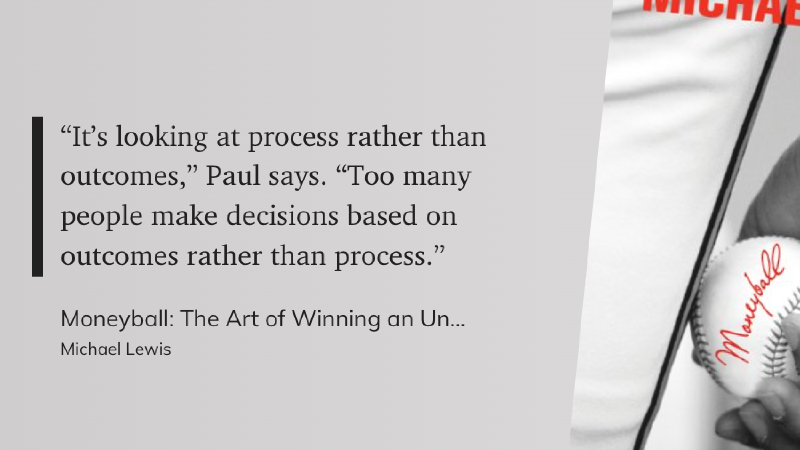
“It’s looking at process rather than outcomes. Too many people make decisions based on outcomes rather than process.”
- Summary: Michael Lewis details how Billy Beane and Paul DePodesta revolutionized sports management by divorcing operational evaluation from outcome luck, anchoring their strategy on rigorous probabilistic process.
- Why it Matters: Outcome bias is one of the most destructive traps in corporate leadership. Rewarding lucky blunders while penalizing well-calculated probabilistic bets inevitably corrupts an organization’s decision-making culture.
- My Take: Process outlasts outcome luck. A great decision can yield a bad result in the short run, and a reckless gamble can pay off; compounding long-term returns requires unwavering discipline to process.
A Brief History of Intelligence#
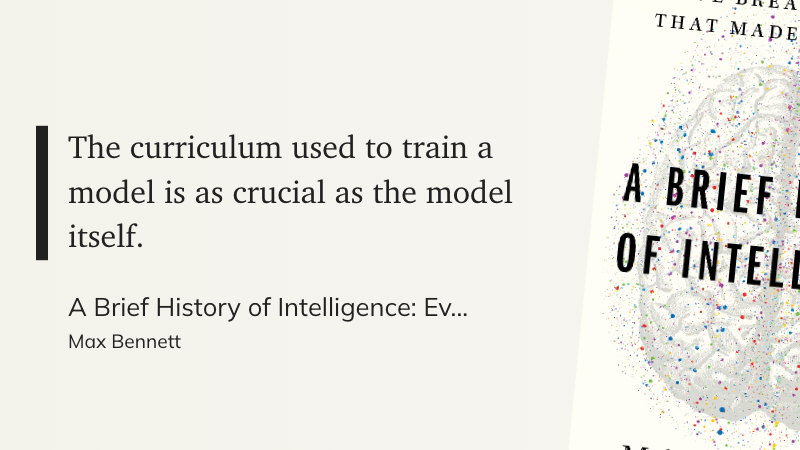
“The curriculum used to train a model is as crucial as the model itself.”
- Summary: Max Bennett explores the evolutionary milestones of biological intelligence, showing how structured environmental feedback and staged developmental curricula are foundational to complex problem-solving.
- Why it Matters: As enterprises rush to adopt off-the-shelf foundation models, competitive defensibility does not come from base weights. Moats are built on proprietary context, domain-specific evaluation loops, and iterative feedback curricula.
- My Take: Model architecture is table stakes; curriculum is the competitive moat. You cannot build enterprise advantage with commodity intelligence without curating proprietary operational feedback and training environments.
Further Reading#
- Agents vs. Skills: Clarifying the AI Architecture: Breaking down the architectural divide between monolithic agents and modular skills.
- Deterministic Evals for AI Skills: Why rigorous automated assertions are required to validate agent reliability.
- Margo vs Marp: The Power of Context-Engineered Slides: Turning markdown into executive-ready presentation systems.
- Tokenization is the Capital Markets Upgrade: How open ledger settlement removes counterparty friction from traditional finance.