

This week’s signals illuminate a sharp divergence between gambling on things that do not create real value or income and compounding operational leverage. At the macroeconomic level, the global financial system is confronting a reckoning: ballooning sovereign debt issuance is overwhelming institutional demand, while national addictions to bidding up residential land have systematically starved productive enterprise capital and stifled productivity.
In sharp contrast, forward-thinking builders and operators are aggressively rewriting organizational playbooks from the ground up. From bespoke AI workflow skills that eliminate massive amounts of friction for executives to algorithmic due diligence tools and talent platforms that dismantle credentialist gatekeeping, the playbook for compounding value is clear: shed bureaucratic overhead, construct owned distribution engines, and ruthlessly decentralize operational authority.
Market Observations & Insights#
Executive Workflows in the Age of Custom AI Skills#
- Summary: Khe Hy demonstrates how bespoke Claude skills and localized AI workflows reduce the production time of executive deliverables like presentation decks by 75%, shifting focus away from manual slide assembly toward high-impact strategic synthesis and storytelling.
- Why it Matters: High-leverage knowledge workers often dismiss generic frontier models because standard chat interfaces fail to incorporate idiosyncratic domain context. Codifying repeatable executive standards into customized agent skills transforms raw model intelligence into reliable enterprise-grade productivity.
- My Take: Forget generic AGI; build workflow-specific tactical agents. Competitive advantage in executive work belongs to operators who document their internal standards and workflows into reusable prompts.
Note that recently I have been adding agent skills “out of the box” with Margo: an agent friendly app that generates slides from markdown. The kinds of skills discussed in this article would be perfect for a tool like Margo, proviing not just version controlled and agent-mananaged slides, but in-built access to best practice slide creation skills.
Zero-to-One Distribution Playbooks#

Distribution 101: A Guide to Reaching Millions
- Summary: Ryan outlines a comprehensive tactical blueprint for constructing organic audience and customer acquisition engines from scratch, emphasizing that continuous narrative distribution is the single highest-ROI capability for modern venture builders.
- Why it Matters: As generative AI compresses software development costs to near zero, product features cease to provide durable differentiation. In an economy of infinite software supply, customer attention and owned distribution channels become the scarce, non-replicable constraint.
- My Take: Distribution eats product features for breakfast. If your growth strategy relies on discovering a defensible technical moat without an owned distribution engine, you have already lost.
For an operational framework on building durable audiences around shared purpose rather than vanity metrics, see Building an Audience Starts With a Reason to Belong.
Rethinking the Paper Ceiling: AI as an Inquiry Engine for Talent#
- Summary: Reid Hoffman argues that conventional corporate recruiting uses rigid credentials such as elite university degrees and familiar past employers as lazy filtering proxies, advocating instead for using AI as an exploratory inquiry engine to uncover high-potential non-traditional talent.
- Why it Matters: Legacy hiring funnels systematically filter for pedigree rather than operational competence. Leaders who deploy AI to contextualize non-linear resumes and evaluate underlying problem-solving capability gain an asymmetric talent arbitrage advantage over competitors trapped in credentialism.
- My Take: Pedigree is a lazy proxy for capability. Leverage AI to expand your aperture for unconventional problem solvers rather than automating bureaucratic gatekeeping.
This article explains one of the reasons why I have invested in Intelletto.
Algorithmic Due Diligence and Defensibility Checks#
- Summary: Lenny Rachitsky introduces an interactive moat-checking evaluation skill that systematically interrogates business models, switching costs, and network effects to evaluate whether a target company possesses durable economic defenses.
- Why it Matters: The explosion of AI-generated SaaS has flooded software markets with ephemeral feature wrappers that lack structural retention or pricing power. Rigorous, systematic evaluation frameworks are essential to separate fleeting viral traction from enduring enterprise defensibility.
- My Take: Speed without defensibility is a treadmill to zero margins. In a world where anyone can deploy software over a weekend, defensibility must be anchored in regulatory capture, deep workflow lock-in, or proprietary data loops.
For an analysis on why code generation commoditizes traditional software barriers, see Moats in the Era of Vibe Coding.
Venture Networks as Embedded Talent Matchmakers#
- Summary: Jordan Mazer details how a16z Speedrun acts as an embedded talent infrastructure layer, directly matching over 140 top-tier operators and engineers into high-velocity portfolio startups at zero recruitment fee.
- Why it Matters: Modern venture capital cannot differentiate solely on capital terms. Venture platforms that internalize the highest-friction operational bottlenecks—chief among them technical talent acquisition—build compounding platform loyalty and accelerate startup survivability.
- My Take: Talent liquidity is the ultimate venture value-add. Capital is a commodity; the ability to de-risk key hires through a curated founder-operator network is a proprietary flywheel.
Deep Reads from the Library#
The Numbers Behind the Bond Bear Market (with a Look at Equities)#
Author: Ray Dalio
- Summary: Ray Dalio breaks down the structural mechanics of sovereign debt cycles, demonstrating that global supply of government debt now vastly exceeds institutional demand, placing upward pressure on yields and crowding out broader equity and private credit liquidity.
- Why it Matters: When debt service burdens outpace income growth and sovereign issuance floods global capital markets, governments face an inescapable dilemma: either endure painful fiscal austerity or monetize the shortfall through inflationary central bank expansion.
- My Take: The sovereign debt supercycle dictates all risk assets. Macro liquidity conditions will punish capital-intensive business models that rely on cheap refinancing, rewarding cash-flow-positive operators who manage balance sheets with extreme conservatism.
Has Britain’s Obsession with House Prices Made Us Poorer?#
Author: The Penwarden Review
- Summary: An economic post-mortem examining how treating rising residential property prices as national wealth creation has cannibalized productive enterprise investment, diverted bank lending away from innovative SMEs, and entrenched generational inequality without producing real economic output.
- Why it Matters: Bidding up the price of existing land creates no additional productive capacity. When a nation’s financial system prioritizes collateralized mortgage debt over funding new businesses, productivity stagnates and capital is trapped in illiquid, unproductive assets.
- My Take: Asset inflation is not wealth creation. True prosperity stems from funding productive enterprises and industrial capability, not inflating the mortgage obligations of the next generation.
If Your Team Is Too Busy Doing Their ‘Normal Job’ to Experiment with AI, You’re Preparing Them to Be Replaced#
Author: Geoffrey Huntley
- Summary: Geoffrey Huntley issues a stark warning to technology and business leaders who treat AI adoption as a peripheral side project, arguing that teams consumed by business-as-usual manual tasks are actively being engineered out of relevance by agentic systems.
- Why it Matters: The transition from manual software authoring to autonomous agent orchestration is not an incremental productivity boost; it is a fundamental paradigm shift. Organizations that fail to carve out aggressive experimentation capacity will find their operational models obsolete overnight.
- My Take: Operational complacency is organizational suicide. If your leaders are not actively rewriting their operational playbooks around AI orchestration, they are preparing their teams for replacement.
To understand why machine-generated software shifts executive focus from syntax to runtime execution and strategic intent, see The Next Compiler: AI and the Evolution of Abstraction.
Highlights from the Stacks#
Broken Money#
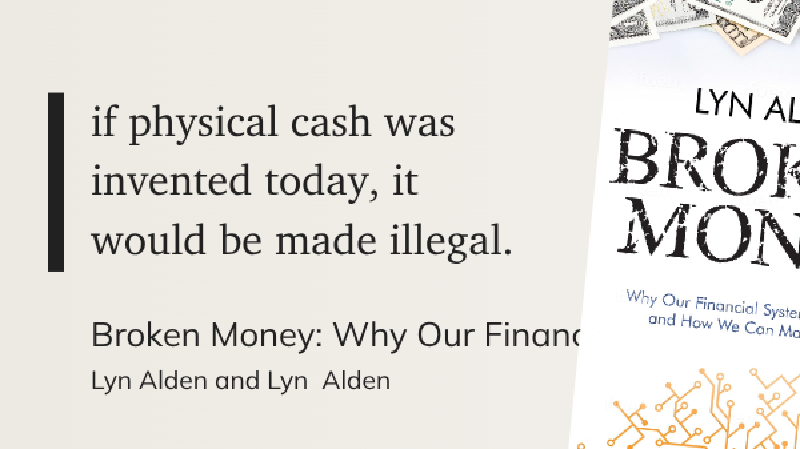
“If physical cash was invented today, it would be made illegal.”
- Summary: Lyn Alden traces the technological and political evolution of monetary systems, showing how the friction-free surveillance capabilities of modern centralized ledgers make permissionless physical cash an unthinkable concept to modern regulatory states.
- Why it Matters: As governments roll out Central Bank Digital Currencies (CBDCs) and tighten digital payment rails, the balance between institutional surveillance and individual financial autonomy is reaching a critical inflection point.
- My Take: Financial privacy is foundational to open societies. Understanding the mechanics of sound, permissionless money is an imperative for anyone building the next generation of financial infrastructure.
For a historical exploration of money and non-state ledger consensus, see The Original Blockchain Was Carved in Stone.
The Innovation Stack#
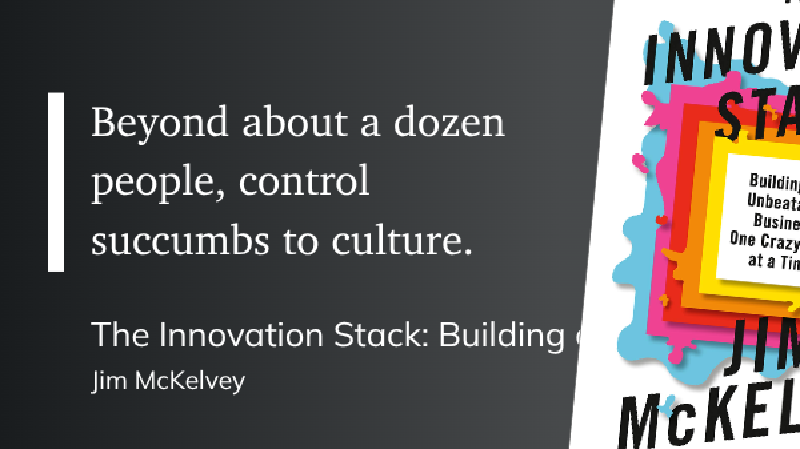
“Beyond about a dozen people, control succumbs to culture.”
- Summary: Square co-founder Jim McKelvey reflects on organizational scaling, demonstrating that direct managerial command-and-control breaks down once a company grows beyond a small core team, leaving shared cultural norms as the true operating system.
- Why it Matters: As autonomous AI agents and automated workflows multiply across corporate teams, top-down oversight becomes even more impractical. Scaling effectively requires encoding clear cultural principles and decentralized accountability into the organization’s DNA.
- My Take: Culture is the ultimate decentralized governance protocol. You cannot write enough rules to govern a scaling enterprise; you can only build a culture that makes the right decisions intuitively.
The Outsiders#
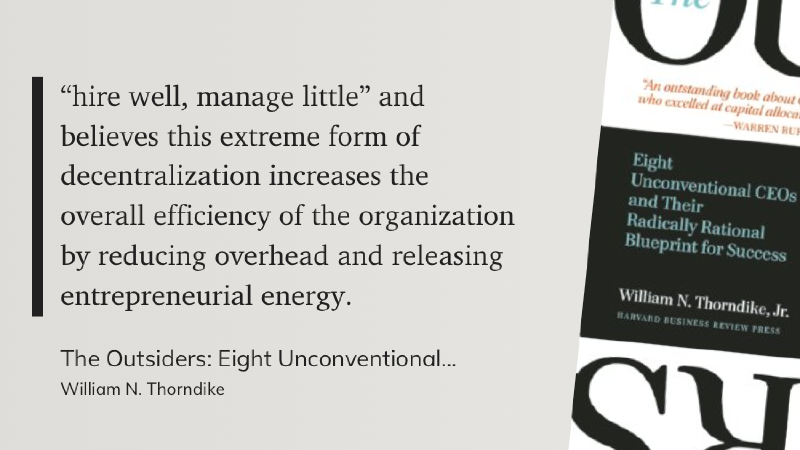
“Hire well, manage little. This extreme form of decentralization increases the overall efficiency of the organization by reducing overhead and releasing entrepreneurial energy.”
- Summary: William Thorndike examines the exceptional track records of eight unconventional CEOs who outperformed the S&P 500 by over 20x through disciplined capital allocation, lean corporate headquarters, and radical operational decentralization.
- Why it Matters: Bureaucratic corporate overhead suffocates executive agility and slows feedback loops. Empowering autonomous business-unit leaders while centralizing only capital allocation creates durable, compounding shareholder value.
- My Take: Decentralize operations; centralize capital allocation. The primary responsibility of executive leadership is not micromanaging workflows, but allocating resources to their highest-return opportunities.
Further Reading#
- Building an Audience Starts With a Reason to Belong: Why lasting distribution is built on community and shared purpose rather than transactional metrics.
- Moats in the Era of Vibe Coding: How the collapse of software production costs reshapes competitive moats and platform defensibility.
- The Next Compiler: AI and the Evolution of Abstraction: Why machine-generated code shifts executive leverage from syntax mechanics to architectural intent.
- The Original Blockchain Was Carved in Stone: How the Yapese Rai stones anticipated modern distributed ledger consensus and sound money principles.