
This week’s signals reveal a profound architectural rewiring across the modern enterprise: the shift from managing humans who move data to designing autonomous operating systems that execute decisions directly. In the executive suite, the CFO role is transforming from accounting scorekeeper into software builder, with lean, high-leverage teams running continuous, zero-day financial closes while deploying internal agentic workflows.
Concurrently, the economic rails themselves are becoming machine-native, as agentic finance protocols and autonomous payment rails challenge legacy commercial bank deposit moats. From developers setting down their manual coding tools to research mathematicians grappling with automated theorem proving, competitive advantage is no longer determined by manual production velocity, but by taste, system architecture, and strategic judgment.
Market Observations & Insights#
The AI-Native CFO and the Rise of the Finance Engineer#

You Need a New CFO
- Summary: Seema Amble highlights how AI is fundamentally restructuring corporate finance, driving teams from ~5% toward ~2% of headcount while transforming CFOs from backward-looking scorekeepers into systems architects who orchestrate internal agent fleets and continuous forecasting.
- Why it Matters: The monthly accounting close was an artifact of fragmented, slow data reconciliation. When finance workflows become code and agents execute routine entries with verifiable audit trails, corporate decision-making accelerates from monthly retrospective reviews to real-time capital allocation.
- My Take: The modern CFO is a systems architect, not an accountant. The competitive moat belongs to finance leaders who replace manual spreadsheet reconciliation with proprietary agentic operating systems.
For an operational retrospective on why manual forms-and-fields accounting stalled and how AI ingestion engines eliminate the data-entry barrier, see Why Our “Free ERP” Failed (& Why AI Changes the Battlefield).
The Agentic Finance Landscape and Machine-Native Rails#

The Agentic Finance Landscape Report: Q3 2026 Edition
- Summary: Cambrian Network’s Q3 2026 report documents the rapid institutional maturation of AgentFi, spotlighting machine-native payment standards like x402 and MPP, autonomous on-chain trading copilots, and major integrations from Visa, Mastercard, and Coinbase.
- Why it Matters: Autonomous AI agents cannot navigate human-centric payment friction like CAPTCHAs, credit card forms, or ACH settlement delays. Programmable, 24/7 stablecoin rails and machine-to-machine micropayments form the indispensable circulatory system of the autonomous agent economy.
- My Take: Machine agency requires machine-native rails. Digital assets and stablecoins are not speculative alternatives to traditional banking; they are the native settlement layer for autonomous economic actors.
Autonomous Agents and the Threat of the Deposit Run#
- Summary: Apollo’s Chief Economist warns that consumer-facing AI agents could destabilize traditional banking by programmatically sweeping retail deposits into 3–5% yield instruments rather than leaving them in traditional bank accounts earning 0.1%.
- Why it Matters: Commercial banking profitability has long rested on deposit inertia—consumers who don’t bother moving cash out of zero-yielding checking accounts. Autonomous personal agents eliminate behavioral inertia, permanently threatening the low-cost deposit foundation of legacy banks.
- My Take: Friction is the only thing protecting legacy banking margins. As autonomous agents optimize consumer cash balances in real time, commercial banks will be forced to compete on yield rather than customer apathy.
To understand how banks must evolve from surface-level features into indispensable rails for autonomous agents, see The AI-Enabling Bank: Why Infrastructure Matters More Than Features in the Agentic Era.
Tokenized Cash Remains the Anchor of On-Chain Value#
- Summary: Lex Sokolin points out that while tokenized equities attract trading buzz, tokenized cash and money market funds represent the real heavyweight in tokenization at ~$18 billion, proving that liquidity and utility eclipse speculative turnover.
- Why it Matters: The durable wedge for institutional real-world asset (RWA) adoption is not exotic illiquid assets, but boring, yield-bearing dollar liquidity that plugs directly into automated on-chain treasury workflows.
- My Take: Boring rails compound faster than speculative assets. Cash equivalents and short-dated sovereign debt remain the foundational collateral underpinning all scalable financial infrastructure.
Productive AI Capex vs. Speculative Bubbles#
- Summary: Cathie Wood argues that rising capital yields reflect high-multiplier enterprise investment in AI infrastructure, underpinned by revenue at frontier labs soaring 3x to 8x, rather than unproductive speculation like the 2007 housing bubble.
- Why it Matters: High interest rates become manageable when capital expenditures drive non-linear productivity expansion. When infrastructure investments yield immediate operational leverage, capex cycles represent fundamental industrial buildout rather than credit froth.
- My Take: Productive compute capex generates compounding economic returns. Capital allocation into compute infrastructure is building the manufacturing floor of the intelligence economy.
Deep Reads from the Library#
100+ Reactions to 100+ Solutions#
Author: Proofs and Prompts
- Summary: A curated collection of candid reactions from over a hundred research mathematicians following OpenAI’s release claiming proofs for scores of open mathematical conjectures across group theory, topology, and geometry.
- Why it Matters: Pure mathematics has long considered itself immune to computational brute force. When frontier models generate unreadable yet valid proofs for long-standing open problems, intellectual communities must redefine what constitutes human understanding and scientific discovery.
- My Take: Discovery without comprehension creates an intellectual bottleneck. The frontier challenge for high-level thinkers is moving from raw problem-solving to synthesis, narrative framing, and human sense-making.
Over My Dead Pencil#
Author: David Heinemeier Hansson
- Summary: DHH reflects on his address at Rails World, declaring that handwriting software line-by-line is no longer an economically viable activity as coding agents evolve from clumsy assistants into hyper-productive coworkers.
- Why it Matters: Software engineering is experiencing the same industrial transition that manufacturing underwent centuries ago. Developers who cling to manual syntax generation will be eclipsed by engineers who orchestrate, review, and direct agentic coding workflows.
- My Take: Artisanal syntax is dead; architectural judgment is everything. Put down the pencil and learn to direct the orchestra of autonomous coding agents.
For an executive perspective on why machine-generated code represents the next historic abstraction layer, see The Next Compiler: AI and the Evolution of Abstraction.
The Commons or the Company Town: The Only Two Places Issuers Will Natively Tokenize#
Author: Gabriel Shapiro
- Summary: Gabriel Shapiro analyzes corporate tokenization dynamics, asserting that genuine native equity tokenization will occur either on the neutral, permissionless Ethereum mainnet (the Commons) or on enterprise-controlled Layer-2 appchains (the Company Town).
- Why it Matters: Corporate issuers will never entrust their core cap tables and legal governance to third-party intermediary blockchains. Builders must structure enterprise tokenization rails that respect corporate sovereignty while retaining permissionless settlement.
- My Take: Sovereign issuers will only tolerate self-governed rails or neutral commons. Any tokenization architecture that introduces intermediary rent-seeking is destined for obsolescence.
Highlights from the Stacks#
High Output Management#
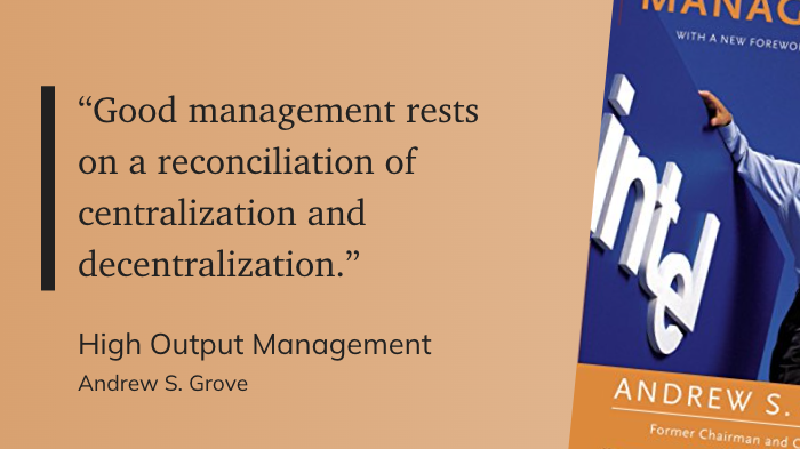
“Good management rests on a reconciliation of centralization and decentralization.”
- Summary: Andy Grove describes the perpetual organizational tension between centralized functional efficiency and decentralized business-unit responsiveness, arguing that managerial excellence lies in continually balancing both.
- Why it Matters: As organizations adopt autonomous AI workflows, the centralization debate reemerges with new intensity: should agents be governed by a unified enterprise policy or deployed independently across decentralized units?
- My Take: Balance structure with autonomy. Standardize data schemas, security guardrails, and audit logging centrally, but empower local operators to configure agents tailored to their immediate workflows.
American Icon#
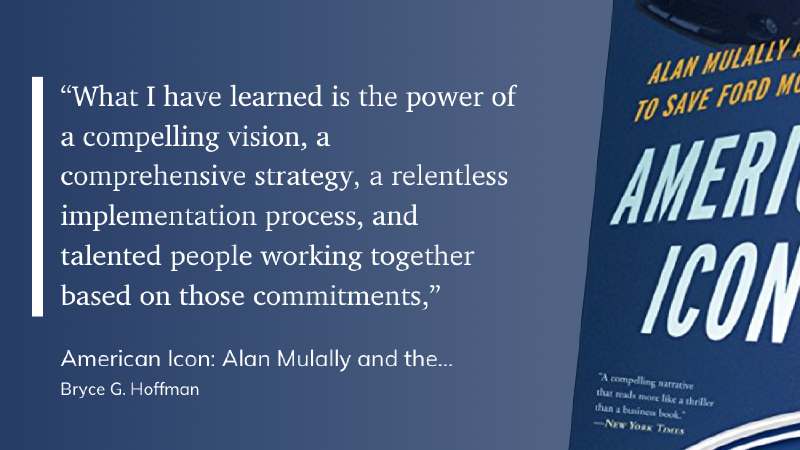
“What I have learned is the power of a compelling vision, a comprehensive strategy, a relentless implementation process, and talented people working together based on those commitments.”
- Summary: Bryce Hoffman chronicles Alan Mulally’s historic turnaround of Ford Motor Company, demonstrating that turnaround success requires clear strategic alignment and disciplined operational cadence rather than charismatic heroics.
- Why it Matters: In an era of breakneck technological change, leaders frequently chase novel tools while neglecting operational rigor. Even the most revolutionary technology fails without disciplined, transparent execution rhythms.
- My Take: Execution discipline beats strategic novelty. A coherent strategy executed with unwavering transparency will outperform brilliant vision coupled with loose operational accountability every time.
Creativity, Inc.#
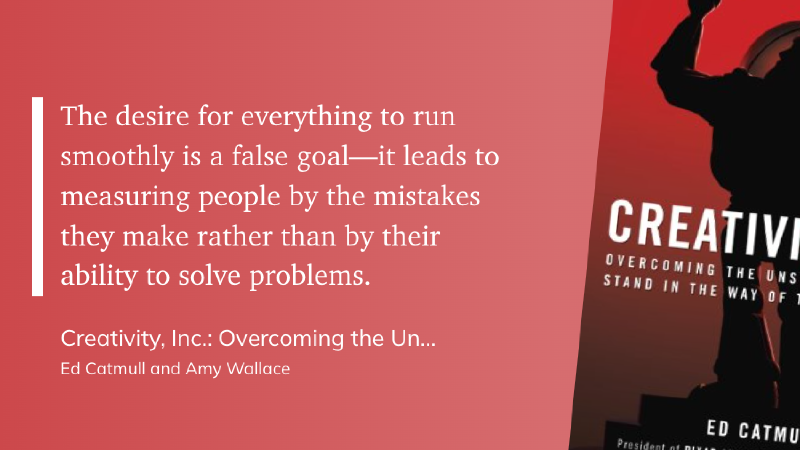
“The desire for everything to run smoothly is a false goal—it leads to measuring people by the mistakes they make rather than by what they create.”
- Summary: Pixar co-founder Ed Catmull reveals how optimizing purely for error prevention breeds risk aversion, ultimately suffocating original creative breakthroughs and compounding institutional fragility.
- Why it Matters: In environments undergoing technological disruption, risk-averse cultures that penalize operational missteps guarantee obsolescence. True organizational resilience requires space for productive failure during exploratory phases.
- My Take: Frictionless operations are a symptom of stagnation. Optimize your culture for creative velocity and bold experimentation, not flawless preservation of legacy processes.
Further Reading#
- Why Our “Free ERP” Failed (& Why AI Changes the Battlefield): An operational retrospective on data entry barriers, accounting ledgers, and AI ingestion engines.
- The AI-Enabling Bank: Why Infrastructure Matters More Than Features in the Agentic Era: How financial institutions must prepare for autonomous agentic workflows and automated treasury management.
- The Next Compiler: AI and the Evolution of Abstraction: Why machine-generated code shifts optimization incentives from syntax ergonomics to runtime execution.