

This week’s signals capture a major structural inflection across technology, capital, and operations. As artificial intelligence drastically lowers inference costs and commoditizes synthetic output, the economic moat is shifting decisively away from raw volume and toward taste, domain judgment, and tangible execution (see the bonus content below). Abundant compute is redefining software from static architecture into disposable, bespoke artifacts, while founder demographics reveal that deep industry experience, not youthful velocity alone, drives top-tier outcomes.
Concurrently, financial and physical infrastructure are undergoing parallel modernization. Sovereign debt markets are quietly onboarding stablecoins as significant private buyers of short-term government paper, traditional asset management giants are acquiring modern custodial rails, and energy systems are turning toward small modular reactors to satisfy compute-scale power demands. Across every sector, the premium belongs to builders who anchor high-speed digital capability in durable, real-world systems.
Market Observations & Insights#
Deflationary Growth in the Intelligence Economy#
- Summary: Cathie Wood argues that plunging AI inference costs (dropping ~99.99% annually at fixed capability) are fueling explosive demand, creating a regime of “good deflation” that expands margins and lifts GDP growth.
- Why it Matters: When technology costs drop exponentially while revenue accelerates, corporate productivity surges without stoking wage-price spirals. Leaders should plan for massive margin expansion in automated workflows alongside aggressive capital reinvestment.
- My Take: Productivity deflation is the engine of compounding growth. Falling compute costs do not shrink the pie; they unlock latent enterprise demand that was previously uneconomic to service.
The Data Disproves the Dropout Myth#
- Summary: An MIT study of 2.7 million US startups reveals that the average founder of a top 0.1% growth venture or successful exit is 45 to 47 years old, with industry experience doubling the odds of building a breakout enterprise.
- Why it Matters: The media narrative of the 22-year-old college dropout is an outlier, not the rule. Scaled value creation requires organizational maturity, customer empathy, distribution networks, and domain fluency that accumulate over decades.
- My Take: Experience is an asymmetric advantage in complex markets. Capital allocators who over-index on youth miss the compound interest of operator pattern recognition.
The Horizon Effect and the Curse of Knowledge#
- Summary: Ole Lehmann highlights how immersion in fast-moving tech ecosystems skews perspective, making practitioners feel perpetually behind even though broad enterprise adoption of basic AI workflows remains in its infancy.
- Why it Matters: Tech builders often suffer from a distorted frame of reference. The gap between frontier capabilities and mainstream operational adoption represents the largest commercial opportunity of the next decade.
- My Take: Frontier benchmarks distort operational reality. Don’t confuse the bleeding edge on your timeline with the massive arbitrage available in upgrading legacy business workflows today.
Narrative Alpha Comes from Real Execution#

Standing Out in 2026
- Summary: Lulu Cheng Meservey explains why the deluge of low-cost, AI-generated synthetic content has driven audience cynicism, making authentic human effort, craft, and verifiable real-world outcomes the ultimate source of narrative alpha.
- Why it Matters: When content generation is zero-cost, generic marketing becomes negative-yield noise. Companies must differentiate through proof of work, tangible artifacts, taste, and long-term reputational trust.
- My Take: Authenticity is the ultimate antidote to synthetic slop. In an era of infinite beige content, narrative authority belongs to leaders who build tangible things and show unfiltered proof of work.
Software as Ephemeral Artifacts#
- Summary: Andrej Karpathy outlines how abundant model intelligence enables bespoke, discardable software artifacts: from interactive HTML applications to custom visual explainers. This shifts human effort up the abstraction stack into oversight.
- Why it Matters: When creating bespoke software costs pennies and seconds, the lifecycle of software shifts from permanent maintenance to ephemeral utility built on demand.
- My Take: Software is evolving from enduring infrastructure into disposable media. The executive leverage is no longer writing code; it is defining intent and curating output.
Deep Reads from the Library#
Stablecoin Issuers’ Growing Appetite for Treasury Securities#
Author: Aleisha Sawyer
- Summary: The Federal Reserve Bank of San Francisco examines how stablecoin issuers have rapidly emerged as major private holders of U.S. Treasury bills, offsetting declining foreign official demand and embedding dollar dominance into digital rails.
- Why it Matters: Stablecoins are no longer merely crypto trading collateral; they are becoming systemic buyers of sovereign debt and critical distribution pipes for global dollar liquidity.
- My Take: Stablecoins are modern sovereign liquidity rails. Global dollar demand is migrating on-chain, creating a structural alignment between Treasury issuance and private digital payment networks.
Analysis: Vanguard acquires Altruist for $4B#
Author: Lex Sokolin
- Summary: Lex Sokolin analyzes Vanguard’s landmark $4 billion acquisition of Altruist, illustrating how traditional asset management titans are purchasing modern custodial and clearing infrastructure to capture the independent RIA ecosystem.
- Why it Matters: Legacy custody is being unbundled. Wealth management value creation is shifting from passive fund manufacturing to modern API-first clearing and advisory workflows.
- My Take: Custodial rails dictate distribution power. Owning the underlying operational pipes of independent advisory is the only way asset managers can defend fee capture against fintech vertical integration.
Small Modular Reactors: With a focus on Aalo Atomics#
Author: Geoff Russell
- Summary: Geoff Russell reviews the accelerated deployment cycles of Small Modular Reactors (SMRs), focusing on factory-fabricated, modular designs like Aalo Atomics that provide baseload clean power for energy-intensive digital compute.
- Why it Matters: The expansion of hyperscale AI data centers is fundamentally energy-constrained. Modular nuclear generation offers a localized, scalable solution to the massive baseload power requirements of next-generation infrastructure.
- My Take: Energy availability is the true compute ceiling. Silicon without dedicated baseload power is stranded capital; modular nuclear represents the physical foundation of the AI era.
Highlights from the Stacks#
The House of Morgan#

“Junius Morgan developed a lofty disdain for price competition and adopted the royal passivity of the Rothschilds and the Barings, who refused to offer cut-rate terms: ‘If we cannot keep the account on such a basis we must be content to let others outbid us.’”
- Summary: Ron Chernow captures the foundational Morgan philosophy: preserving brand prestige and margin discipline by refusing to participate in margin-destroying price wars.
- Why it Matters: Competing solely on price is a race to insolvency. Enduring institutional authority is built on unwavering underwriting standards and premium positioning.
- My Take: Discounting is the first concession of a weak value proposition. True market leaders preserve structural pricing power by gladly conceding low-margin business to competitors.
Originals#
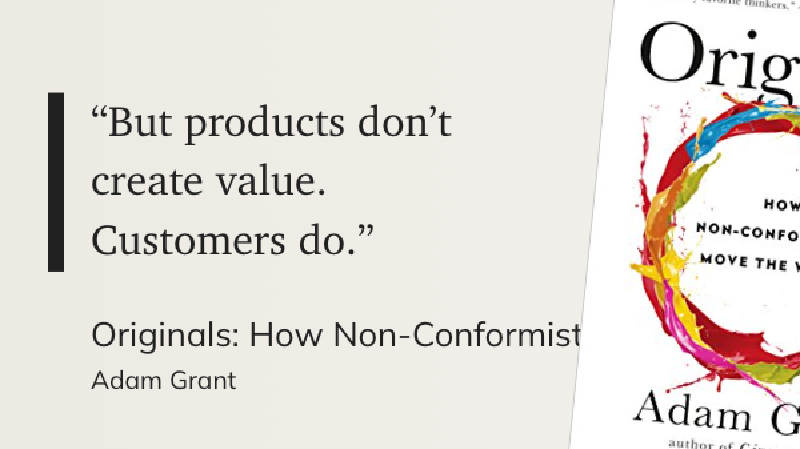
“But products don’t create value. Customers do.”
- Summary: Adam Grant highlights that an invention or product has zero intrinsic value until it solves an acute problem and delivers tangible utility to an end user.
- Why it Matters: Technical ingenuity without distribution, market pull, and customer adoption is merely expensive research and development.
- My Take: Value exists exclusively in the customer’s adoption, not the engineering backlog. Fall in love with customer outcomes rather than proprietary features.
The Millionaire Real Estate Agent#

“Failure is about avoiding failure. Success is about trying.”
- Summary: Gary Keller and Dave Jenks reframe the psychology of execution, pointing out that true failure stems from risk aversion and inaction rather than failed experiments.
- Why it Matters: In rapidly shifting markets, the cost of inaction far exceeds the cost of measured operational experiments that don’t pan out.
- My Take: Inaction is the only irreversible mistake. An organization that penalizes intelligent trial and error systematically breeds stagnation.
Ideas, Vision and Taste#
It so happened that as I was compiling this week’s Signals, I was listening to Lex Fridman’s latest interview with DHH on the Future of Programming, AI, Agentic Engineering, Vibe Coding & Linux. When we talk about moats moving towards taste, domain judgment, and tangible execution, the following from the interview resonated:
The implementation part is only a small segment of it. The other thing I’d say is that most organizations don’t know what they want. They don’t know how to make it better. They’re not bottlenecked on implementation. They’re bottlenecked on ideas. They’re bottlenecked on vision. They’re bottlenecked on taste.
Watch the interview here. The part referenced is from the 19-20 minute mark (of a 5 hour interview!):