
This week’s signals point to one operating reality: AI is compressing the distance between an idea and a working product, so old forms of defensibility are losing value. Patents, visible software features, and process-heavy jobs are easier to copy or automate. The durable advantages are moving toward reinvention speed, balance-sheet strength, institutional trust, and the judgment to choose a consequential problem.
The financial system is being rebuilt in parallel. Stablecoin infrastructure is attracting the largest payment networks, tokenized securities are moving into supervised experiments, and regulators are finally confronting a question they cannot postpone: can institutions verify what matters without collecting every piece of personal data? That is not a crypto side issue. It is the design problem for the next generation of financial rails.
Market Observations & Insights#
Your Moat Is Only Good Until the Next Moat#

What Counts as a Moat in the Age of AI?
- Summary: Peter Diamandis argues that AI is weakening patents, proprietary code, switching costs, distribution, and even Nvidia’s CUDA advantage by making it cheaper to copy and recompile what used to require years of specialist effort.
- Why it Matters: A static moat is becoming a depreciating asset. Investors and executives need to underwrite the organization’s rate of reinvention, access to capital, and ability to move into the next advantage before the current one is attacked.
- My Take: A moat is now a metabolic rate, not a wall. Founders should show how quickly they have changed the business, not repeat a patent-pending slogan. The most credible defence is a management team that can keep reconstructing its advantage.
Tokenizing Access to Venture Capital#
- Summary: ARK is putting its venture fund on-chain with Securitize, presenting tokenization as a way to expand how investors access and participate in private and public markets.
- Why it Matters: The important development is not the token wrapper. It is the gradual migration of private-market ownership, compliance, transfer rules, and investor access into programmable infrastructure.
- My Take: Tokenization is a market-structure upgrade before it is a product feature. The winners will be the platforms that solve eligibility, liquidity, reporting, and governance together. A token without those controls is just a new certificate.
Stablecoins Need Institutional Governance#

Businesses using stablecoins should have a stake in their future
- Summary: Open Standard is launching OUSD with Coinbase, Mastercard, Shopify, Stripe, and Visa as founding partners, combining initial liquidity, platform adoption, and shareholder representation in the issuer’s governance.
- Why it Matters: Stablecoin adoption at scale will depend on who controls the rules, who funds liquidity, and how the interests of payment networks, merchants, banks, and users are represented. Governance is part of the payments product.
- My Take: The stablecoin race is becoming a governance race. The infrastructure that wins will not only settle faster. It will give the businesses creating the demand a credible stake in how the network evolves.
Private Credit Moves Into the Credit Box#
- Summary: JPMorgan has explored a second-look model in which private-credit firms could fund some co-branded card applicants the bank declines, potentially expanding approvals without putting every loan on the bank’s balance sheet.
- Why it Matters: Private credit is no longer confined to corporate lending. If it becomes an outsourced layer for consumer underwriting, risk will move across institutions while the customer relationship remains attached to the bank and its brand partners.
- My Take: The next credit cycle will be defined by who owns the declined customer. Banks can widen the credit box through outside capital, but they will need clear accountability for underwriting, servicing, data sharing, and losses.
When Software Gets a Bank Account#
- Summary: Clagett reduces the AI governance problem to a financial-control problem: the moment software can spend money, its permissions, limits, audit trail, and liability become matters of financial regulation.
- Why it Matters: An agent with purchasing authority can create exposure through fraud, errors, vendor concentration, or uncontrolled recurring spend. Model safety is not enough. Enterprises need transaction controls and accountable owners.
- My Take: Agent governance starts at the payment boundary. Give software the authority to act and you have created a financial operator. The control plane needs budgets, approval thresholds, segregation of duties, and a tamper-resistant record.
Deep Reads from the Library#
Looking for Change in Haystacks: Remarks before SIFMA’s Digital Assets Conference#
Author: Commissioner Hester M. Peirce
- Summary: Hester Peirce argues that financial surveillance has created enormous data haystacks while cryptographic tools can verify specific attributes, such as eligibility or sanctions status, without exposing the underlying personal data.
- Why it Matters: The next regulatory debate should be about better evidence, not simply more collection. Attribute-based credentials and zero-knowledge proofs can lower privacy risk while improving the quality of financial controls.
- My Take: More data is not the same as more control. Regulators and institutions should ask what fact they need to verify, then collect the minimum evidence required to establish it. That is better risk management and better customer experience.
The Adolescence of Technology#
Author: Dario Amodei
- Summary: Dario Amodei frames advanced AI as a technological adolescence in which humanity receives extraordinary power before it has developed reliable institutions for handling it.
- Why it Matters: Capability growth will outrun policy cycles, corporate review processes, and social adaptation. Leaders need operating rules that make responsible action possible under uncertainty instead of waiting for perfect consensus.
- My Take: Governance is an execution discipline, not a press release. The companies that earn durable trust will set clear boundaries, test them in live operations, and change them when evidence proves them wrong.
You’re Already a Meat Proxy#
Author: Obie Fernandez
- Summary: Obie Fernandez describes software teams where AI produces code, plans, tickets, and documentation while humans remain trapped in approval rituals that create the appearance of work without meaningful progress.
- Why it Matters: More output does not create more value when nobody owns the decision, checks the result, or secures the cooperation needed to ship it. AI exposes the difference between execution volume and operating judgment.
- My Take: The scarce skill is choosing what deserves to exist. Leaders should use AI to compress production, then spend the recovered time on problem selection, stakeholder commitment, and consequences.
Highlights from the Stacks#
American Icon#
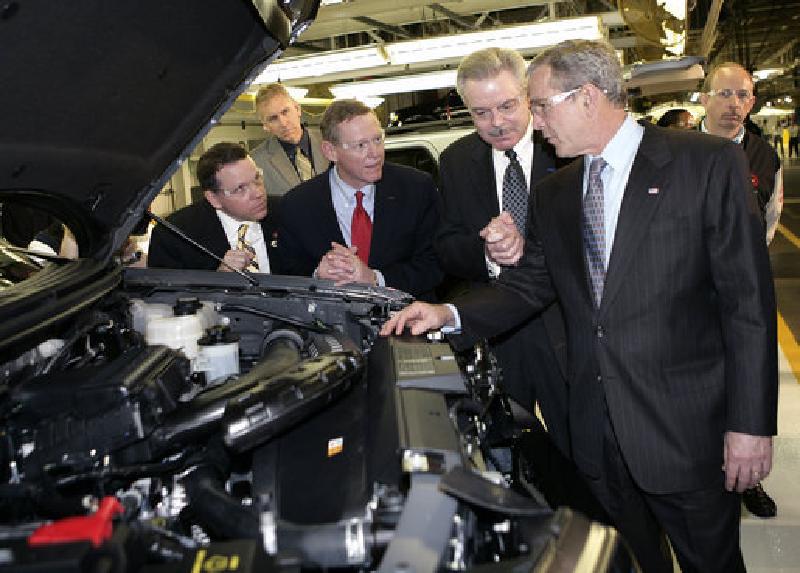
“Running a business is a design job. You need a point of view about the future, a really good plan to deliver that future, and then relentless implementation.”
- Summary: Bryce Hoffman describes management as the deliberate design of a future, followed by a plan and persistent execution.
- Why it Matters: Strategy without implementation is theatre. A strong point of view only matters when it changes resource allocation, operating cadence, and what the team does next.
- My Take: Strategy is a design decision with a payroll attached. The test is not whether the plan sounds intelligent. The test is whether it changes behaviour and survives contact with the operating system.
Image: Mulally (wearing the red tie) with President George W. Bush at the Kansas City Assembly Plant in Claycomo, Missouri on March 20, 2007, touring Ford’s new hybrid cars. Credit: By Eric Draper Public Domain
BPMN Method and Style#
In my BPMN training, a student once asked me how to show that an activity normally completes in five hours. I replied that this is not a question BPMN asks. It asks what action occurs if the activity is not completed in five hours.
- Summary: Bruce Silver argues that process design should specify the response to a missed threshold, not merely document the average time required under normal conditions.
- Why it Matters: Real businesses fail at the edges. Exception handling, escalation, and recovery paths are where operational resilience becomes visible.
- My Take: Happy paths describe hopes; exception handlers describe architecture. Every AI workflow, payment flow, and market-entry plan should make its failure response explicit before launch.
From Strength to Strength#
“Knowledge is knowing that a tomato is a fruit; wisdom is knowing not to put it in a fruit salad.”
- Summary: Arthur Brooks uses a compact distinction between knowledge and wisdom to show that facts do not automatically produce sound judgment.
- Why it Matters: AI can make knowledge cheap and abundant. The premium shifts to context, taste, timing, and knowing which technically possible action is strategically foolish.
- My Take: Information is not judgment. The coming advantage belongs to operators who can decide what not to do, even when the machine can make the wrong thing instantly.