

This week’s signals capture an accelerating transition from generic abstraction to operational precision across software architecture, corporate finance, and capital allocation.
In applied artificial intelligence, the industry consensus is pivoting away from bloated frontier generalists toward compact, highly tuned models and type-safe systems languages engineered for execution speed. Simultaneously, the corporate financial stack is witnessing the structural collapse of boundaries that have stood for decades: accounting software is dissolving directly into core banking ledgers, and autonomous agent-to-agent micropayments are quietly proving out on stablecoin rails.
Across every domain, enduring leverage belongs not to those chasing surface-level trends, but to operators doing the hard, unglamorous work of building deterministic systems that function reliably under real-world constraints.
Market Observations & Insights#
Narrow Models Outperform Generalist Giants#
- Summary: Rahul details an end-to-end implementation guide demonstrating how a compact 1.5-billion parameter model fine-tuned with QLoRA on 200–500 domain-specific examples consistently outperforms a generic 70-billion parameter frontier model on targeted enterprise tasks.
- Why it Matters: Organizations routinely overpay for cloud API latency and compute costs by prompting massive generalist models to handle narrow operational workflows. Specialized small models fine-tuned on proprietary company datasets deliver superior schema compliance, tighter domain vocabulary, and lower inference costs while keeping institutional IP fully contained.
- My Take: Fine-tuning is not about expanding intelligence; it is about guaranteeing execution consistency. Prompting a frontier generalist model for repetitive business tasks is like hiring a university professor to stamp passports. The real enterprise leverage in AI belongs to fleets of lightweight, specialized models trained on proprietary operational exhaust.
The Rust Shift in Agentic Software#
- Summary: Mark K observes that Python’s historical dominance is beginning to erode because its primary advantage of syntactic simplicity for human programmers becomes irrelevant when AI coding agents write software, tipping the balance toward fast, type-safe, compiled languages like Rust.
- Why it Matters: High-level dynamic languages traded memory efficiency and execution performance for developer ergonomic convenience. When coding agents write and refactor software at machine speed, runtime latency, memory safety, and deterministic concurrency regain primacy.
- My Take: When machines write the code, human syntax convenience yields to compute efficiency. The ergonomics of programming languages were designed around human cognitive bottlenecks. As agentic coding eliminates human typing latency, the economic optimization curve shifts back toward compiled performance, rigorous type systems, and low-level resource management.
For more on how machine-generated code shifts optimization incentives, see The Next Compiler: AI and the Evolution of Abstraction.
Autonomous Machine Payments on Stablecoin Rails#
- Summary: An analysis of Tempo’s $2 billion monthly transaction volume reveals that alongside treasury movements and contractor payroll, an emerging signal has arrived: 1.1 million autonomous machine payments totaling just $36,000.
- Why it Matters: Traditional financial networks impose minimum interchange fees and multi-day settlement windows that make sub-dollar transactions economically unfeasible. High-volume, low-value payments confirm that autonomous software agents are already using permissionless stablecoins as native programmatic currency.
- My Take: The future of payments is autonomous, high-frequency, and sub-penny. Legacy payment rails charge fixed tollbooths designed for fifty-dollar retail swipes. Autonomous agents calling APIs, purchasing GPU seconds, and routing data require continuous cryptographic micropayments that only permissionless stablecoins can clear at scale.
The Unification of Banking and the General Ledger#
- Summary: Nik Milanovic highlights Mercury’s launch of Mercury Books, embedding full double-entry accrual accounting and real-time AI reconciliation directly into its business banking platform, eliminating the traditional divide between external bank accounts and delayed accounting ledgers.
- Why it Matters: Corporate finance has long maintained two parallel versions of truth: the real-time cash ledger at the bank and the delayed accrual ledger in ERP software, reconciled through grueling month-end closes. Merging these layers turns financial reporting from a historical post-mortem into a continuous operating dashboard.
- My Take: Banking data and company books are a single dataset; separating them was an artifact of human latency. The historical barrier between banking and accounting existed solely because software could not interpret transactions at the moment of execution. Collapsing reconciliation into the bank account transforms corporate financial planning from backward-looking compliance into real-time operational steering.
For the systemic implications of modernizing financial rails, see Why AI-Enabling Bank Infrastructure Matters.
The Battle Over the Unearned Deposit Monopoly#
- Summary: Columbia Business School Adjunct Professor Omid Malekan urges stablecoin issuers and fintech platforms to maximize user reward-sharing, directly challenging traditional commercial banks that lobby against federal stablecoin clarity to defend zero-yield deposit franchises.
- Why it Matters: Commercial banking profitability heavily relies on paying near-zero interest on retail and business checking deposits while investing those funds in high-yielding sovereign debt. Programmable stablecoins and tokenized money-market funds structurally threaten this net interest margin by passing yield directly to asset holders.
- My Take: Commercial banking’s greatest moat is unearned deposit inertia. Banks have extracted billions by treating customer deposits as free leverage while paying negligible interest. Transparent, yield-sharing stablecoin rails bring open market competition to deposit gathering, forcing legacy institutions to compete on value rather than regulatory gating.
Deep Reads from the Library#
The Diligence Gap#
Author: Benedict Johnson
- Summary: Benedict Johnson examines why private equity investment theses routinely fail during the holding period, explaining that while diligence values acquisitions based on holistic brand strength and pricing power, post-acquisition operating playbooks fragment the company into siloed functional cost centers that unintentionally cannibalize the core intangible asset.
- Why it Matters: Financial models in corporate acquisitions frequently treat operational restructuring as harmless margin expansion, failing to recognize that cutting creative craft, customer service, and product nuance destroys the intangible flywheel that justified the valuation multiple.
- My Take: The asset is bought whole; the operating model receives it in pieces. When spreadsheets dictate operational cuts, they measure immediate cost savings while blinding leadership to compounding brand erosion. Sustainable value creation requires viewing the enterprise as an integrated organic system rather than a collection of independent line items to be trimmed.
Three Models for Cross-Border Payments#
Author: Borja Neira
- Summary: Borja Neira breaks down the mechanics, liquidity requirements, and settlement dynamics of the three prevailing cross-border payment architectures: legacy correspondent banking (nostro/vostro accounts), the stablecoin sandwich (on/off-ramp crypto corridors), and the tokenized two-tier system (BIS Project Agorá with tokenized deposits and wholesale CBDCs).
- Why it Matters: Global payment rails are undergoing their most consequential modernization in fifty years. Comparing hop-by-hop bilateral screening against atomic multilateral settlement clarifies why liquidity efficiency and 24/7 continuous clearing will dictate the next generation of global capital flows.
- My Take: Settlement architecture dictates geopolitical and financial liquidity. Correspondent banking is weighed down by fragmented time zones, sequential risk, and pre-funded float. While central banks experiment with tokenized consortium ledgers, market forces are already voting with their feet by adopting stablecoin rails that settle globally in seconds.
The 13 Years That Made Warren Buffett#
Author: Kursor
- Summary: Kursor revisits the founding years of the Buffett Partnership Ltd. (1956–1969), dissecting the radical incentive design of zero management fees paired with a 25% profit share over a 6% hurdle, the disciplined division of capital into Generals, Workouts, and Controls, and Buffett’s willingness to return all capital when market valuations detached from reality.
- Why it Matters: The modern alternative asset management industry is predominantly structured around asset-gathering incentives, collecting management fees on bloated AUM regardless of investment performance. Buffett’s early partnership documents remain the masterclass in absolute stakeholder alignment and disciplined capital stewardship.
- My Take: The rarest skill in capital allocation is knowing when to stop. Most investment managers dilute returns by chasing speculative bubbles simply to keep fee-generating assets under management. Buffett’s decision to dissolve his partnership at the peak of the 1969 Go-Go market is a timeless reminder that preserving reputation and capital requires the courage to walk away when returns stop making mathematical sense.
Highlights from the Stacks#
BPMN Method and Style#
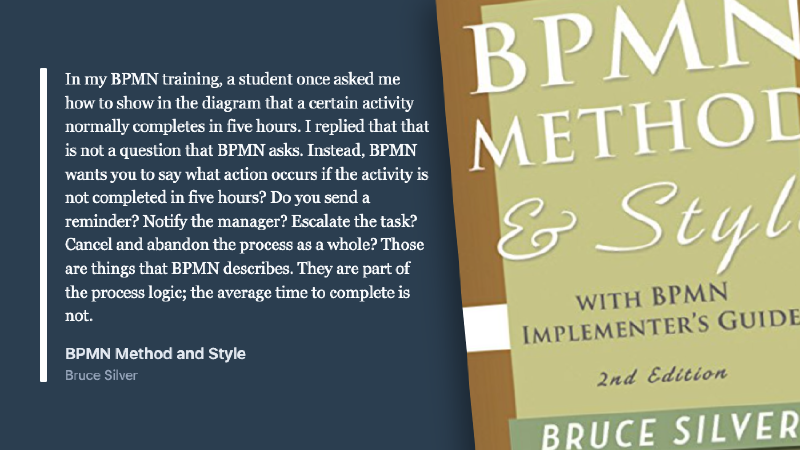
In my BPMN training, a student once asked me how to show in the diagram that a certain activity normally completes in five hours. I replied that that is not a question that BPMN asks. Instead, BPMN wants you to say what action occurs if the activity is not completed in five hours? Do you send a reminder? Notify the manager? Escalate the task? Cancel and abandon the process as a whole? Those are things that BPMN describes. They are part of the process logic; the average time to complete is not.
- Summary: Process modeling authority Bruce Silver explains that rigorous business process modeling is not about documenting optimistic happy-path averages, but defining explicit deterministic actions when standard operational thresholds are breached.
- Why it Matters: Untested operations and fragile software architectures invariably collapse because their designers assumed normal conditions. Resilient systems are defined entirely by how gracefully they detect, isolate, and remediate operational exceptions.
- My Take: Happy paths describe hopes; exception handlers describe architecture. Amateur process designers document what happens when everything goes right. Veteran operators build systems around what happens when execution fails, SLAs time out, or dependencies degrade.
How to Measure Anything#
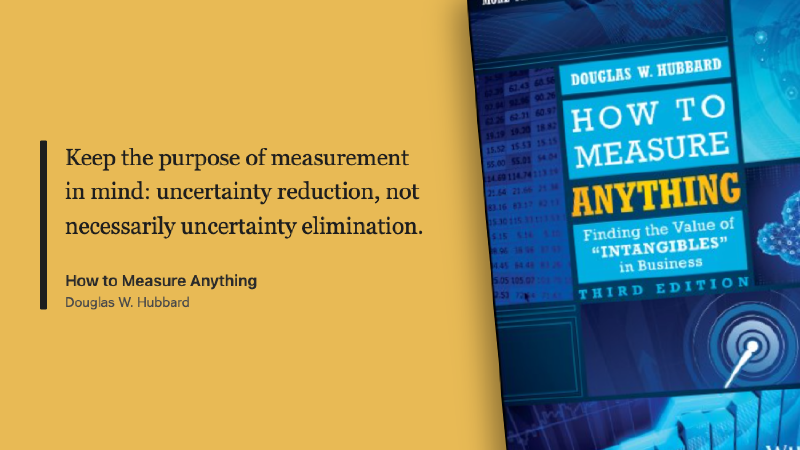
Keep the purpose of measurement in mind: uncertainty reduction, not necessarily uncertainty elimination.
- Summary: Douglas Hubbard demonstrates that the objective of quantitative measurement in business decision-making is to reduce uncertainty by an amount that exceeds the cost of information, rather than striving for unattainable certainty.
- Why it Matters: Executives routinely suffer from analysis paralysis by demanding exhaustive, flawless data before making strategic commitments, failing to recognize that even small amounts of well-targeted data drastically shift probability distributions.
- My Take: Measurement is an economic decision, not a quest for certainty. Chasing absolute certainty is a wasteful trap that slows execution speed. High-velocity leadership requires identifying the single variable that most reduces decision risk and acting decisively once the distribution tilts in your favor.
Radical Candor#
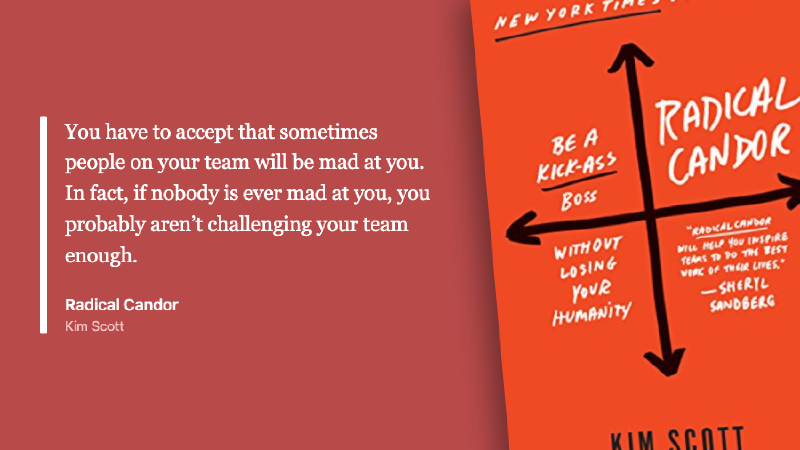
You have to accept that sometimes people on your team will be mad at you. In fact, if nobody is ever mad at you, you probably aren’t challenging your team enough.
- Summary: Former Google and Apple executive Kim Scott reminds leaders that effective management requires caring personally while challenging directly, even when pushing teams outside their comfort zones triggers temporary friction.
- Why it Matters: Leaders who confuse organizational harmony with team performance default to ruinous empathy, avoiding candid feedback and allowing mediocre standards to calcify across the enterprise.
- My Take: Universal comfort is a leading indicator of stagnation. A leadership culture obsessed with avoiding friction inevitably produces polite complacency. True institutional care is demonstrated by holding high standards and delivering unvarnished truth with clarity and compassion.
Further Reading#
- Why AI-Enabling Bank Infrastructure Matters: How the convergence of real-time ledgers and AI transforms core financial services.
- The Next Compiler: AI and the Evolution of Abstraction: Why machine-generated code shifts optimization incentives from syntax ergonomics to runtime execution.