
This week’s signals capture an unmistakable paradigm shift across technology, organizational architecture, and financial infrastructure: the era of surface-level automation is over, and the era of systems engineering has begun. In applied artificial intelligence, teams are discovering that endless prompt tuning yields diminishing returns. Building truly reliable autonomous agents requires a structural harness: explicit contracts, typed tool gateways, durable state, and deterministic verification gates that bound probabilistic models in code.
Concurrently, high-performing enterprises are applying this systems mindset upstream:
- In brand and creative operations, the legacy service-desk model is giving way to “brand as software,” turning institutional taste and repeatable decisions into scalable internal platforms.
- In software development, coding agents are accelerating the pace of software creation from the speed of human typing to the speed of compute, collapsing unit costs and expanding addressable use cases.
- And in financial plumbing, the debate over tokenization clarifies why permissionless protocols offer endogenous settlement guarantees that centralized, permissioned gatekeepers can never replicate.
Across every discipline, enduring leverage belongs to those who build the underlying environment rather than merely tweaking the inputs.
Market Observations & Insights#
The Seven Layers of Harness Engineering#

Harness Engineering: The Field Guide to Agents That Survive Contact With Reality
- Summary: Spect outlines seven foundational layers of agent harness engineerin: contracts, context maps, tool gateways, durable state, external policy, evidence-based completion, and classified recovery. This demonstrates why prompt editing fails when autonomous agents encounter the reality of production.
- Why it Matters: When an agent fails, developers reflexively patch system prompts with more instructions, creating layers of brittle “prompt scar tissue”. Production reliability is not a reasoning deficit; it is a design challenge where deterministic code must enforce boundaries and models supply judgment.
- My Take: Prompts carry intent; harnesses carry invariants. Adding adjectives to a prompt when an agent breaks is like yelling louder at an engine with a broken transmission. Enduring agentic architecture separates probabilistic planning from deterministic execution, making limits enforceable, failures observable, and completion provable.
Brand as Living Software#

Brand as Software
- Summary: Paul Jun details Ramp’s evolution of brand strategy from static PDF guidelines and an overwhelmed internal design service desk into “brand as software”: a shared intelligence layer that turns institutional taste, product truths, and approved design patterns into automated, editable production infrastructure.
- Why it Matters: In high-velocity companies, creative talent is routinely consumed by the repetitive chore of resizing banners, formatting sales decks, and policing visual consistency. Transforming repeatable decisions into executable software liberates artists to focus on brand-defining vision while maintaining coherent expression across hundreds of parallel touchpoints.
- My Take: Taste remains human; repetition belongs in software. Static brand manuals are wet napkins in an organization moving at modern speed. By pairing artists who define the standard of craft with builders who codify those choices into reusable components and agent skills, companies turn creative taste into compounding organizational infrastructure.
The Only Businesses Left to Build#
- Summary: Greg Isenberg maps the enterprise and startup landscape in a post-software world, arguing that defensible economic value will concentrate in AI-native service firms, domain-specific agent harnesses, proprietary datasets, physical assets, robotics, and energy infrastructure.
- Why it Matters: As generative intelligence drives the marginal cost of generic software code toward zero, traditional horizontal SaaS moats evaporate. Value migrates either to hard physical constraints (energy, land, distribution) or to hyper-vertical workflow orchestrators that own the entire job end to end.
- My Take: When code becomes free, defensibility moves to physical gravity and operational accountability. Selling generic workflow software is an endangered business model. The next generation of enduring ventures will either control physical infrastructure and proprietary datasets or operate vertical harnesses that take full legal and financial responsibility for business outcomes.
The software-engineering mechanics behind this shift are explored in The Next Compiler: AI and the Evolution of Abstraction.
The Autonomous Financial Operator#
- Summary: Siqi Chen announces Runway’s rebrand to cfo.ai alongside Ari, an autonomous AI CFO agent capable of producing comprehensive, fully wired financial models and scenario analyses from conversational prompts in under thirty minutes.
- Why it Matters: Corporate financial planning and analysis (FP&A) has long suffered from the bottleneck of manual spreadsheet formulas and headcount-constrained modeling cycles. Integrating deterministic financial mathematics with agentic exploration collapses multi-week forecasting sprints into immediate interactive loops.
- My Take: Finance is a natural frontier for deterministic agent harnesses. Corporate finance demands mathematical rigor bounded by strict accounting principles. Autonomous financial agents will not displace strategic CFO judgment; they will turn financial modeling into an ambient, real-time reflex that allows leadership teams to stress-test complex capital allocation decisions continuously.
Edge Intelligence and Sovereign On-Device Compute#
- Summary: Samuel Zeng introduces Edge0, an open-source framework that runs a 35-billion parameter language model directly on an iPhone utilizing only 1 to 2.5 GB of peak RAM with zero cloud dependency.
- Why it Matters: Centralized inference architectures introduce prohibitive bandwidth costs, latency spikes, and severe enterprise privacy liabilities. Compressing frontier-scale parameter models into consumer hardware memory envelopes enables offline, zero-latency, cryptographically private local execution.
- My Take: The ultimate operational leverage is sovereign edge compute. While model training will remain concentrated in gigawatt-scale data centers, everyday operational workflows demand privacy, instant responsiveness, and resilience against network outages. The migration of serious inference to client-side hardware is the missing link for pervasive agentic computing.
Deep Reads from the Library#
Software is about to eat the world much faster#
Author: Marc Andreessen
- Summary: Fifteen years after his foundational 2011 essay, Marc Andreessen notes that technology’s share of the top ten global market capitalizations surged from 31% to 94% even though software was written by hand by only 1 in 300 people worldwide. He argues that autonomous coding agents writing upwards of 90% of production code will transition developers from manual bricklayers to CTOs of agent fleets, making previously uneconomical problems addressable at the speed of compute.
- Why it Matters: Every major productivity leap in computing history, from compilers to open source to cloud hosting, reduced unit costs, triggering Jevons paradox and multiplying aggregate demand for software. Coding agents will not diminish the software engineering profession; they will unlock a massive expansion of tailored software across every traditional enterprise.
- My Take: Jevons Paradox will define the agentic software economy. Critics who anticipate a collapse in software engineering demand fail to grasp the limitless elasticity of human needs. When building software costs cents rather than hundreds of thousands of dollars, businesses will build dedicated software systems for micro-workflows and customer niches that could never previously justify an engineering budget.
The Operational, Financial, and Business Benefits of Permissionless Blockchains Over Permissioned Networks#
Author: Omid Malekan
- Summary: Columbia Business School Adjunct Professor Omid Malekan presents a rigorous structural analysis contrasting permissionless blockchains with enterprise permissioned networks, demonstrating that open protocols deliver endogenous liveness and cryptographic settlement guarantees, whereas permissioned consortia reintroduce single points of failure, counterparty risk, and incumbent monopoly power.
- Why it Matters: Traditional financial institutions and regulators often gravitate toward permissioned networks under the misconception that centralized gating confers institutional safety. In reality, private networks forfeit the true technological breakthroughs of blockchain: anti-fragility, 24/7 uptime, and atomic multi-asset settlement. All while locking participants into brittle, rent-seeking vendor cartels.
- My Take: Neutrality is the prerequisite for financial anti-fragility. As highlighted in our discussion of capital markets last week, private consortia merely recreate the clearing delays, discretionary censorship, and counterparty hazards of legacy finance. Genuine modernization requires open, permissionless settlement rails where rules execute deterministically without discretionary intermediaries.
For the broader market-structure case, see Tokenization Is the Capital Markets Upgrade.
What Feeds the Dragon: AI Is Buying the Data of Dead Companies#
Author: Mary Bush
- Summary: Mary Bush explores the emerging frontier of AI training data, where foundation model laboratories, having exhausted the open public web, are turning to bankruptcy auctions and corporate liquidations to acquire the internal operational archives, communications records, and transactional databases of bankrupt enterprises.
- Why it Matters: The exhaustion of public internet corpora is shifting the data frontier toward closed institutional repositories. Corporate bankruptcy proceedings are evolving from physical liquidation sales into intellectual property auctions where historic operational data becomes the primary liquid asset.
- My Take: Enterprise operational exhaust is the new mineral reserve. The highest-signal training data for domain-specific agent harnesses is trapped within enterprise ERPs, support tickets, and legacy databases. As economic cycles turn, corporate distress will increasingly be resolved through the valuation and acquisition of private operational data archives.
I wrote about the value of closed institutional repositories in the past. This further quantifies that value.
Highlights from the Stacks#
Creativity, Inc.#
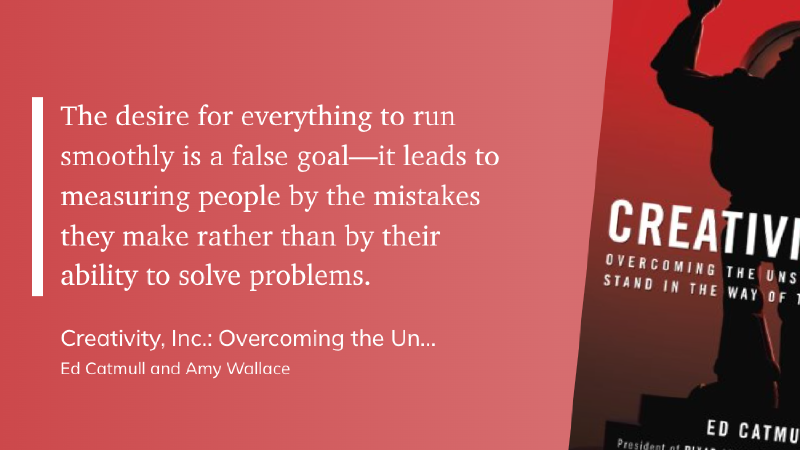
The desire for everything to run smoothly is a false goal—it leads to measuring people by the mistakes they make rather than by their ability to solve problems.
- Summary: Pixar co-founder Ed Catmull explains that over-indexing on administrative smoothness and zero defects penalizes initiative and breeds cultures that punish mistakes rather than fostering active problem-solving.
- Why it Matters: In dynamic environments, attempting to prevent every conceivable error creates bureaucratic gridlock and intellectual conservatism, blinding leadership to emerging risks.
- My Take: Zero errors is a symptom of zero ambition. Resilient organizational design focuses on fast detection, containment, and adaptive recovery rather than constructing elaborate bureaucratic checkpoints that choke creative experimentation.
High Output Management#
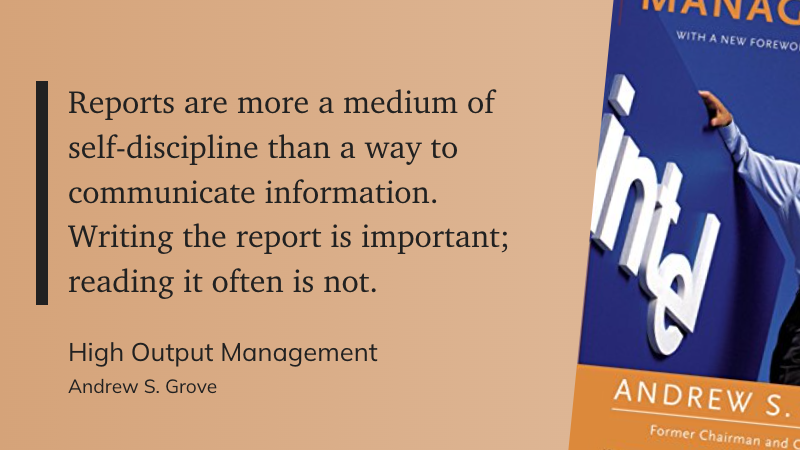
Reports are more a medium of self-discipline than a way to communicate information. Writing the report is important; reading it often is not.
- Summary: Intel CEO Andy Grove observes that the primary managerial value of formal reporting lies in the rigorous self-examination required to write it, rather than the transfer of information to the reader.
- Why it Matters: The discipline of distilling complex operational metrics into structured prose forces leaders to confront hidden inconsistencies and prioritize execution before communicating with stakeholders.
- My Take: Writing is the ultimate cognitive compiler. The act of synthesizing disparate operating signals into clean, structured arguments exposes flawed assumptions far more effectively than verbal updates or slide presentations.
Broken Money#
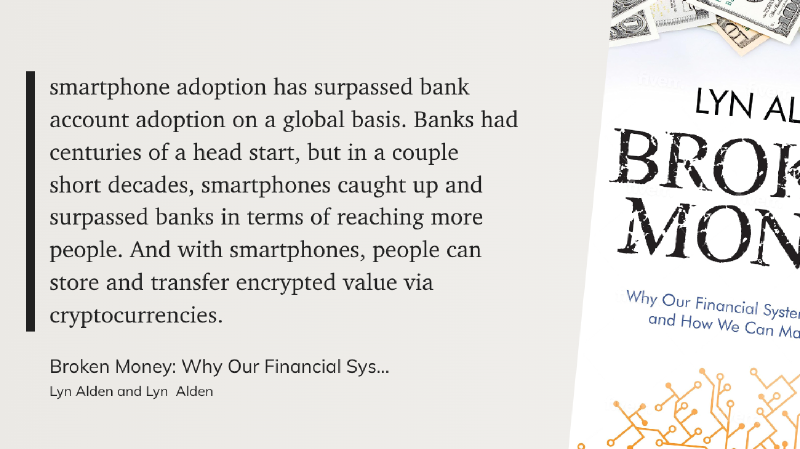
smartphone adoption has surpassed bank account adoption on a global basis. Banks had centuries of a head start, but in a couple short decades, smartphones caught up and surpassed banks in terms of reaching more people. And with smartphones, people can store and transfer encrypted value via cryptocurrencies.
- Summary: Lyn Alden highlights how consumer pocket computers and cryptographic protocols outpaced centuries of traditional banking expansion, delivering global access to encrypted value transfer without relying on physical bank branch networks.
- Why it Matters: Traditional correspondent banking networks are structurally limited by high overhead, regulatory friction, and geographic exclusion. Cryptographic protocols running on commodity smartphone hardware fundamentally change the economics of financial distribution.
- My Take: Software protocols consistently leapfrog physical rails. Just as developing economies skipped copper wire telephone grids in favor of cellular networks, global capital is bypassing legacy correspondent banking cartels in favor of direct cryptographic settlement.
Further Reading#
- Moats in the Era of Vibe Coding: Why cheaper software creation makes data, distribution, trust, and workflow depth more important.
- Investing in Atoms: How AI Is Forcing Venture Capital to Break Its Software Addiction: Why energy, manufacturing, and grid infrastructure become strategic constraints as AI scales.