

This week’s theme is quality content in the age of AI: high-context systems, writing, and structures to cut through the noise of an automated content explosion. As the web becomes flooded with AI-generated “slop,” the value of clear, human-driven prose and strategic synthesis has skyrocketed.
Talent & Operations: True growth happens when you combine smart strategies with top talent. Y Combinator does this by teaching founders lean, fast-paced market research tactics. Facebook used a similar strategy in 2010 by acquiring skilled startup founders and giving them total freedom to run major teams.
AI & Data: For AI agents to actually get smarter, they need better ways to process information. Simply storing data in standard databases isn’t enough. They need connected systems (knowledge graphs), real-world context, and decentralized networks to make sense of complex information.
The core lesson is clear: differentiation is the ultimate competitive strategy: whether in game theory, organizational scale, or memory design.
Market Observations & Insights#
The Art of High-Context Technical Writing#
- Summary: Highlighting a dedicated body of AI technical writing.
- Why it Matters: In an era saturated with generic, automated content, high-context and deeply researched technical writing is a key differentiator.
- My Take: Depth is the new premium. Clear, long-form technical explanations build long-term intellectual authority.
Combating AI Writing Slop#
- Summary: A look at Clay’s newly instituted official AI writing policy to combat the degradation of communication quality.
- Why it Matters: As organizations rush to integrate generative tools, the default output tends to degrade into flat, uninspiring prose that dilutes brand trust.
- My Take: Standardize curation, not generation. Define strict guidelines for how and where AI outputs can be used, and prioritize human editing.
The Pre-Slop Writing Discipline#
- Summary: A throwback to Amazon’s internal writing guidelines that forced rigorous narrative-driven documentation over slide decks.
- Why it Matters: Amazon’s culture of written narratives forced clarity of thought and ownership before building. A timely reminder.
- My Take: Clarity of writing is clarity of thinking. Organizations must return to structured, narrative-driven documentation to make real strategic decisions.
The 3-Hour YC Market Research Loop#
- Summary: A workflow for using LLMs as tireless research partners by feeding them competitive websites, earnings calls, reviews, and forums to map out strategic blind spots.
- Why it Matters: Speed-to-insights is a critical edge for early-stage startups trying to establish go-to-market strategies without bloated timelines.
- My Take: Context window is the leverage. Do not ask LLMs to browse the web broadly; instead, curate high-fidelity inputs and prompt the model to attack the core assumptions.
The Founder-Centric M&A Playbook#
- Summary: A historical look at Mark Zuckerberg’s 2010 M&A strategy of acquiring small companies to place talented founders in massive product roles.
- Why it Matters: Scaled organizations often struggle with retaining mission-driven builders, who get bogged down in corporate bureaucracy.
- My Take: Buy the builders, not the business. Compensate talent at founder rates and give them the trust and scope to operate like founders within the larger machine.
Deep Reads from the Library#
Hotelling doesn’t say what you think it says#
Author: Brian Albrecht
- Summary: An analysis of the Hotelling model of competition, clarifying the tension between convergence (minimal differentiation) and pricing power (maximal differentiation).
- Why it Matters: Traditional economic teachings overemphasize the “median voter” convergence, ignoring the powerful market force to differentiate to preserve profit margins.
- My Take: Differentiation preserves margins. Competing purely on features or location leads to price war commoditization; true strategy requires maximal differentiation.
LLM Memory#
Author: Grant Slatton
- Summary: A deep dive into LLM memory architectures, evaluating the limitations of vector embeddings and proposing knowledge graphs, meta-document summarization, and reference frames.
- Why it Matters: Building reliable AI agents requires moving past simple context windows or flat database lookups to systems that mimic human episodic synthesis and decay.
- My Take: Memory is active synthesis. A robust memory architecture requires automated garbage collection, relational graphs, and episodic summarization (like sleep).
The Future is for Everyone#
Author: Mark Zuckerberg
- Summary: Meta’s AI manifesto advocating for decentralized, open-source personal superintelligence to empower individuals rather than concentrate power in a few institutions.
- Why it Matters: The debate between centralized safety and open distribution will define the geopolitical and economic control of AI capabilities.
- My Take: A balance of power is the safest architecture. Distributing tools of invention to the edges ensures competition, resilience, and personal agency over institutional monocultures.
Highlights from the Stacks#
The Undoing Project#
A part of good science is to see what everyone else can see but think what no one else has ever said. The difference between being very smart and very foolish is often very small. So many problems occur when people fail to be obedient when they are supposed to be obedient, and fail to be creative when they are supposed to be creative. The secret to doing good research is always to be a little underemployed. You waste years by not being able to waste hours. It is sometimes easier to make the world a better place than to prove you have made the world a better place.
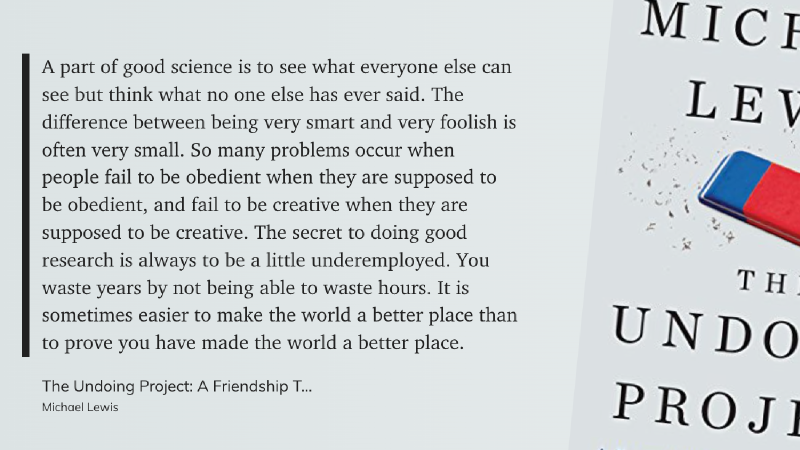
- Summary: Michael Lewis on the nature of discovery, highlighting that breakthroughs require seeing common things in uncommon ways and having the unstructured time to explore them.
- Why it Matters: In hyper-efficient organizations, the obsession with utilization rates kills the very slack required to stumble upon non-linear innovations.
- My Take: Slack is the precursor to breakthrough. If you do not design unstructured time into your schedule, you will remain optimized for incrementalism.