
The transition from speculative AI to hard-boiled implementation is bringing the “degree of difficulty” into sharp focus this week. As organizations roll out agentic systems, they are discovering the hidden tax of “botsitting”: the manual effort required to clean up, manage, and contextualize models that fail to grasp institutional reality.
The lesson of the week: technology doesn’t automate away the need for systems design. Whether we are confronting the quiet ticking clock of quantum decryption, tokenizing real-world logistics assets, or rediscovering first principles in compiler design, true leverage remains rooted in iteration and architecture. Ecosystems are the true moats.
Market Observations & Insights#
AI Adoption is a Myth#

AI Adoption is a Myth
- Summary: An analysis of enterprise AI adoption showing a steep “barbell” split where 10% of users consume 90% of tokens while the other 90% see little to no productivity gain.
- Why it Matters: Simple licensing rollouts fail because using AI well is a craft, not a default state. The real bottleneck is organizational design and system-level context, not token abundance.
- My Take: The AI chasm is an integration problem. You cannot expect a non-technical workforce to prompt their way to efficiency. The solution is putting the AI in the background of existing systems of record rather than forcing users to become prompt engineers. As explored in Why 95% of Executive AI Strategies Fail (And How to Fix It), true operating leverage requires transitioning from standalone tools to governed, background workflows.
Crafting Interpreters#
- Summary: A recommendation of Bob Nystrom’s “Crafting Interpreters,” which guides readers through building a full programming language from scratch.
- Why it Matters: As AI-native tools abstract away coding foundations, a deep grasp of parsing, virtual machines, garbage collection, and memory management becomes rare and highly valuable.
- My Take: Foundations are the ultimate leverage. The developers who understand what happens beneath the LLM abstractions are the ones who will build the next generation of infrastructure, not just paste code into templates. This shift is part of a larger trend detailed in The Next Compiler: AI and the Evolution of Abstraction, where AI acts as the next layer of compilation, making validation and architecture the true moats.
The AI Geopolitics & Security Reality Check#
- Summary: Key takeaways from a podcast with Mike Angelopoulos, discussing the rise of Chinese open-source models, the collapse of software as a moat, and the rise of AI-generated fake job applicants.
- Why it Matters: The acceleration of open-source models outside the West and the threat of weight-level backdoors are dismantling traditional enterprise security perimeters.
- My Take: Software is commoditized; verification is the new moat. In a world of infinite generated software, security requires independent “guardian models” and physical verification of identity.
Logistics Tokenization in Japan#
- Summary: A consortium led by Daiwa House successfully closed a JPY 7.73bn public offering for a digital real estate security token backed by logistics centers.
- Why it Matters: Real-world asset (RWA) tokenization is moving from experimental pilots to multi-billion-yen institutional distributions on public/private rails.
- My Take: Liquidity is the killer feature of real estate. Securitizing physical logistics via digital tokens collapses issuance costs and democratizes access, signaling a mature rail for institutional fintech.
LLMs and the Limits of Deduction#
- Summary: An argument that while LLMs excel at induction (finding patterns) and deduction (logic chains), they lack “abduction”: the ability to jump beyond existing boundaries to invent new concepts.
- Why it Matters: LLMs can fill gaps in existing human knowledge, but they cannot invent entirely new conceptual worlds (like calculus or scheme theory).
- My Take: Models interpolate; humans abduct. The true value of builders is not in answering existing questions faster, but in asking the questions that redefine the boundaries of what is possible.
Deep Reads from the Library#
How Much Time Do Your Employees Spend Botsitting?#
Author: Rebecca Hinds, Paul Leonardi
- Summary: An HBR study revealing that digital workers spend nearly a day a week “botsitting”, feeding context to AI, reviewing outputs, and correcting errors.
- Why it Matters: Standalone AI tools shift the management burden onto employees, creating a productivity paradox and cognitive wear.
- My Take: Context must be treated as infrastructure. If your models lack meta-knowledge of how your organization actually functions, employees will waste hours patching the gaps. Build agents directly into systems of record.
Quantum Computers Won’t Beat the Market. They’ll Do Something Far Scarier.#
Author: Voltex
- Summary: An analysis of Q-Day and “harvest now, decrypt later,” arguing that quantum’s threat to public-key cryptography (like RSA) puts a quiet expiry date on encrypted data.
- Why it Matters: Adversaries are archiving encrypted data today, waiting for the quantum scale to decrypt it later. Wall Street is already migrating to post-quantum cryptography (PQC).
- My Take: Confidentiality is a timer. Rebuilding your encryption vault must happen years before the heist. If you wait for Q-Day, you’ve already been compromised.
On Being An Elder#
Author: joshpuckett.me
- Summary: Reflections on the responsibilities of industry elders in technology: passing down tacit wisdom, opening doors, speaking up, and remaining available to guide the next generation.
- Why it Matters: Tacit knowledge and cultural norms in rapid industries are easily lost when founders and builders exit without transferring their “how” and “why.”
- My Take: Service is the true measure of seniority. Mentorship and open door policies are what prevent industries from becoming cargo cults. We must actively document and share the stories behind our decisions.
Highlights from the Stacks#
My Life and Work#
A manufacturer is not through with his customer when a sale is completed. He has then only started with his customer.
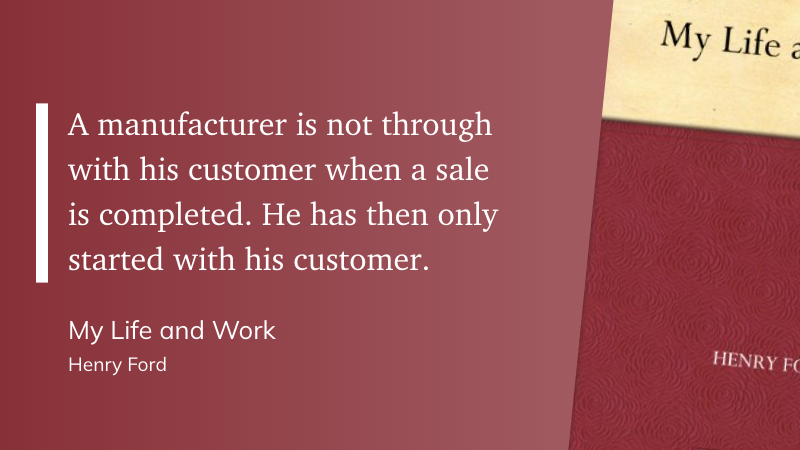
- Summary: Henry Ford’s philosophy on product lifecycle, arguing that sales are the beginning of a service relationship, not the end.
- Why it Matters: In the modern SaaS and agent economy, post-sale retention and customer success are the only indicators of true product-market fit.
- My Take: The transaction is the starting line. Value is realized in usage, not in the contract signature.
How Innovation Works#
The genius of the Wright brothers was precisely that they realized they were in an incremental, iterative process and did not expect to build a flying machine at the first attempt. And the Kitty Hawk moment came before several more years of hard slog, tinkering and retinkering, till the Wrights knew how to keep a plane aloft for hours, how to lift off without a head wind, how to turn and how to land.
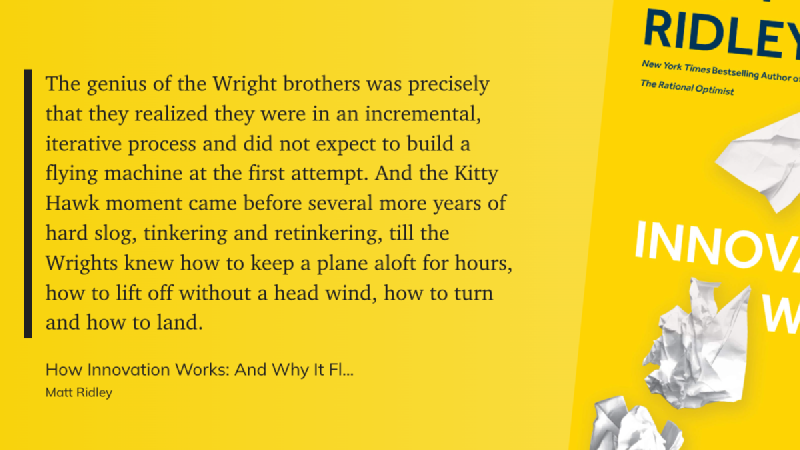
- Summary: Matt Ridley’s breakdown of the Wright brothers’ success, highlighting the gruelling, incremental nature of true innovation.
- Why it Matters: We glorify the “Eureka” moment while ignoring the years of systematic, daily tweaking required to scale a breakthrough.
- My Take: Innovation is sweat plus statistics. There are no shortcuts to scaling complex systems. You must fall in love with the grind of the feedback loop.
The Undoing Project#
most advances in science come not from eureka moments but from ‘hmmm, that’s funny.’
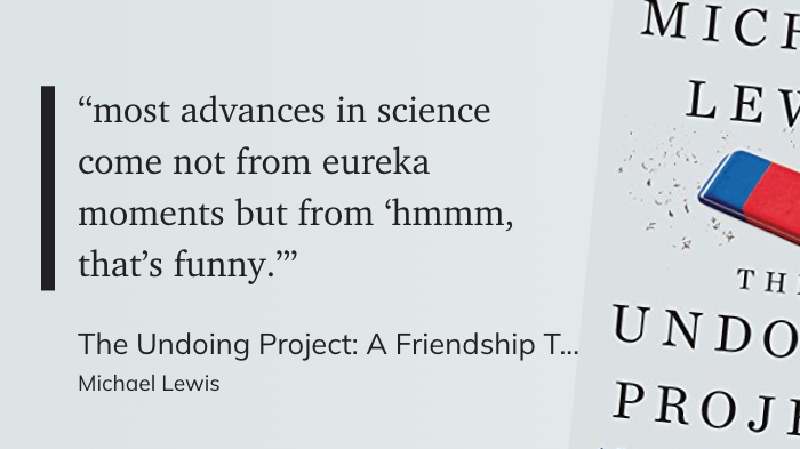
- Summary: Michael Lewis on the nature of scientific discovery, which often begins with noticing anomalies rather than executing grand plans.
- Why it Matters: Real breakthroughs happen when we pay attention to what doesn’t fit our current models, rather than trying to force-fit the data.
- My Take: The anomaly is the guide. Pay attention to the weird edge cases in your business metrics; they are usually the earliest signals of a major shift.
Further Reading#
- Why 95% of Executive AI Strategies Fail (And How to Fix It): Frameworks for moving from standalone tool rollouts to governed workflows.
- The Next Compiler: AI and the Evolution of Abstraction: Exploring the levels of abstraction shift for engineers in the AI era.