

This week’s signals highlight a critical shift in how we approach scalability, resilience, and value capture in the technology ecosystem. As artificial intelligence matures from experimental chatbots to production systems, the engineering constraint is moving rapidly from foundation model weights to deterministic execution harnesses, proving that the infrastructure wrapper, rather than the model itself, is the primary driver of real-world agent reliability. This continues an argument from Signals: Week 27, 2026: the operating system around the model increasingly determines the value it creates.
This theme of robust design and operational focus echoes through other domains, from vertical AI platforms solving unique go-to-market challenges in non-digitized sectors, to the physical semiconductor testing bottlenecks capturing the actual economics of the AI hardware boom. Ultimately, whether designing software agents, organizational structures that bring engineers and designers into the same room, or corporate turnaround strategies that restore consumer trust, the message remains clear: success is dictated by the systems we design and the distribution networks we control, not just the underlying components we build.
Market Observations & Insights#
Harness Engineering as the Primary Driver of Agent Performance#
- Summary: A computer science paper establishes that the execution harness unifying sandboxes, protocols, lifecycle orchestration, observability, and governance is the primary determinant of AI agent reliability, boosting SWE-bench coding benchmarks from 6.7% to 68.3% without modifying the underlying model.
- Why it Matters: Developers and enterprise builders often default to upgrading to larger, more expensive foundation models to fix agent failures. This research shifts the paradigm toward deterministic harness architecture as the true lever for system reliability.
- My Take: The harness is the product. Foundation models are increasingly commoditized; the real moat lies in the engineering wrapper that constrains, monitors, and validates their execution.
Go-to-Market Strategies for Vertical AI Startups#
- Summary: Insights from a16z’s discussion with the founders of LassieAI, who surpassed $10M in ARR by selling vertical AI solutions directly to dental practices.
- Why it Matters: Reaching buyers in offline or non-digitized industries requires rewriting the standard B2B SaaS playbook. Traditional channels like LinkedIn and direct IT sales are non-existent in these segments. That is one route into AI pilot purgatory: building a generic capability without an adopted, repeatable workflow.
- My Take: Distribution beats model sophistication. In vertical AI, winning is about workflow integration and meeting the customer where they are, not building the most complex neural network.
The Dangers of Chatbot Cognitive Offloading in Education#
- Summary: Andrew Ng announces LearnVector, a new venture backed by a $100M investment from Coursera, to build highly personalized, guided learning paths rather than generic chat assistants that encourage cognitive offloading.
- Why it Matters: While chatbots can complete homework, they often leave students less skilled because they offload critical cognitive work. True education requires guided paths, guardrails, and structured skill verification.
- My Take: Guides, not crutches. The future of AI in education, and in professional tools, must center on active learning and mastery verification, rather than passive task completion.
The Search for a LinkedIn Competitor#
- Summary: A brief observation questioning why a viable competitor to LinkedIn has not emerged to capture users seeking higher-signal professional networks.
- Why it Matters: As algorithmic optimization rewards engagement bait and self-promotion, the signal-to-noise ratio of professional networks has deteriorated, creating an opening for curated alternatives.
- My Take: Curated utility over engagement. The next professional network will win by prioritizing high-signal interactions and actual collaboration over vanity engagement loops.
The Forgotten Solutions in Design History#
- Summary: An observation highlighting that optimal recipe design patterns were solved decades ago, yet modern platforms choose to ignore these established structural solutions.
- Why it Matters: It reflects a broader tech trend where developers and designers continuously reinvent the wheel, ignoring historical design standards that already solved the fundamental user interaction problems.
- My Take: Study the archives before building. Modern builders often mistake new technologies for new problems; looking back at analog or early digital design patterns can save years of product iteration.
Deep Reads from the Library#
Agent Harness Engineering: A Survey#
Author: Anonymous Authors
This is the paper referenced in the market observation above.
- Summary: A systematic survey of agent harness engineering, proposing the ETCLOVG seven-layer taxonomy (Execution, Tooling, Context, Lifecycle, Observability, Verification, Governance) to bridge the gap between academic research and production deployment practices.
- Why it Matters: It formalizes the “binding-constraint thesis,” showing that for frontier models, the infrastructure governing execution constraints and feedback loops drives benchmark variance and reliability more than model weights.
- My Take: Systems engineering is the new prompt engineering. If you want reliable agents, stop tweaking prompts and start building sandboxes, runtime policies, and robust verification loops.
Lighthouse or Landgrab?#
Author: Joe Schmidt IV
- Summary: An analysis arguing that AI founders burn valuable runway and developer time chasing vanity Fortune 100 enterprise “lighthouse” logos that fail to convert to meaningful, scalable revenue.
- Why it Matters: Startups frequently mistake enterprise pilots for product-market fit. These long-cycle deals tie up engineering teams in custom work instead of allowing them to build a scalable product for the broader market.
- My Take: Chasing logos is capital destruction. Build for the middle of the market where conversion is fast and feedback loops are tight, rather than getting stuck in enterprise sales purgatory.
Who Captures the AI-Test Dollar in Southeast Asia?#
Author: The SEA Analyst
- Summary: A detailed look at how AI hardware accelerators are reshaping the semiconductor testing value chain in Southeast Asia, highlighting which listed companies are capturing structural economics.
- Why it Matters: Software-driven AI hypes often obscure the physical realities of the supply chain. Testing complex silicon packaging is a critical, highly specialized, and geopolitical step that serves as a bottleneck for hardware delivery.
- My Take: The sticky value is in the physical bottlenecks. Do not ignore the physical testing and packaging layers of the hardware boom; that is where the real pricing power resides.
Highlights from the Stacks#
American Icon: Alan Mulally and the Fight to Save Ford Motor Company#
Mulally knew Ford had to stop losing money, but he also knew that was only part of the equation. It also needed to give consumers a reason to believe in the Blue Oval again.

- Summary: Alan Mulally’s turnaround strategy at Ford was not just a cost-cutting exercise; it required restoring consumer faith and brand pride in the “Blue Oval” brand.
- Why it Matters: Operational and financial restructuring are necessary but insufficient for long-term survival. Without a compelling product vision that consumers believe in, efficiency leads only to a slower death.
- My Take: Survival is the floor; vision is the ceiling. You cannot cost-cut your way to market leadership. Your turnaround must give the customer a concrete reason to care.
Elon Musk#
“At other places I worked,” von Holzhausen says, “there was this throw-it-over-the-fence mentality, where a designer would have an idea and then send it to an engineer, who sat in a different building or in a different country.” Musk put the engineers and designers in the same room.
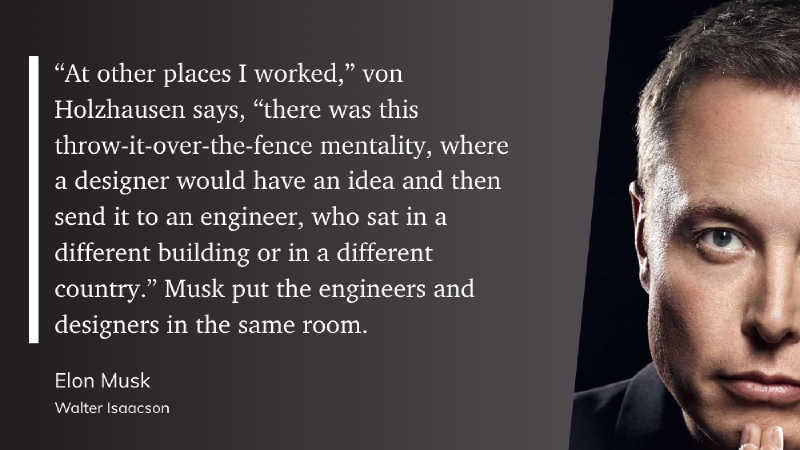
- Summary: The design and engineering integration at Tesla and SpaceX succeeded by physically co-locating the designers and engineers, eliminating the standard “throw-it-over-the-fence” delays found in traditional manufacturing.
- Why it Matters: Organizational design directly dictates product feedback loops. High-bandwidth communication and physical proximity drastically accelerate iteration cycles.
- My Take: Colocation is communication. If you want high-speed innovation, destroy the physical and organizational walls between the people who dream the product and the people who build it.