
This week’s signals focus on the shift from manual generation to reusability, both in software architecture and organization design. We examine the early-adopter penetration of consumer AI subscriptions, pointing to the B2B enterprise mandate as the primary monetization engine.
In engineering, we look at the efficiency of deriving clean API clients from browser-agent interactions, the critique of using tokens to repeatedly build standard software elements from scratch, and the value of building an LLM from the ground up to understand its core physics.
For leadership and corporate architecture, we explore predictions for the agentic work landscape, insights on risk-averse management (from Moneyball!), the power of community integrations over commodity transactions in platforms, and the crucial distinction between point-wise and steady-state process design.
Finally, for a Philippine spin, we dissect Jollibee’s proposed international spinoff, demonstrating that listing venue changes cannot substitute for operational cash flow. Even with Chickenjoy!
Market Observations & Insights#
The 2.2% Ceiling: AI Subscriptions and Market Penetration#
- Summary: Only 2.2% of U.S. households currently pay for an AI subscription, indicating that consumer AI adoption is still in its infancy.
- Why it Matters: High valuations assume rapid, mainstream market penetration. The data shows we are still in the early-adopter phase of consumer monetization, meaning the immediate commercial growth is still heavily enterprise-driven.
- My Take: The mass market has not arrived. Focus on B2B workflows where utility is easily quantified, rather than assuming consumers will pay for open-ended conversation helpers.
Future Shock: The Agentic Work Landscape in Three Years#
- Summary: Greg Isenberg outlines 16 predictions for an agentic future, including specialized agent managers, calendar negotiation between autonomous agents, itemized agent expenses, and HR managing both agents and employees.
- Why it Matters: Organization design is going to change dramatically. When the ratio of agents to employees scales to 10:1, the job of the manager shifts from doing work to orchestrating and auditing machine execution.
- My Take: Orchestration is the primary skill. The highest-leverage builders of the next decade will not write raw syntax; they will design systems and manage autonomous agents that do.
Demystification: Building a Large Language Model From Scratch#
- Summary: An educational review highlighting a developer who built a complete large language model from scratch to understand the math and mechanics underneath.
- Why it Matters: Black-box applications create fragile engineering. Understanding the core mechanics, from tokenization to attention weights, is essential for builders to locate why context alignment and prompts fail at scale.
- My Take: Know the physics of your stack. If you don’t understand the basic arithmetic of weights and token embeddings, you cannot design robust agent interfaces.
Client Derivation: Browser Control to API Synthesis#
- Summary: A demonstration of using browser-based agent automation to record network requests into HAR files, dynamically synthesizing clean API clients instead of repeating browser-control loops.
- Why it Matters: Browser automation is slow and prone to UI shifts. Recording network interactions during a manual/agent walkthrough to generate direct API clients is a much more efficient way to build web wrappers.
- My Take: Browser control is a training step, not a runtime solution. Use the browser to discover the API, then synthesize direct network calls to minimize latency and improve reliability.
Too much agent in the run-time
There is in general way too much LLM in the run-time driving token spend. Once designed, agent generated skills can often be moved into deterministic programs and scripts. LLMs in the run time regulalry violate DRY: Don’t Repeat Yourself!
Peak AI Psychosis: The Finite Element Model of Software#
- Summary: A critique arguing that 99% of software consists of the same finite set of elements, and using tokens to repeatedly rebuild these common components from scratch is highly inefficient.
- Why it Matters: Generative coding is currently treating every feature as a custom creation. As the field matures, we must shift to reusing standardized, pre-tested component libraries rather than prompting models to reinvent the wheel.
- My Take: Reusability overrides generation. Building software is a curation game. Leverage pre-packaged modules for standard workflows and reserve token budgets for the 1% of your codebase that actually defines your competitive edge.
Deep Reads from the Library#
Jollibee’s Global Arm Is Real. Its Wall Street Re-Rating Is a Mirage.#
Author: The SEA Analyst
- Summary: An in-depth analysis of Jollibee Foods Corporation’s plans to spin off and list its international business on a US exchange, demonstrating that listing venue changes alone cannot sustain premium growth multiples absent superior underlying unit economics.
- Why it Matters: Capital allocators often rely on structural financial engineering (spin-offs, cross-listings) to unlock value, but markets are highly adaptive; the listing venue cannot permanently mask low margin profiles or capital inefficiency.
- My Take: Venue is not value. You cannot multiply worth by simply changing the ticker location. True leverage comes from structural unit economics and operational cash flow, not geography.
Highlights from the Stacks#
The MicroGuide to Process and Decision Modeling in BPMN/DMN#
Point-wise goals and steady-state goals. Point-wise goals are the goal of the process with respect to a user, customer, or stakeholder. Steady-state goals are more like continuous metric objectives: quantified and measurable.
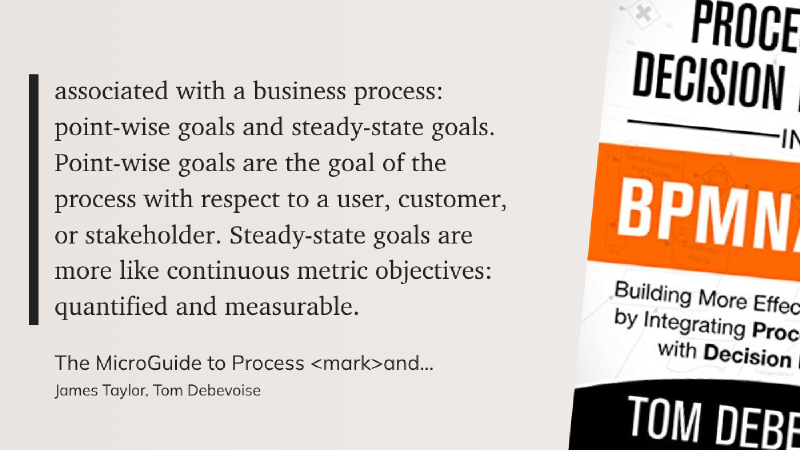
- Summary: James Taylor and Tom Debevoise distinguish between point-wise goals (user-facing endpoints) and steady-state goals (continuous operational metrics) in business process modeling.
- Why it Matters: In modern systems design and agentic engineering, teams often focus entirely on point-wise execution (finishing a task) while ignoring the steady-state stability (latency, cost, throughput) of the system over time.
- My Take: Systems run on steady-states. It is not enough for your automation or agents to succeed once; they must maintain predictable, measurable operational baselines over millions of executions.
Moneyball#
“I figured out that managers do all this shit because it is safe,” said Alderson. “They don’t get criticized for it.”
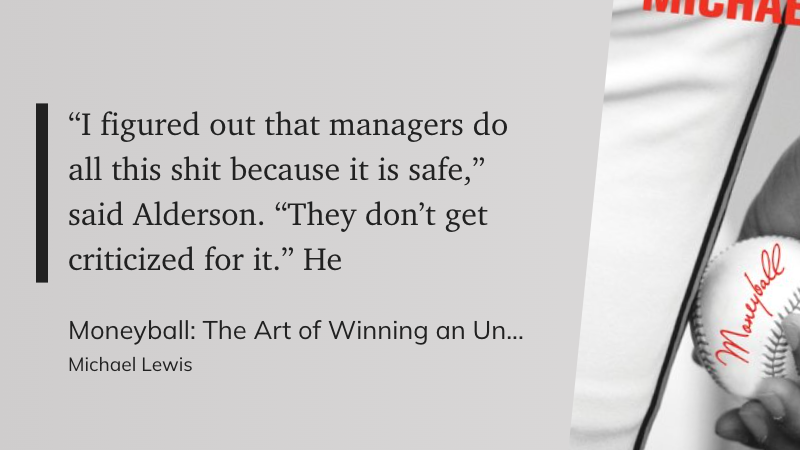
- Summary: Sandy Alderson explains that managers in baseball frequently rely on traditional, low-leverage strategies simply because they are safe and shield them from public criticism.
- Why it Matters: Corporate leadership often defaults to standard industry playbooks (expensive consulting, safe tech stack migrations) not because they produce the best outcomes, but because they serve as career-protection insurance.
- My Take: Safety is a silent tax on alpha. True innovation requires the willingness to run counter-cultural strategies and absorb short-term criticism in exchange for structural, long-term advantages.
The Airbnb Story#
“Right now, travel is oriented around being an outsider, having limited access to public places,” Chesky says. “This is going to be about being an insider and immersing in a community. And that is a profound shift.”
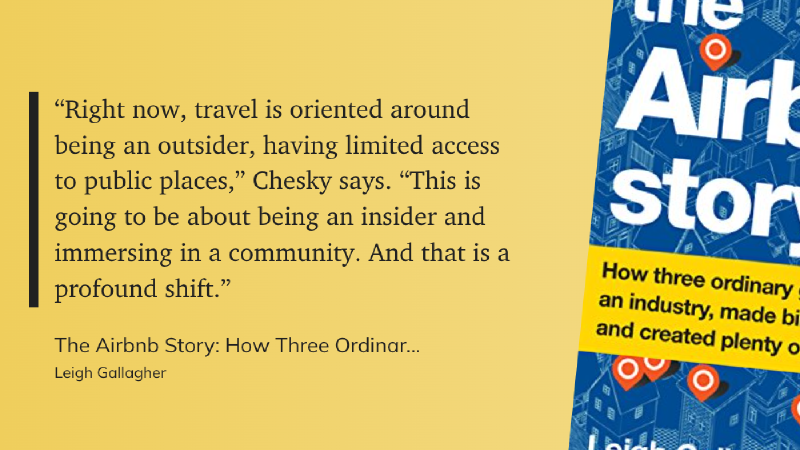
- Summary: Brian Chesky details Airbnb’s strategic pivot from selling transactional travel accommodations to offering immersive, community-integrated insider experiences.
- Why it Matters: In platform economics, the transition from transactional utility to relational community lock-in is the ultimate moat. Customers pay a premium to feel like insiders rather than generic buyers.
- My Take: Moats are relational, not transactional. If your product or service is just a commodity utility, you are vulnerable to price wars. Build an experience that integrates your customer into a community.