
This week’s signals focus on the mechanics of complex systems, from the lowest levels of software architecture to corporate knowledge engines, algorithmic trading frameworks, and the financialization of social capital. Building a Unix-like operating system from scratch reminds us of the power of minimalist design, while Cerebras’s internal knowledge base shows how organizations can fuse disparate data sources without forcing rigid behavior changes. In markets, the classic Bell Labs stack demonstrates that a true edge requires a holistic system, from signal detection to position sizing, rather than a single algorithm. Finally, we look at the transition to AI-native enterprise models, the discipline of skill engineering, and the real-world premium of repurchasing public commons.
Market Observations & Insights#
Minimalist Systems: Unix-Like OS in 1,000 Lines#
- Summary: An educational project detailing how to build a fully functional, Unix-like operating system in just 1,000 lines of C code, complete with paging, process switching, and a file system.
- Why it Matters: Stripping away the complexity of modern operating systems reveals the fundamental primitives of hardware-software interfaces, proving that clean, focused architecture is often superior to bloat.
- My Take: Simplicity is the ultimate leverage. When designing systems, start with the absolute minimum viable interface before layering on abstractions.
The Six-Layer Trading Edge: Bell Labs Stack#

Bell Labs Solved Trading in the 1950s. You're 70 Years Late.
- Summary: A deep dive into the historical papers from Bell Labs (1948–1963) that contain the blueprint for a complete trading edge: Signal (Shannon), Distribution (Mandelbrot), Sizing (Kelly/Thorp), Compounding (Hamming/Munger), Discipline (Feynman/Livermore/Marks), and Reality (Lo/Derman).
- Why it Matters: Algorithmic systems often focus entirely on signal generation (Layer 1) while ignoring sizing, compounding, and execution discipline, which is where system failures and blowups actually occur.
- My Take: Infrastructure is Strategy. A great signal paired with poor sizing or lack of compounding discipline is a math problem waiting to solve itself to zero. Build the entire stack.
Engineering Corporate Memory: Cerebras Knowledge Base#

How we built our knowledge base
- Summary: Cerebras details their internal knowledge base architecture, which ingests data from Slack (via Socket Mode and LLM distillation), codebases (using CocoIndex), and custom plugins into a unified Postgres embeddings datastore.
- Why it Matters: Forcing employees to use a single “source of truth” platform fails; a modern knowledge base must meet data where it lives (GitHub, Slack, Jira) and synthesize it asynchronously.
- My Take: Ergonomics override mandates. The best internal tools conform to existing developer workflows rather than forcing compliance.
The Next Frontier: Modernizing the Financial System#
- Summary: Brian Armstrong outlines eight major areas where the global financial system needs modernization, highlighting tokenization of real-world assets, 24/7 trading, stablecoin payments for AI agents, and risk management.
- Why it Matters: A friction-free financial layer is the primary prerequisite for the emerging machine-to-machine economy, where autonomous AI agents require instant settlement.
- My Take: Tokenization is inevitable. Capital efficiency and settlement speed will drive all assets onchain; early adopters of agentic payments will capture the developer mindshare.
The Price of a Destroyed Commons: Repurchasing Social Capital#

Young adults are poor despite every metric which suggests otherwise
- Summary: An essay exploring why young adults feel financially squeezed despite positive top-line economic metrics, arguing that previous generations received valuable social capital (safe neighborhoods, strong schools, active communities) for free, which the young must now repurchase privately.
- Why it Matters: As public trust and civilizational commons decay, families are forced to spend disproportionate amounts of financial capital on private security, housing moats, and private schooling.
- My Take: Social capital is a balance sheet asset. When communities fragment, the cost of living spikes because individuals must buy back what used to be a free civilizational endowment.
Deep Reads from the Library#
Why I wrote “AI Native: The Mandate to Transform Your Company”#
Author: Kai-Fu Lee
- Summary: Kai-Fu Lee shares insights from his upcoming book, reflecting on his 1983 PhD application at CMU and detailing how modern enterprises must move beyond simple AI pilots to completely redesign their operating models to be “AI Native.”
- Why it Matters: Companies that merely plug AI models into existing legacy workflows will be outpaced by competitors built from the ground up around agentic workflows and automated decision-making.
- My Take: Retrofitting is a transition state. Long-term competitive advantage belongs to those who rebuild organization designs around what models can do, not where they can fit.
The Dark Arts of Skill Engineering#
Author: Paul Bakaus
- Summary: Bakaus outlines nine critical techniques for moving beyond “vibed prose” prompts to build robust, predictable, and environment-agnostic agentic skills that function reliably at scale.
- Why it Matters: As developers transition to managing AI agents and coding harnesses, building standardized, testable skill libraries becomes a core software engineering discipline.
- My Take: Software engineering principles apply to AI. If your agentic skills are not versioned, tested, and decoupled from raw LLM quirks, you are building on sand.
Highlights from the Stacks#
The Money Hackers#
Letting the machines do all the work unsupervised is problematic. You need somebody who can correlate the results you’re seeing with the real cause that’s in the world. Ultimately, it’s a human thing.
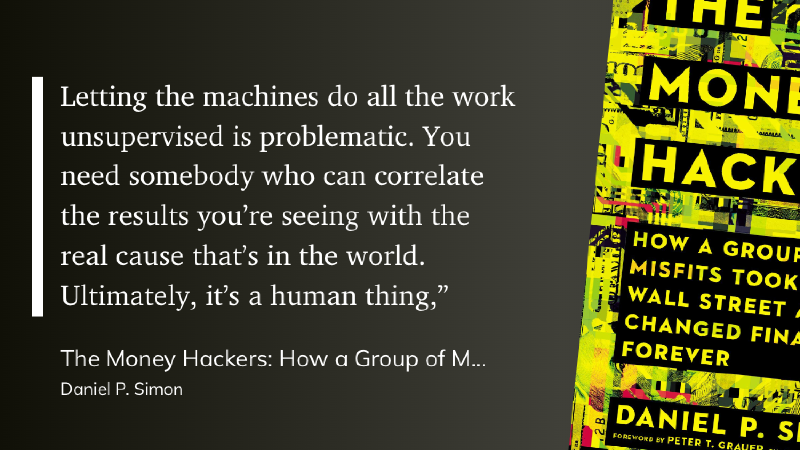
- Summary: Simon details the limits of pure algorithmic automation in finance, arguing that human operators are still needed to connect quantitative outputs with real-world qualitative events.
- Why it Matters: Total automation is a fragile equilibrium; the most resilient architectures combine model scale with human intuition at critical decision boundaries.
- My Take: Humans are the circuit breakers. Pure data loops fail to account for geopolitical and psychological black swans; the human-in-the-loop is an asset, not a bottleneck.
The House of Morgan#
Junius Morgan developed a lofty disdain for price competition and adopted the royal passivity of the Rothschilds and the Barings, who refused to offer cut-rate terms: “If we cannot keep the account on such a basis we must be content to let others outbid us.”

- Summary: Chernow describes the philosophy of Junius Morgan, who rejected price-cutting wars to preserve the firm’s elite status, pricing power, and long-term viability.
- Why it Matters: Competing on price is a race to the bottom that turns premium services into low-margin commodities.
- My Take: Pricing power is the ultimate proxy for value. Let competitors win the low-margin battles; focus your energy on defending quality and maintaining trust.