

This week’s signals converged on a simple point: the AI edge is moving out of the model demo and into the operating system around it. Better harnesses, tighter workflows, sharper judgment, and cleaner management loops are starting to matter more than raw model mystique. That should get every CEO’s attention, because the next winners will not be the teams shouting loudest about agents. They will be the teams that can actually run them.
Market Observations & Insights#
The harness is starting to matter as much as the model#
- Summary: Akshay Pachaar breaks down a Hugging Face result where a frozen open model went from failure to near frontier-level benchmark performance by improving the runtime wrapper around it rather than retraining the model itself.
- Why it Matters: This is the clearest evidence yet that agent performance is now a systems design problem. File handling, tool execution, context routing, and termination logic can create or destroy output quality before model intelligence even becomes the issue.
- My Take: Execution infrastructure is now strategy. If your benchmark, workflow, or product depends on brittle orchestration, you do not have a model edge. You have a process bug.
Human visual reasoning still sits far ahead of AI#
- Summary: Yasmine Khosrowshahi recaps Judy Fan’s MIT talk on why humans excel at making the invisible visible, from sketches and diagrams to scientific abstraction, and why current AI systems still struggle to reason the same way.
- Why it Matters: This is a useful correction to the current multimodal hype. AI can classify and mimic more visual tasks than before, but human judgment still dominates when communication requires selective abstraction, causality, and tradeoff management.
- My Take: Seeing is not the same as understanding. CEOs should treat visual AI as a useful assistant, not as proof that machine reasoning has closed the gap on human explanation.
Programming is being pulled back toward intent#
- Summary: A clip on Bret Victor’s old argument shows how much of software still depends on brittle text instructions even though more direct and goal-oriented programming ideas were already visible decades ago.
- Why it Matters: AI coding is not just making developers faster. It is reopening the question of what programming should feel like when machines can infer more of the path from a clear objective.
- My Take: Intent is becoming a first-class interface. The teams that adapt fastest will stop treating code as sacred text and start treating it as one layer in a broader control system.
One operator can now run far more surface area#
- Summary: Zephyr highlights Jacob Bank’s claim that one marketer can coordinate a large stable of AI agents at modest monthly cost instead of relying on a traditional team structure.
- Why it Matters: Whether or not every cost claim holds, the directional shift is real. Small teams can now carry much more operational load if they have clean process design, narrow scopes, and strong review discipline.
- My Take: The minimum efficient team just got smaller. That changes hiring plans, margin structures, and the economics of new ventures from day one.
The fintech talent leak is still a structural problem#
- Summary: PsudoMike points to SoFi’s acquisition of Composer, a Toronto-built fintech product that never reached Canadian users despite being created there.
- Why it Matters: This is the old market structure problem in plain sight. Weak local distribution, slower regulatory adaptation, and shallow domestic scale keep pushing strong financial products toward larger foreign balance sheets.
- My Take: Geography still decides who captures value. Building talent locally is not enough if the market architecture keeps exporting the payoff.
Deep Reads from the Library#
Don’t Train the Model, Evolve the Harness#
Author: huggingface.co
- Summary: The article behind Akshay Pachaar’s x post shows how agent benchmark gains can come from improving the harness around a model rather than changing the model itself, especially in tool use, file operations, and execution control.
- Why it Matters: Too many teams still blame the model when the real failure sits in the workflow shell around it. That is expensive. It sends product, engineering, and capital toward the wrong bottleneck.
- My Take: Most AI disappointments are operating design failures first. Fix the wrapper before you spend another quarter chasing a new model.
Please stop the AI Confidence Theater#
Author: Elena Verna
- Summary: Elena Verna argues that AI discourse is being distorted by exaggerated personal workflows, inflated claims, and social pressure to pretend systems are more autonomous than they really are.
- Why it Matters: This lands directly on execution risk. Inflated narratives produce bad procurement, weak hiring signals, and unrealistic board expectations about what agents can already do in production.
- My Take: Receipts matter more than rhetoric. If a workflow is truly valuable, you should be able to show the operating impact without theatrical language.
The AI Economy: The Next Chapter#
Author: Ricky Ho
- Summary: Ho makes the case that long-term AI value may consolidate less around the smartest individual models and more around the orchestration, compliance, routing, and cloud infrastructure that enterprises trust to deploy them.
- Why it Matters: This is where capital allocation gets more interesting. If models become more interchangeable across enterprise workloads, the durable moat shifts toward the governance layer that decides how intelligence is used.
- My Take: Distribution beats brilliance once markets mature. The real prize may sit with the platforms that manage AI safely at scale, not just the labs chasing the best benchmark.
Highlights from the Stacks#
How to Measure Anything#
Keep the purpose of measurement in mind: uncertainty reduction, not necessarily uncertainty elimination.
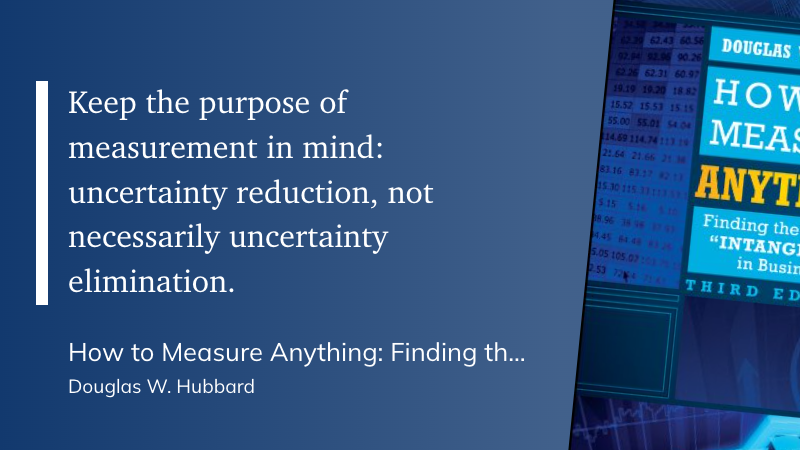
- Summary: Hubbard strips measurement down to its real job, reducing uncertainty enough to improve decisions.
- Why it Matters: This is exactly the right lens for AI, operations, and investing. You do not need perfect certainty to move. You need a cleaner decision basis than you had yesterday.
- My Take: Good operators measure to decide, not to perform precision. That distinction saves time, money, and false confidence.
The Design of Everyday Things#
Requirements made in the abstract are invariably wrong. Requirements produced by asking people what they need are invariably wrong. Requirements are developed by watching people in their natural environment.
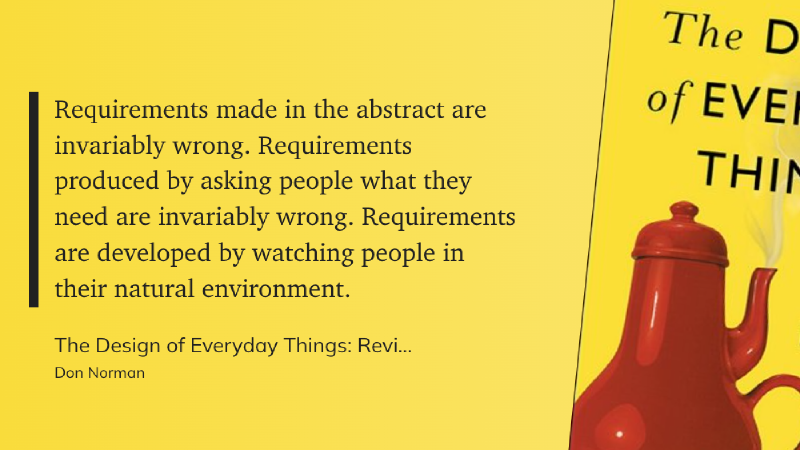
- Summary: Norman makes the case that real design starts with observed behavior, not abstract planning sessions.
- Why it Matters: This applies directly to workflow automation and agent products. If you do not study how work actually flows, you will automate the wrong thing and then wonder why adoption stalls.
- My Take: Observation beats speculation. Most broken internal tools are not technical failures. They are empathy failures dressed up as requirements.
Autobiography of Andrew Carnegie#
When everything would seem to be matter of price, there lies still at the root of great business success the very much more important factor of quality.
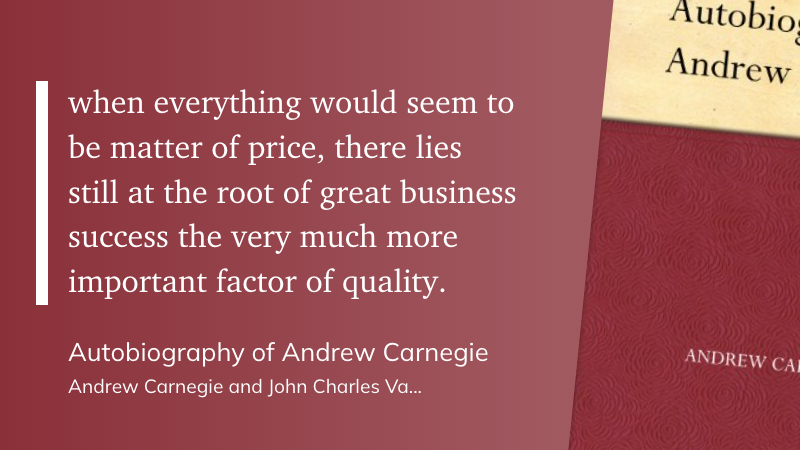
- Summary: Carnegie reminds us that price pressure never fully erases the premium on quality.
- Why it Matters: That is worth remembering in an AI market racing toward cheaper inference and faster output. Lower cost expands access, but quality still determines who wins trust and repeat demand.
- My Take: Cheap intelligence is not the same as valuable intelligence. As models commoditize, quality control becomes the margin layer.