
The week’s signals converge on a singular theme: the shift from humans using tools to systems producing outcomes. Whether it’s AI agents becoming independent economic actors on Stripe, neobanks being rebuilt as messaging app primitives, or large-scale AI infrastructure being deployed in “fabric tents” to bypass traditional utility timelines, the latency of innovation is collapsing. We are moving beyond the pilot phase into an era where infrastructure is the strategy, and the ability to measure intangibles like brand damage and organizational originality becomes the ultimate differentiator.
Market Observations & Insights#
- Summary: Meta is deploying AI chips in fabric tents powered by gas turbines to bypass the 2-3 year wait for permanent buildings and grid power.
- Why it Matters: The bottleneck for AI is no longer just compute, but the physics of power and real estate. “Speed-to-power” is the new competitive advantage.
- My Take: Infrastructure is the ultimate pivot. When a software giant starts operating like a frontier energy utility, the traditional boundaries of a “tech company” are officially dead.

The internet has a new economic actor
- Summary: Stripe is rolling out infrastructure for “economic agents”—AI systems that can buy, build, and pay for services autonomously.
- Why it Matters: This represents the birth of a machine-to-machine economy. If agents can manage their own wallets, the velocity of commerce will decouple from human decision speed.
- My Take: The Agentic Economy is already here. We’ve spent decades building software for people; we’re now building the world for the agents.
- Summary: MoneyGram has launched MGUSD on the Stellar network, integrating stablecoin cash-in/cash-out directly into its app for its 60M+ customers.
- Why it Matters: This is the “last mile” of crypto. Bringing stablecoins to 500,000 physical locations bridges the gap between digital assets and real-world utility for the unbanked.
- My Take: Distribution is the real killer app. It doesn’t matter how fast the chain is if you can’t get your money into your hand at a physical corner store.

10 AI Concepts Every Builder Must Understand Before Writing a Single Line of Code
- Summary: A foundational breakdown of 10 AI concepts—tokens, attention, RAG, and agents—that builders must master to move beyond chatbots.
- Why it Matters: The “vibe coding” era is maturing into engineering. Understanding the underlying probability and architecture is the only way to build reliable, production-ready systems.
- My Take: Concept over Code. You can prompt your way to a prototype, but you have to engineer your way to a product.
- Summary: An episode featuring MIT scientist Donald Hoffman, discussing how the human brain evolved to perceive a “user interface” of reality rather than reality itself.
- Why it Matters: Understanding the limits of human perception is critical as we build AI systems that increasingly mediate our experience of the world.
- My Take: Reality is the ultimate abstraction. As we build world models in AI, we’re essentially creating new user interfaces for existence.
Longer Reads#
The neobank playbook for when acquisition is the only hard problem#
- Summary: Explores how messaging platforms like Telegram are the new distribution frontier for neobanks, lowering CAC for underbanked users.
- Why it Matters: Distribution is shifting from app stores to messaging primitives. Finance is becoming a feature of conversation.
- My Take: Embedded Finance 2.0. Your bank isn’t an app anymore; it’s a contact in your chat list.
Why prediction markets matter#
- Summary: a16z crypto breaks down how prediction markets turn collective belief and skin-in-the-game into real-time probability estimates.
- Why it Matters: Traditional forecasting is broken. Incentivized markets are the most efficient truth-discovery mechanism we have.
- My Take: Incentives are Information. If you want to know what will happen, follow the trades, not the polls.
The Frontier Firm Playbook: Five Dimensions for Regulated AI#
- Summary: Sabine VanderLinden outlines how regulated firms succeed with AI by focusing on governance, leadership, and human-agent teaming.
- Why it Matters: Innovation in regulated sectors is 10% technology and 90% organizational architecture.
- My Take: Governance is a Competitive Advantage. Companies that can safely deploy AI in regulated environments will capture the largest markets.
Book Highlights#
American Icon#
“What I have learned is the power of a compelling vision, a comprehensive strategy, a relentless implementation process, and talented people working together based on those commitments”
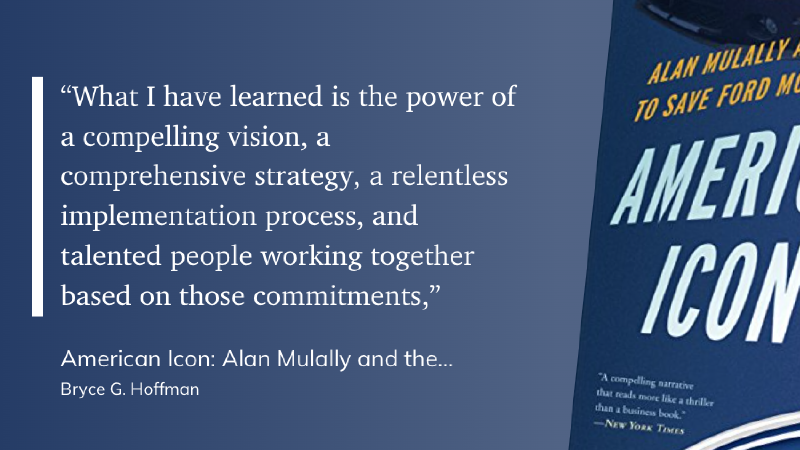
- Summary: Alan Mulally’s leadership at Ford was defined by a singular vision and a relentless implementation process that prioritized collaboration over corporate politics.
- Why it Matters: Even in the era of AI and high-speed tech, the fundamental “operating system” of a successful organization remains human alignment and execution rigor.
- My Take: Strategy is a commodity; execution is the alpha. You can have the best AI in the world, but if your people aren’t aligned on the vision, you’re just automating chaos.
How to Measure Anything#
Cybertrust surveyed chief executives as well as the general public about perceptions of brand damage. It also compared the actual losses in stock prices of companies after such events. Through these surveys and comparisons, Tippett was able to confirm that the brand damage due to customer data stolen by hackers was worse than the damage caused by misplacing a backup tape.
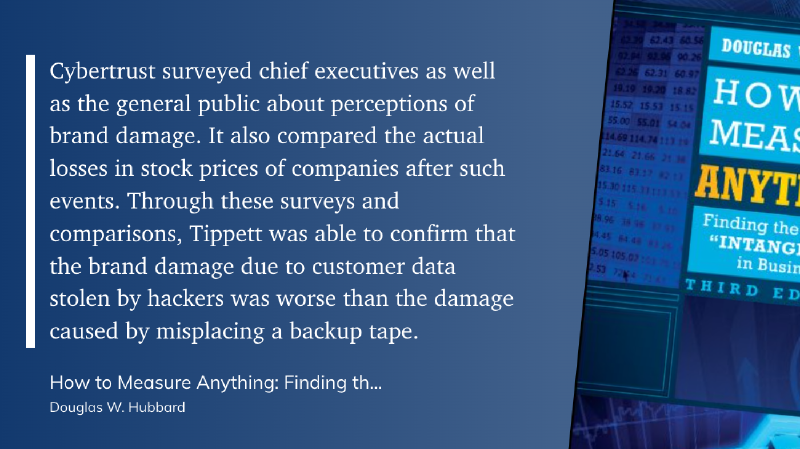
- Summary: Research shows that “brand damage” from security breaches is often perceived as immeasurable, yet it can be quantified by comparing it to known benchmarks and market data.
- Why it Matters: To manage risk, you must be able to measure it. Treating critical intangibles as “unmeasurable” leads to irrational capital allocation and fear-based decision making.
- My Take: If it matters, it has a magnitude. The moment you quantify an intangible, you turn a vague worry into a manageable line item.
Originals#
Becoming original is not the easiest path in the pursuit of happiness, but it leaves us perfectly poised for the happiness of pursuit.
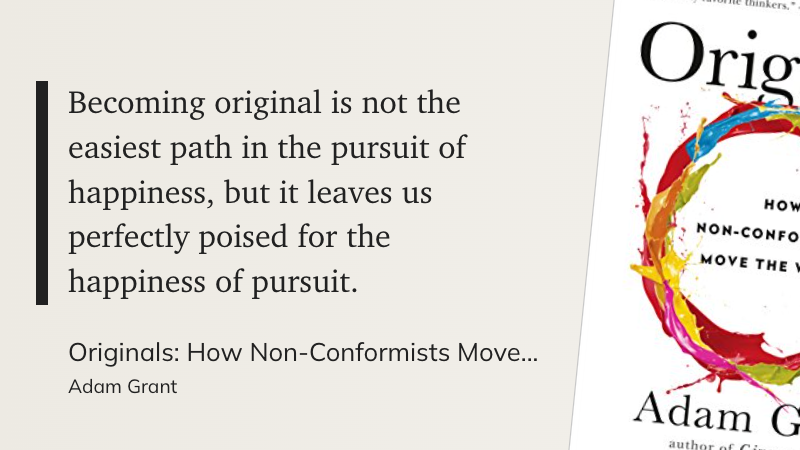
- Summary: Originality isn’t about being perfectly happy; it’s about the deep satisfaction found in the process of challenging the status quo and pursuing a meaningful goal.
- Why it Matters: Builders often mistake the “happiness of pursuit” for the “pursuit of happiness,” leading to burnout when the path gets difficult.
- My Take: Originality is a marathon, not a mood. The goal isn’t to be comfortable; the goal is to be right about the future.