

This week’s signals converge on the theme of Systems, Survival, and the Architecture of Trust. From the way stablecoins are creating a 24x7 liquidity loop to the evolution of credit screening from merchant bankers to data models, we are seeing a fundamental shift in how we design the infrastructure of our lives. Whether it’s the mathematical imperative of avoiding ruin in Fortune’s Formula or the decentralized speed of The Outsiders, the message is clear: survival isn’t a matter of luck; it’s a matter of system design.
Market Observations & Insights#

Who Wants to Work Anyway?
Summary: An exploration of AI’s potential to displace labor and the urgent need to redesign social contracts around wealth distribution and “ownership” of AI.
Why it Matters: As AI matures, the “problem” of labor is being solved, but the “problem” of distribution is becoming acute.
My Take: The future is a design problem. We need to stop asking who will work and start asking who owns the machines that do.

Stablecoins and the 24x7 Liquidity Loop
Summary: Simon argues that banks are finally seeing stablecoins as a revenue source and a liquidity tool rather than a threat.
Why it Matters: This is the “on-chaining” of the global financial system’s plumbing.
My Take: Liquidity is the ultimate feature. Digital bank deposits are trapped; stablecoins are free. The bank of the future is a protocol.

Avoiding Death on the Yellow Brick Road
Summary: A defense of the AI application layer, arguing that while base models are powerful, the value remains in the specialized “last mile” of utility.
Why it Matters: Founders are terrified of being “Sherlocked” by OpenAI. Schmidt provides a roadmap for survival.
My Take: The model is a commodity; the workflow is the moat. Solve a specific, messy human problem and you’re safe.
Summary: A free 4-hour course on working with Codex, featuring 229 slides and a focus on practical application for researchers.
Why it Matters: Accessibility to complex tools is the key to widespread adoption.
My Take: Teaching is scaling. The faster we lower the floor for tool mastery, the higher we raise the ceiling for innovation.
Summary: A professor’s grassroots effort to create a better systems programming textbook through a collaborative wikibook project.
Why it Matters: Open-source knowledge management is the only way to keep pace with rapidly evolving technical fields.
My Take: Frustration is the mother of infrastructure. Don’t wait for the textbook to be written; build the wiki.
Deep Dives & Analysis#
Why Most Time Series Models Fail Before They Start#
Summary: A technical deep dive into why stationarity is the silent killer of time series forecasting.
Why it Matters: In a world driven by “predictive” models, understanding the limits of forecasting is a competitive advantage.
My Take: Data is not destiny. If you don’t understand the underlying stability of your inputs, your outputs are just noise.
How The Heck Does Shazam Work?#
Summary: An explanation of audio fingerprinting and the hash-based matching that allows Shazam to identify songs in noisy environments.
Why it Matters: It’s a masterclass in efficient search and pattern matching at scale.
My Take: Complexity is a series of simple shortcuts. Shazam doesn’t “hear” the song; it hashes the highlights.
Neobank 101: Why Every Crypto Wallet Is Becoming a Bank#
Summary: The convergence of crypto wallets and traditional banking services through stablecoin integration.
Why it Matters: The UI of money is shifting from the ledger to the wallet.
My Take: The wallet is the new browser. It’s the primary interface for our digital and financial lives.
For millions of Filipinos, owning a home is a dream the market was never built to fulfil#
Summary: A look at the structural failures in the Philippine housing market where supply is built for investors, not dwellers.
Why it Matters: Housing is the foundational infrastructure of social stability.
My Take: Market signals are not human needs. When the “market” optimizes for yield over shelter, the system is broken.
From the Library#
The Outsiders#
“hire well, manage little” and believes this extreme form of decentralization increases the overall efficiency of the organization by reducing overhead and releasing entrepreneurial energy.
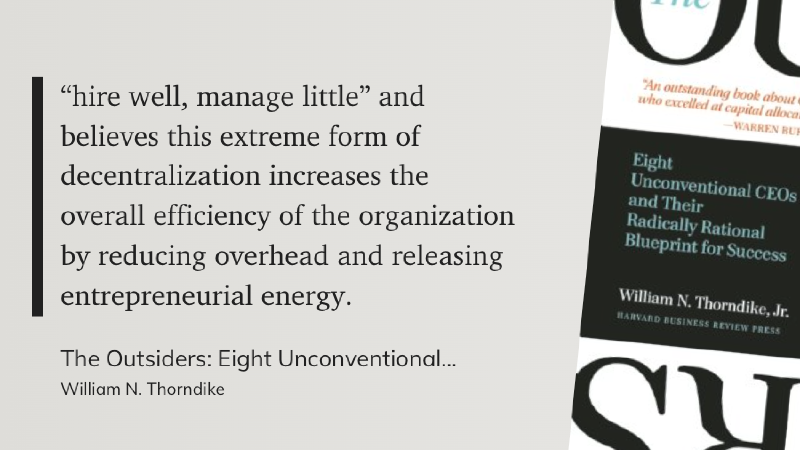
Summary: A core principle from the unconventional CEOs profiled in The Outsiders: extreme decentralization as a tool for efficiency and entrepreneurial speed.
Why it Matters: In large organizations, overhead is the silent killer of innovation. Decentralization isn’t just a structure; it’s a performance multiplier.
My Take: Management is a tax. The best leaders minimize that tax by pushing decision-making authority to the edges of the organization.
The House of Morgan#
early merchant bankers used character and class as crude forms of credit screening; ever since the Medicis and Fuggers, it was a practical way for private bankers to protect their precious capital base.

Summary: Historical context on how credit screening evolved from social signaling to the sophisticated (but still flawed) data models we use today.
Why it Matters: It reminds us that credit is fundamentally about trust and reputation, even when wrapped in algorithms.
My Take: Data is just digital reputation. Whether it’s a FICO score or an on-chain history, we are still just trying to solve the problem of character at scale.
Fortune’s Formula#
The best strategy is one that offers the highest compound return consistent with no risk of going broke.
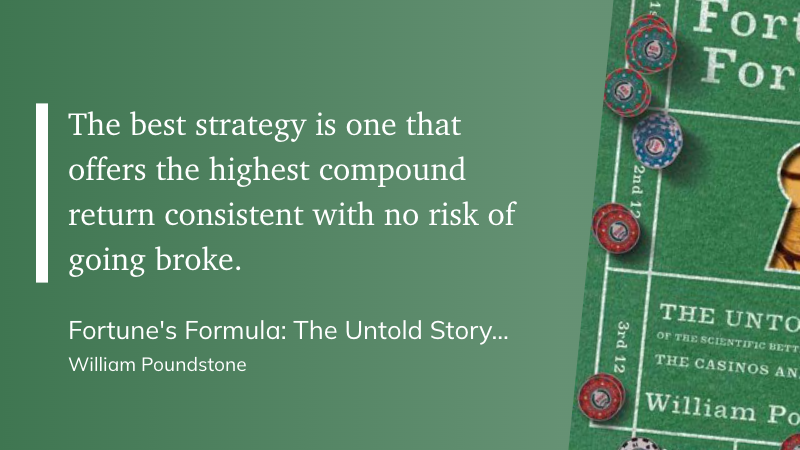
Summary: An introduction to the Kelly Criterion and the mathematical necessity of avoiding “ruin” above all else in betting and investing.
Why it Matters: Most strategies focus on maximizing returns. Great strategies focus on surviving long enough for compounding to work.
My Take: Survival is the first directive. If you have a non-zero chance of going broke, the expected value of your return is irrelevant.