
As the distinction between tools that guide work and systems that do work collapses, we are seeing a recursive shift in the architecture of attention and ambition. This week’s signals trace a line from the “legal coding” of capital to the computational coding of AI agents, revealing a common truth: Infrastructure is not just the plumbing; it is the strategy. From the layering of legacy card stacks and the regulatory filtering of stablecoin incentives to the “picks-and-shovels” reality of the AI IPO market, the competitive moat is moving from the product to the institutional protocols and the identity underneath.
Highlights From Social#
The Evolution of Company Playbooks#
- Summary: Brian Halligan reflects on his interview with Jack Dorsey, noting that most modern company playbooks are still derivatives of Andy Grove’s “High Output Management.”
- Why it Matters: In an era of rapid technological shift, the foundational principles of management remain remarkably durable, even as the “players” (human or agentic) change.
- My Take: Management is the OS. You can upgrade the apps, but if the kernel (the playbook) isn’t robust, the system fails under load.
There is no spoon; a picks-and-shovels IPO#

There is no spoon; a picks-and-shovels IPO
- Summary: Matt Slotnick argues that there is no product, only the “picks-and-shovels” of AI infrastructure, as background agents begin to automate tasks unattended.
- Why it Matters: We are moving from a world of SaaS tools for humans to “Background-as-a-Service” where agents act as the primary workforce.
- My Take: The product is the prompt. If there is no spoon, the value resides entirely in the intent and the infrastructure that realizes it.
How card payments actually work#

How card payments actually work
- Summary: A deep dive into the card payment stack, clarifying the roles of PSPs, gateways, and acquirers in 7 slides.
- Why it Matters: Payments infrastructure remains one of the most misunderstood yet critical layers of the global economy.
- My Take: Complexity is a feature, not a bug. Understanding the stack is the prerequisite for disrupting it.
Hermes Agent Masterclass#

Hermes Agent Masterclass
- Summary: A masterclass on Hermes Agent, highlighting its self-evolving skills and three-tier memory architecture.
- Why it Matters: This represents the shift from “static” bots to agents that compound their own intelligence through GEPA optimization.
- My Take: Memory is the new Moat. An agent that remembers is an agent that learns; an agent that learns is an asset that appreciates.
Longer Reads#
Inside APAC Banks’ Legacy Card Infrastructure Problem#
- Summary: APAC banks are modernizing legacy systems by adding orchestration layers rather than full core replacements to handle digital demand.
- Why it Matters: It confirms the “strangler fig” approach to digital transformation is the only viable path for systemic institutions.
- My Take: Layering is the new migration. You don’t rebuild the foundation while the house is on fire; you build a better fire department.
The Guide to Stablecoin Incentives Under the CLARITY Act#
- Summary: Analyzing how the CLARITY Act categorizes stablecoin rewards, banning passive holding yields while permitting activity-based incentives.
- Why it Matters: Regulation is finally catching up to the nuance of crypto-economic incentives, forcing a shift from “idle” to “active” utility.
- My Take: Utility is the only regulatory shield. If it doesn’t do something, it shouldn’t earn something.
Book Highlights#
The Code of Capital#
Contracts and property rights support free markets, but capitalism requires more—the legal privileging of some assets, which gives their holders a comparative advantage in accumulating wealth over others.
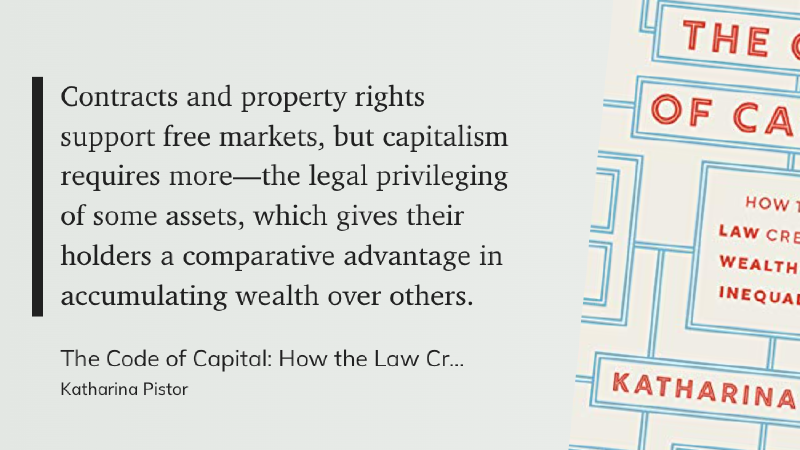
- Summary: Pistor argues that capital is created through the legal coding of assets, granting them specific protections and privileges.
- Why it Matters: In the digital age, the “code” is no longer just legal; it is computational. The advantage goes to those who can code the rules.
- My Take: Code is Law, and Law is Capital. The competitive edge in Fintech is the ability to wrap traditional assets in superior legal and digital protocols.
Useful Not True#
Perspectives feel real
- Summary: A concise observation on how subjective frameworks dictate our objective experience.
- Why it Matters: Alignment in an organization is entirely about aligning perspectives.
- My Take: Narrative is the ultimate interface. Change the perspective, change the outcome.
Underwriters of the United States#
Insurance is a quintessential practice of capitalists.
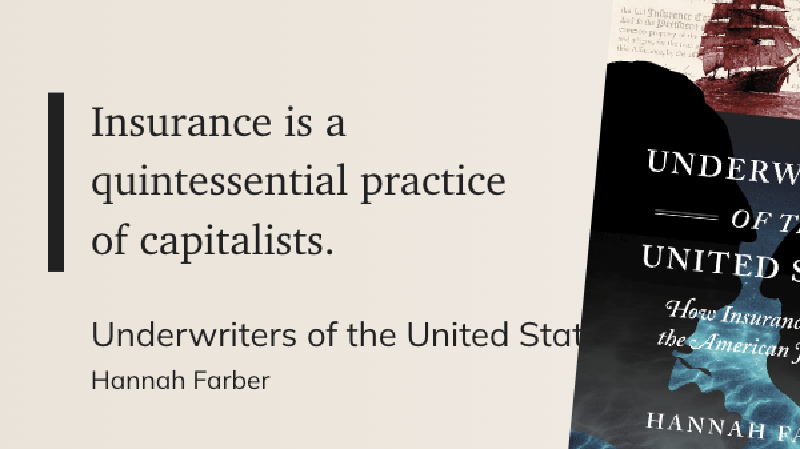
- Summary: Examining the historical role of insurance in the formation of capitalist structures.
- Why it Matters: Risk management is the “silent partner” in every venture ever built.
- My Take: Capitalism is just priced risk. If you can’t price it, you can’t trade it.