
This week’s signals revolve around the intersection of probability, infrastructure, and institutional memory. From the mathematical bedrock of prediction markets to the hard-earned lessons of database architecture and cloud repatriation, a clear theme emerges: complexity is a cost, not a feature. Whether you are building a Polymarket bot or a global conglomerate, success depends on identifying the core mechanics that actually drive value while stripping away the “degree of difficulty” that adds no points to the scoreboard.
Highlights from Social#
Nassim Taleb on Options & Probabilities#
- Summary: A 1-hour Stanford lecture where Nassim Taleb breaks down the relationship between options markets and the convexity of outcomes.
- Why it Matters: Understanding tail risk and convexity is essential for any capital allocator in volatile markets.
- My Take: Probabilistic thinking is the ultimate executive edge. Most people mistake “likelihood” for “payout,” but Taleb reminds us that the tails drive everything.
The Nostalgia of Physical Software#
- Summary: A look back at Egghead Software in 1993, when software was a physical product on a shelf.
- Why it Matters: It highlights the massive reduction in friction for software distribution over the last 30 years.
- My Take: The cloud didn’t just change deployment; it changed our psychological relationship with tools. We moved from “buying” software to “renting” capability.
There are many information only businesses still distributing product physically, including banks and insurance companies!
Polymarket Bot Architecture#

How We Built a Polymarket Bot That Works
- Summary: A technical breakdown of a working Polymarket bot, focusing on systematic edge and fractional Kelly formulas.
- Why it Matters: It signals the transition of prediction markets from retail curiosity to institutional-grade execution.
- My Take: The line between a game and a market is now purely a matter of latency. If you aren’t building for systematic execution, you aren’t playing the same game.
Myron Scholes on the Trillion Dollar Equation#
- Summary: The inventor of the Black-Scholes model discusses the math that runs the entire options market.
- Why it Matters: It connects the theoretical origins of modern finance to current market volatility.
- My Take: Models are maps, not the terrain. Scholes remains the master of the map, but we must never forget the state of the terrain.
The AI App Layer Trap#
- Summary: Investor Graham Weaver breaks down the AI stack, labeling the infrastructure layer as “safe” and the app layer as a trap.
- Why it Matters: It challenges the current venture narrative that “there’s an app for that” in AI.
- My Take: Infrastructure is the only safe bet in a gold rush. If you can’t own the data center, you’re just another tenant in a collapsing building.
Headless ERP and SAP Complexity#
Steven Sinofsky on headless ERP and SAP complexity
- Summary: Steven Sinofsky discusses the 100,000+ tables in a typical SAP install and the rise of headless enterprise systems.
- Why it Matters: It highlights the “invisible friction” that slows down large organizations.
- My Take: Complexity is technical debt with interest. The next decade belongs to whoever can hide this complexity without losing the capability.
Just after I bookmarked this, Salesforce announced the release of their headless CRM. I think you can take the case of CRMs and ERPs much further as a domain specific and structured LLM Knowledge Base.
Why Your “AI-First” Strategy Is Wrong#

Why Your AI-First Strategy Is Probably Wrong
- Summary: A critique of companies prioritizing AI over product-market fit and operational efficiency.
- Why it Matters: It acts as a sanity check against the “AI-everything” hype.
- My Take: Product-first beats AI-first every time. AI is a tool, not a strategy.
Longer Reads#
Ge And Alphabet: A Tale Of Two Conglomerates#
- Summary: An academic comparison between the old-school conglomerate (GE) and the modern platform (Alphabet).
- Why it Matters: It provides a blueprint for how to manage multiple disparate businesses in the digital age.
- My Take: Networked platforms outperform integrated hierarchies. The “Google model” of capital allocation is the new standard for corporate strategy.
Architecture Of A Database System#
- Summary: The definitive guide to how modern databases are built, focusing on memory and I/O.
- Why it Matters: Understanding the low-level constraints of data movement is critical for scaling any digital business.
- My Take: Data latency is the ultimate bottleneck. If you don’t understand how your system talks to the disk, you can’t scale your strategy.
Passion isn’t Fervor#
- Summary: Lessons from building music prediction games and why fan passion doesn’t always translate to betting.
- Why it Matters: It distinguishes between “enthusiasm” and “edge” in market participation.
- My Take: Incentives must match the culture. You can’t force a betting market onto a community that just wants to listen to music.
The 3 Old Math Formulas Quietly Powering Modern Polymarket Trading#
- Summary: A look at how Bayes, Kelly, and Black-Scholes are used by top prediction market traders.
- Why it Matters: It proves that old math still rules the new web.
- My Take: Master the fundamentals. The platforms change, but the math of risk is eternal.
Leaving the cloud will save us ~$10 million over five years.#
- Summary: Basecamp’s detailed breakdown of their exit from the public cloud.
- Why it Matters: It challenges the “cloud-only” orthodoxy and shows the potential for massive margin improvement.
- My Take: Ownership is a competitive advantage. Sometimes the best way to innovate is to go back to the iron.
Books#
Berkshire Hathaway Letters to Shareholders#
you are awarded no points in business endeavors for “degree of difficulty.”
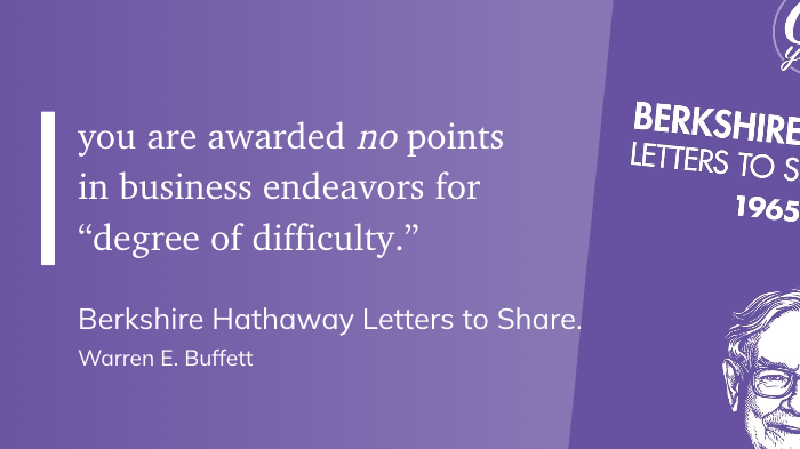
- Summary: Buffett’s reminder that complexity doesn’t increase returns.
- Why it Matters: It’s an antidote to the “smartest guy in the room” syndrome.
- My Take: Complexity is a tax on your attention. Seek the simplest path to the highest return.
Useful Not True#
Almost nothing people say is true
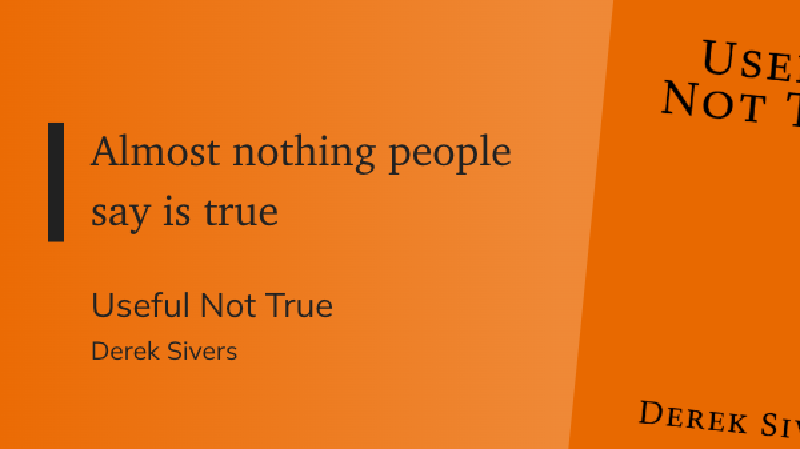
- Summary: Sivers argues that truth is often less important than utility.
- Why it Matters: It shifts the focus from “right” to “effective.”
- My Take: Pragmatism is the ultimate filter. Stop looking for “the truth” and start looking for what works.
The Code of Capital#
Accumulating wealth over long stretches of time requires additional fortification that only a code backed by the coercive powers of a state can offer.
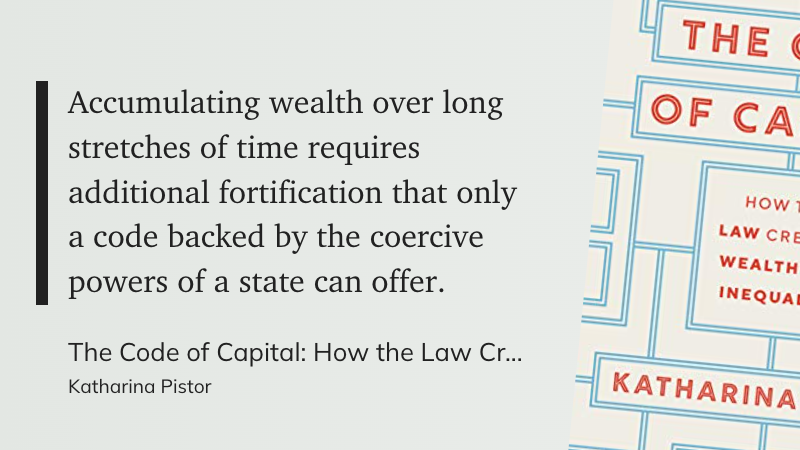
- Summary: Pistor explains how law is the essential ingredient that turns assets into capital.
- Why it Matters: It reveals the hidden legal infrastructure of global wealth.
- My Take: Law is the original source code. If you don’t understand the legal coding of your assets, you don’t really own them.