
This week, the signals are clear: we are in a massive, systemic re-coding of our financial and intellectual operating systems. From the 500-year-old foundations of bookkeeping to the cutting-edge of photonic computing, the theme is the same: Efficiency is the new strategy. Whether it’s Andrej Karpathy building LLM knowledge bases or Ramp reimagining the Venetian friar’s double-entry system for the AI age, the shift is from manual, human-centric processes to automated, high-velocity intelligence.
On Social#
Wow, this tweet went very viral!
— Andrej Karpathy (@karpathy) April 4, 2026
I wanted share a possibly slightly improved version of the tweet in an "idea file". The idea of the idea file is that in this era of LLM agents, there is less of a point/need of sharing the specific code/app, you just share the idea, then the… https://t.co/4UAmYYFzCw
- Summary: Karpathy discusses using LLMs to build personal knowledge bases, shifting from code manipulation to token-based knowledge management.
- Why it Matters: This represents a fundamental shift in personal productivity and cognitive leverage, moving from information storage to semantic retrieval.
- My Take: Knowledge is an API. We are moving into an era where the value of information is defined by its accessibility to an agent.
In 2013, Harvard professor Clayton Christensen gave a 59-minute masterclass at Oxford on why smart companies destroy themselves.
— andrew engler (@aerockrose) April 4, 2026
His frameworks:
- The seminary of new finance
- The steel mill death spiral
- The $35 plastic box that changed India
12 lessons on disruption: pic.twitter.com/1T0FY2lwTG
- Summary: A 12-lesson thread distilling Clayton Christensen’s Oxford masterclass on why smart companies destroy themselves.
- Why it Matters: These frameworks, the seminary of new finance and the steel mill death spiral, remain the foundational logic for understanding platform shifts.
- My Take: Disruption is a design choice. Leaders who ignore the logic of new finance are essentially designing their own obsolescence.

Photonic Computing: The Final AI Hardware Frontier
- Summary: An exploration of optical computing as the next AI hardware frontier, potentially bypassing the silicon and power bottlenecks that constrain current GPU scaling.
- Why it Matters: The compute moat is the primary constraint on AI scaling. If photonic computing matures, the cost of intelligence will drop by orders of magnitude.
- My Take: Light is the new Silicon. The hardware frontier is shifting from electronic switching to optical matrix multiplication.
532 Years
- Summary: The story of Luca Pacioli and how Ramp is using AI to automate the 15th-century bookkeeping system that still runs the world’s businesses.
- Why it Matters: Finance is the ultimate “old code” in need of a refactor. Automating the ledger is the first step toward the real-time enterprise.
- My Take: Automation is the new Ledger. Double-entry was a human solution for human errors; AI solves the trust problem at the protocol level.
Longer Reads#
Why Losing Money Was the Smartest Strategy#
- Author: Guy Raz
- Summary: The story of Marc Lore and the aggressive market positioning that led to the acquisition of Diapers.com and the founding of Jet.com.
- Why it Matters: It highlights the brutal reality of “corporate warfare” and the strategic use of capital to force market consolidation.
- My Take: Strategy is the cost of entry. Sometimes the most aggressive move is the only one that secures survival.
Books#
Underwriters of the United States#
Insurance is a quintessential practice of capitalists. Insurers also aggregated valuable information on the plight of the American merchant fleet, which the new American state had no infrastructure to collect on its own.

- Summary: Explores the overlooked role of maritime insurance in the American founding and state formation.
- Why it Matters: Shows how private financial infrastructure often precedes and stabilizes state power, providing the data that states cannot collect.
- My Take: Insurers are the original nation builders. Information aggregation has always been the real source of power in finance.
The Code of Capital#
Capital, I argue in this book, is coded in law. These legal modules, namely contract, property rights, collateral, trust, corporate, and bankruptcy law, can be used to give the holders of some assets a comparative advantage over others.
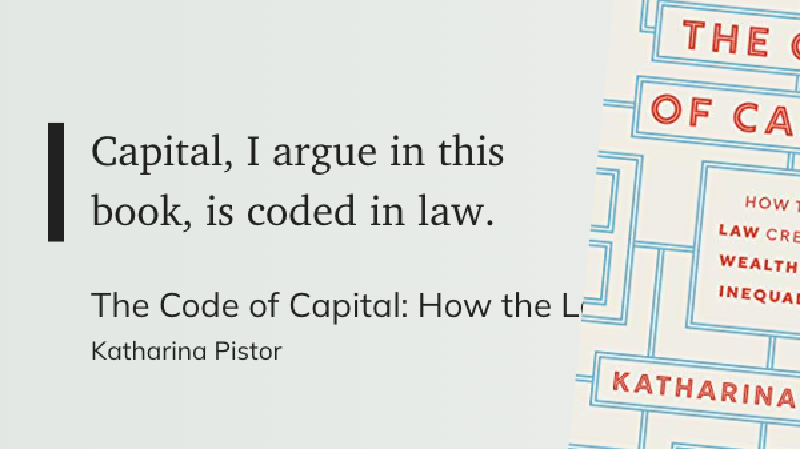
- Summary: A deep dive into how the legal system codes assets into capital, effectively creating wealth through legal privilege.
- Why it Matters: Reminds us that “capital” is a legal construct, not just a physical one. To change the economy, you have to change the code.
- My Take: Law is the operating system of Capitalism. We are seeing this code being rewritten in real-time through smart contracts and digital assets.
Looking for more? You can explore the archives of previous fast-twitch market observation and insights on the Signals page and have them delivered directly to your inbox going forward:
You're on the Pulse.
Success! Now check your email to confirm your subscription.
If these market observations are relevant to the operations of, or innovation at, your organization and you want to discuss these further and more indepth, let’s talk.
Book a Call