
The common thread this week is the tension between capability and execution. In AI, we’re seeing the “uncomfortable truth” that current LLMs react rather than reason, posing limits on autonomous agents. In leadership, the focus returns to systematic rigor: whether it’s Alan Mulally’s “design job” approach to Ford or the realization that 99% of business books are noise. We are moving from a phase of exuberant exploration to one of hardened implementation.
On Social Media#

LLMs Don't Reason, They React
Summary: A new paper from Google DeepMind, Meta, and others argues that most “AI agents” are merely reactive token generators, not reasoning entities. They mimic smarts without the underlying cognitive architecture.
Why it Matters: We are rushing to deploy agents into critical workflows. If they are fundamentally reactive, their failure modes will be brittle and unpredictable. Building “Agency” requires more than just scaling inference; it requires a new architecture for planning.
My Take: Reasoning is the moat. The next wave of value won’t come from faster tokens, but from models that can stop, think, and self-correct before acting.
99% of business books are trash and should be blog posts
— mert (@mert) January 23, 2026
I've wasted a lot of time reading stupid ones, here are the ones that are actually useful:
- only the paranoid survive (grove)
- amp it up (slootman)
- hard thing about hard things (horowitz)
- score takes care of itself…
Summary: A harsh but fair assessment that 99% of business books should be blog posts. The few exceptions listed—Only the Paranoid Survive, Amp It Up, The Hard Thing About Hard Things, The Score Takes Care of Itself—focus on the visceral reality of operating.
Why it Matters: As information costs drop to zero, curation becomes the primary value driver. For CEOs, the opportunity cost of reading bad advice is higher than the price of the book.
My Take: Read the operators. Ignore the observers. If the author hasn’t stared into the abyss of payroll on a Friday with no cash, their advice is likely academic.

The Silicon Valley Canon
Summary: An analysis of the books that shaped the worldview of Silicon Valley leaders. It questions what these texts reveal about the industry’s shift toward “national responsibility.”
Why it Matters: Technology is no longer neutral; it is the substrate of geopolitics. Understanding the inputs (the canon) helps predict the outputs (policy and product direction) of the world’s most powerful companies.
My Take: Ideas have consequences. The shift from libertarian idealism to techno-nationalism is visible in the reading lists of the elite before it appears in legislation.
More on our experiments here: https://t.co/rze6VX3eov
— Michael Truell (@mntruell) January 14, 2026
Summary: Cursor sharing experiments on “long-running autonomous coding.” This is the shift from “copilot” (human-in-the-loop) to “agent” (human-on-the-loop).
Why it Matters: The cost of software maintenance is about to collapse. When code can fix itself, technical debt is no longer a permanent liability, but a queue for the agents.
My Take: Delegation is the new coding. The skill of the future isn’t syntax; it’s specification and review.

The Yen Carry Bomb
Summary: A deep dive into the Yen carry trade and its potential to destabilize global liquidity markets.
Why it Matters: In a hyper-connected financial system, a rate change in Tokyo can liquidate a portfolio in New York. This is the macro risk lurking beneath the AI bull run.
My Take: Liquidity is oxygen. You don’t notice it until it’s gone. Keep an eye on the BOJ; they are the butterfly that causes the hurricane.
Long Form Articles#

Summary: Ben Thompson analyzes Netflix’s dominance and the physical constraints of chip production (TSMC) for the AI boom.
Why it Matters: We are hitting the hard limits of physics (energy, capacity) and attention (hours in the day). The companies that solve these constraints—or own the distribution—win.
My Take: Scale is the only strategy. In a world of abundance, only the massive aggregators (Netflix) or the singular suppliers (TSMC) have pricing power.

Peter Steinberger is the creator is Clawdbot, an open-source, self-hosted, and privacy-focused personal AI assistant designed to run 24/7 on your own hardware (laptop, server, etc.). It is behind the current trend amongst tech fans of using the M4 Mac Mini to host it.
Summary: Notes from the trenches of building AI-powered tools. A focus on the practical, “boring” engineering required to make GenAI reliable.
Why it Matters: The “magic” of AI is 10% model and 90% plumbing. We need more AI Engineers and fewer AI Philosophers.
My Take: Reliability is a feature. The gap between a demo and a product is filled with error handling, evaluations, and boring code.
Books#
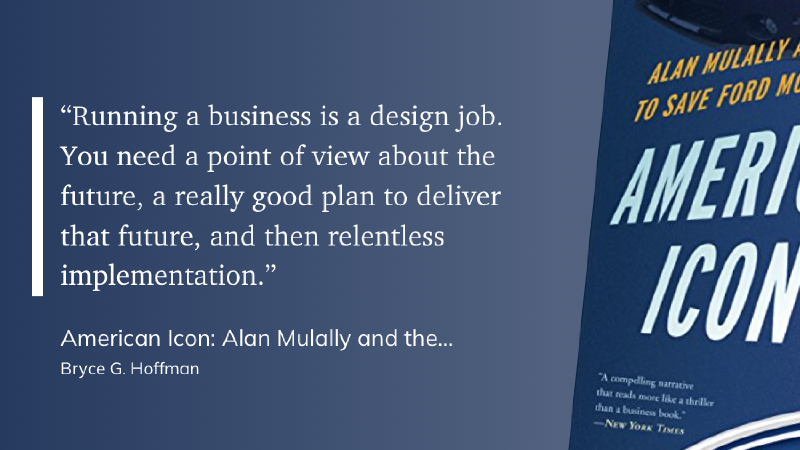
Summary: Alan Mulally’s philosophy that turned around Ford. (From American Icon)
Why it Matters: It reframes the CEO’s role from “manager” to “architect.” You aren’t just driving the car; you are designing the traffic system.
My Take: Business is Design. If the system is broken, the output will be broken. Fix the design, not the symptom.
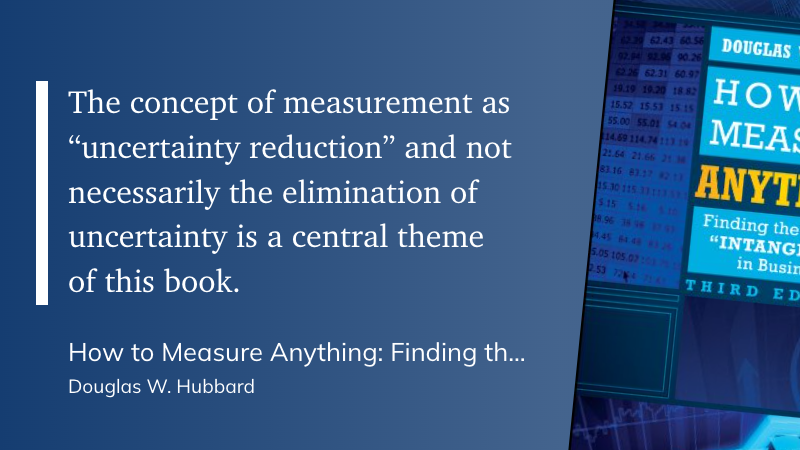
Summary: Redefining measurement not as finding an exact number, but as reducing the margin of error. (From How to Measure Anything)
Why it Matters: Executives often freeze because they can’t get “perfect” data. This mindset shift allows for speed in decision making by accepting calibrated estimates.
My Take: Measure to Decide. If a measurement doesn’t change a decision, it has zero value. Stop measuring vanity metrics.
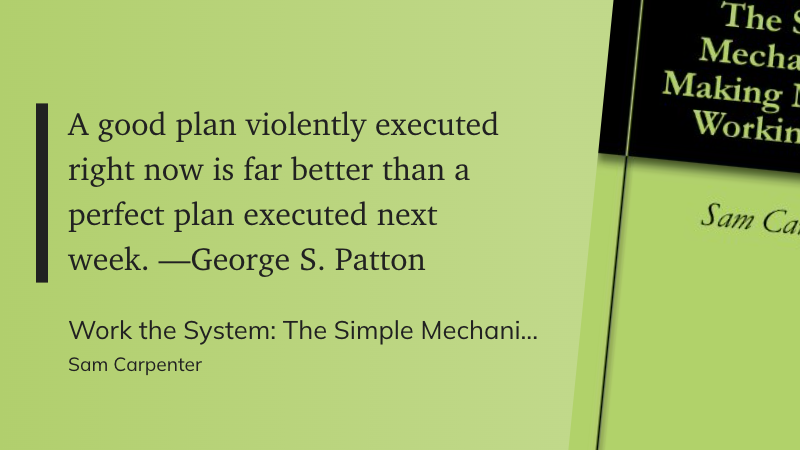
Summary: A classic reminder that speed and momentum often outweigh precision. (From Work the System)
Why it Matters: In a fast-moving market, latency is the enemy. A perfect plan for a market that has already moved is a failed plan.
My Take: Action Over Perfection. You can steer a moving ship; you can’t steer one that’s sitting in the dock.