
In the world of coding, Python has always been a bit of a chameleon: easy to learn, widely used by data scientists, and now a favorite of the “vibe coders” who mix a little (or a lot!) of generative AI into their workflow.
Before we dive into the tools that keep Python projects tidy, it’s worth taking a quick look at why Python became the go-to language in the first place.
Python’s readability and rich ecosystem of libraries made it the darling of the data science world. And today, with the rise of AI tools, Python has become the playground for everyone—from traditional developers to newcomers leveraging AI to help them code. For more on the history of Python’s popularity, see the Python documentary in the Carve Outs section.
As I’ve been using Python more seriously, I’ve had to figure out the tools and frameworks to manage my code. Like many, I’m exploring and learning as I go. And along the way, I discovered why Python’s flexibility is both a blessing and a bit of a puzzle to solve. That puzzle usually shows up the moment a project breaks after a pip install, or when code that worked yesterday suddenly doesn’t today.
Sharing the overall context here (“big picture”). There are many great resources with more details, tutorials and implementation steps. I won’t be recreating that material here. With the big picture, hopefully it provides the context within which to best leverage these resources. I have provided some links to these in the context setting that follows.
Why Does Dependency Hell Happen in Python?#
So why does this whole dependency-management challenge pop up so often in Python?
At its core, Python has a philosophy of being easy to learn and easy to share. That philosophy is a big part of what makes the ecosystem so vibrant and dynamic. There are packages for almost anything you want to do, and that’s fantastic. But it also means that different projects can quickly end up needing different versions of the same package. When it’s that easy to pull in dependencies, version conflicts become almost inevitable.
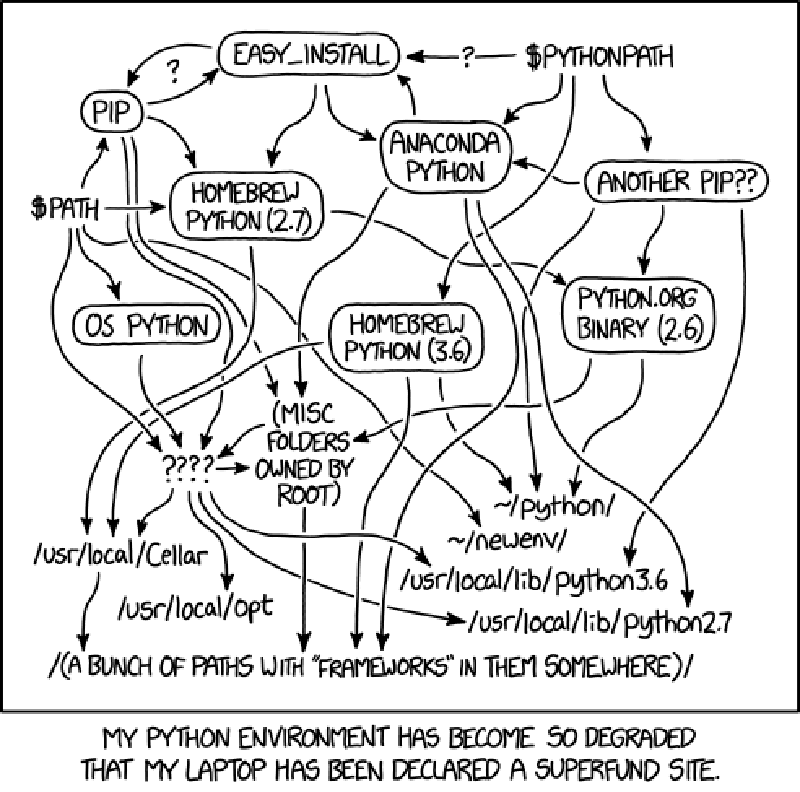
Other languages can face similar issues, but Python’s ecosystem and design choices make this more visible:
- Breadth and popularity: Python is used for everything from web apps to data science to scripting. That breadth means massive reuse of third-party packages—and frequent version clashes.
- Contrast with lower-level languages: Languages like C or C++ have historically taken a more monolithic or manual approach. Dependencies are often handled via build systems and compilation rather than a central package index. (That’s changing with tools like Conan and vcpkg, but the culture is different.)
In short, Python’s dependency challenges are not a flaw so much as a side effect of its success.
A Similar Story in Node.js and npm#
It’s not just Python.
If you’ve ever worked with Node.js and npm, you’ll recognize the same pattern. Node’s ecosystem shares a similar philosophy: make it incredibly easy to reuse and distribute code. That speed and flexibility unlocked massive innovation—but also created dependency sprawl.
Just as Python evolved virtual environments and lock files, Node evolved node_modules, package.json, and eventually lockfiles for the same reason: fast reuse comes with coordination costs. Modern ecosystems trade simplicity at the start for tooling complexity later.
The Evolution of Python Tools: From Virtualenv to UV#
As I was teaching myself how to handle all this, I discovered that Python’s tooling didn’t appear all at once—it evolved in layers, each solving a specific pain point.
It started with virtual environments to isolate dependencies. Then tools like pyenv helped manage Python versions themselves. Poetry came along to simplify dependency management and packaging. And most recently, Astral’s UV has pushed things even further with a focus on performance and developer experience.
Each tool didn’t replace the previous one outright—it responded to what still hurt.
Virtual Environments#
In the early days, Python developers quickly found themselves in the aforementioned dependency hell. Different projects needed different versions of the same libraries, and installing everything globally was a recipe for breakage.
Virtual environments were the first real hero. They allowed each project to live in its own sandbox, with its own dependencies, without interfering with the rest of your system.
If you want a practical walkthrough, this detailed tutorial on virtual environments does a great job of explaining the mechanics.
Pyenv and Version Management#
Virtual environments solved package conflicts, but not Python version conflicts. Older macOS versions (pre-12.3) came with Python 2.7 pre-installed, intended for Apple’s internal system tools. In modern macOS versions (12.3 and later) Apple has removed Python from the default operating system installation.
However, if you have installed the Xcode Command Line Tools, you will have a version of Python 3 (e.g., Python 3.9.6) installed as a dependency for the developer tools. This version is intended for system use, not for general development, and it is recommended to install a separate, up-to-date Python version for your projects. Confusing?
That’s where pyenv comes in. Need Python 3.7 for one project and 3.11 for another? pyenv makes installing and switching between them straightforward, without touching your system Python.
This Real Python guide offers a clear, hands-on explanation of how it works and why it matters.
Poetry: The Story Behind the Tool#
Poetry was created by Sébastien Eustace, who saw that Python developers were still stitching together too many tools: pip, requirements.txt, setup.py, and virtual environments—often by hand.
Poetry’s key insight was to treat the project as the first-class object, not just the environment. By unifying dependency management, packaging, and environment handling around a single pyproject.toml file, Poetry dramatically reduced friction and inconsistency.
It wasn’t just a new tool—it was a cleaner mental model. Poetry filled the gaps that older tools left open and became a favorite for modern Python projects.
UV: The Next Evolution#
Now, let’s talk about Astral’s UV.
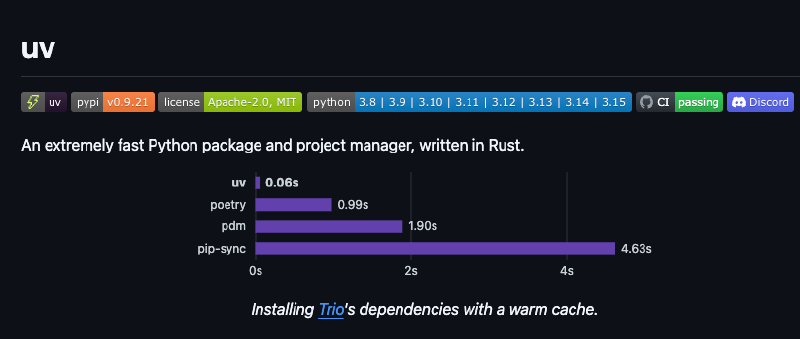
UV is the brainchild of Astral’s founder Charlie Marsh, driven by a simple question: what if Python tooling were both simpler and dramatically faster? The answer was to rebuild core pieces of the workflow in Rust.
By writing UV in Rust, the team focused on speed, low overhead, and predictable behavior. In practice, this shows up as dramatically faster installs and dependency resolution—especially noticeable in larger projects and CI pipelines.
UV takes the lessons learned from virtualenv, pyenv, and Poetry, and pushes them further. It’s less about adding features and more about removing friction. Datacamp has a great UV tutorial which also covers the difference between UV, Poetry, PIP, Conda, and virtualenv.
Conclusion#
Hopefully, this gives you a big-picture understanding of why Python (and ecosystems like Node.js) struggle with dependency complexity—and how the community has steadily evolved better tools to cope with it.
I didn’t know any of this upfront. I learned it by breaking things, fixing them, and gradually understanding why these tools exist in the first place.
The journey from virtualenv to UV is really the story of Python’s community continuously refining the developer experience. Each tool isn’t just a replacement, but an evolution—driven by developers who felt the pain and believed there had to be a better way.
If you want to go further, here are a few entry points into Python’s broader role in AI and vibe coding:
- Stanford CS146S: the first comprehensive university course covering how coding LLMs are transforming every stage of the software development life cycle. “The assignments are intended to take you from noob to expert in how to use AI to improve your software engineering productivity.”
- Introductions to LangChain and agentic AI libraries
- Top Python-based resource for deep learning
For me, learning these tools wasn’t about mastering Python. It was about understanding how modern software ecosystems evolve when speed, collaboration, and experimentation are the priority. If you’ve ever wondered why Python feels both magical and messy, you’re not alone.
Carve Outs#
The Story of Python and how it took over the world. I enjoyed this documentary on what “began as a side project in Amsterdam during the 1990s became the software powering artificial intelligence, data science and some of the world’s biggest companies. But Python’s future wasn’t certain; at one point it almost disappeared.” Perhaps this provides some historical insights on the trade-offs mentioned above: