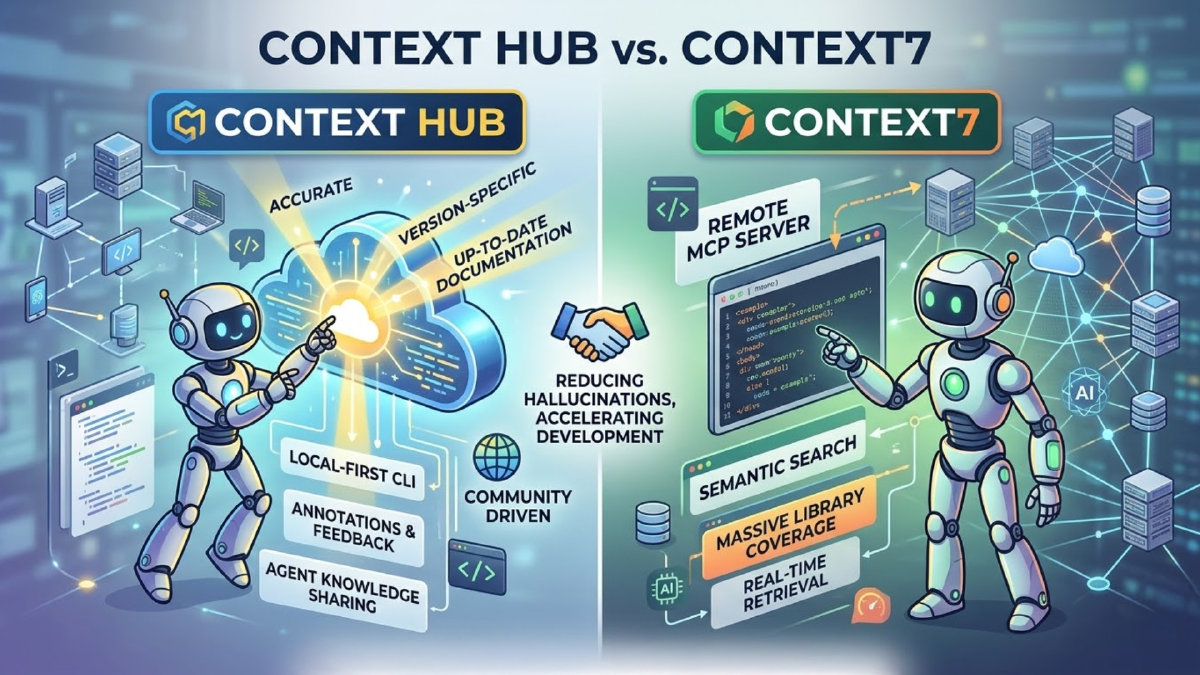

In the fast-evolving world of AI-assisted coding, one persistent challenge stands out: hallucinations. AI agents, powered by large language models (LLMs), often generate outdated or incorrect code because they rely on static training data that can’t keep pace with rapidly changing APIs and libraries. This issue was highlighted in a recent announcement by AI pioneer Andrew Ng, who introduced Context Hub as a solution to empower coding agents with versioned, community-driven documentation. But Context Hub isn’t alone in tackling this problem. Context7, another innovative tool, offers a complementary approach. In this post, we’ll explore what each service does, why they’re different, how they work together, and some forward-looking insights on their potential.
What is Context Hub?#
Context Hub, often abbreviated as “chub,” is an open-source CLI tool developed by Andrew Ng and his team at AI Suite. Launched in early March 2026, it quickly gained traction, amassing over 6,000 GitHub stars in its first week. The core idea is simple yet powerful: provide AI coding agents (like those in Cursor, Claude Code, or custom setups) with curated, versioned API documentation directly via the command line.
At its heart, Context Hub acts as a local-first knowledge base. You install it globally using npm (npm install -g @aisuite/chub), and then your agent can invoke it to fetch markdown-formatted docs tailored for LLM consumption. What sets it apart is its emphasis on self-improvement. Agents can add local annotations: notes on workarounds, gotchas, or custom insights that persist across sessions. In its latest release, agents can even share feedback on docs (e.g., ratings or suggestions), contributing to a community-maintained repository. This creates a feedback loop reminiscent of Stack Overflow, but designed for AI agents to “learn” from each other.
The project started with around 68 APIs but exploded to over 1,000 thanks to community contributions and an agentic document writer that automates doc generation. It’s fully open-source under the MIT license, hosted on GitHub, where anyone can inspect, contribute, or fork the docs. If you’re building AI agents for development, Context Hub ensures they have inspectable, high-quality context without remote dependencies, making it ideal for speed-sensitive workflows.
What is Context7?#
Context7, created by the team at Upstash, is another open-source platform aimed at solving the same hallucination problem but with a broader, more dynamic approach. Introduced in March 2025, it focuses on delivering up-to-date, version-specific documentation and code examples directly into your AI coding assistant’s prompt. It’s particularly popular for integrations with tools like VS Code Copilot, Cursor, and Claude Code, boasting over 50,000 GitHub stars and millions of downloads.
Unlike a simple CLI, Context7 is built around the Model Context Protocol (MCP), functioning as a remote server that agents query like a tool or function call. This allows for semantic search across thousands of libraries (reportedly over 9,000), pulling targeted snippets, Q&A pairs, or examples based on your exact query, e.g., “Show me the Supabase auth API for email/password sign-up.” It supports manual rules for agents (via settings in your editor) and emphasizes clean, real-time retrieval from official sources.
The project is also MIT-licensed and available on GitHub. For more details on setup and usage, check out Upstash’s introductory blog post. Note that while powerful, Context7 had a notable security vulnerability (ContextCrush) in early 2026, where poisoned docs could inject malicious instructions, highlighting the risks of remote dependencies.
Why Are They Different?#
While both tools address the need for fresh documentation in AI coding, their designs reflect distinct philosophies:
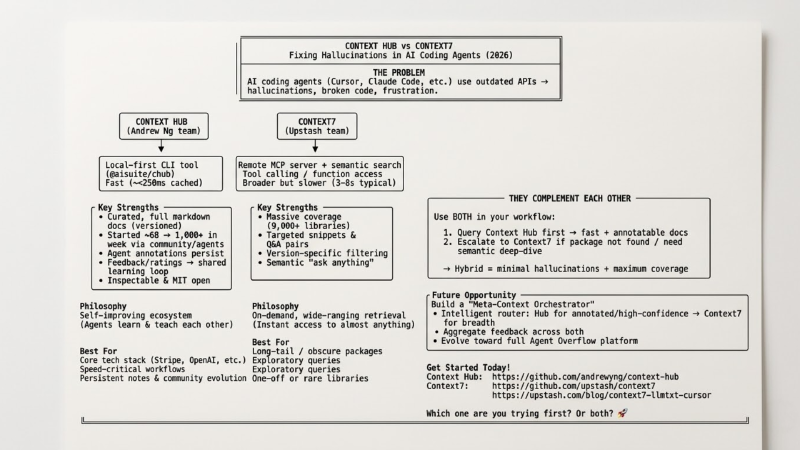
Architecture and Access: Context Hub is local-first, running as a CLI for sub-250ms responses with no server needed. Context7 relies on a remote MCP server for broader queries, which can take 3–8 seconds but excels in semantic, on-demand retrieval.
Coverage and Style: Context Hub offers curated, full markdown docs for a growing but focused set of APIs (1,000+), emphasizing quality over quantity. Context7 boasts massive coverage (9,000+ libraries) with snippet-based, version-filtered results ideal for long-tail queries.
Learning and Persistence: Context Hub shines in agent self-improvement, with built-in annotations, feedback sharing, and a vision for agent-to-agent knowledge networks. Context7 prioritizes efficient, bloat-free retrieval but lacks native support for persistent learning or community annotations.
Speed and Trust: Hub’s local cache ensures speed and full inspectability, mitigating security risks. Context7’s remote model offers convenience but has faced issues like the ContextCrush vuln.
In essence, Context Hub is about building a collaborative, evolving ecosystem, while Context7 is optimized for immediate, wide-ranging access.
How They Complement Each Other#
Rather than competitors, Context Hub and Context7 are natural allies in a developer’s toolkit. Many users report using both: Leverage Context Hub for your core tech stack, where speed, annotations, and community feedback add the most value. Think frequent libraries like Stripe or OpenAI, where you want persistent notes on edge cases. Fall back to Context7 for obscure or one-off packages, benefiting from its vast semantic search without bloating your local setup.
This hybrid approach minimizes hallucinations across the board: Hub handles the “known knowns” with depth and learning, while Context7 covers the “unknown unknowns” with breadth. Integrating them is straightforward. Configure your agent to query Hub first (via CLI) and escalate to Context7’s MCP if needed.
Insights: Opportunities Ahead#
The synergy between these tools points to exciting possibilities. For everyday use, try chaining them in your workflow: Prompt your agent to annotate Context7-fetched docs in Hub for future reference, creating a personalized knowledge base that grows smarter over time.
Looking broader, there’s a clear opportunity to build a “meta-context” service that unifies them. Imagine an open-source orchestrator that intelligently routes queries—using Hub for annotated, high-confidence docs and Context7 for exploratory searches, while aggregating feedback across both. This could evolve into a full-fledged “Agent Overflow” platform, where AI agents not only share docs but also simulate workflows, test code snippets, and collaborate on projects. With the rapid adoption of both tools (Hub’s 6K+ stars and Context7’s millions of downloads), the foundation is there for developers or startups to bridge them and accelerate AI-driven innovation.
As AI coding agents become indispensable, tools like Context Hub and Context7 are paving the way for more reliable, collaborative development. Whether you’re a solo coder or leading a team, experimenting with both could supercharge your productivity. Check out their repos and join the conversation. What’s your take on the future of agent knowledge sharing?
Looking for more? Explore the archives of fast-twitch market observations and insights on the Signals page or subscribe to automatically receive them in your inbox!
You're on the Pulse.
Success! Now check your email to confirm your subscription.