

Most sites treat categories and tags as a filing exercise. That is how they end up with 30 categories, hundreds of one-off tags, and no useful path from one idea to the next.
I use them differently, and so should you! Categories state the durable role of a post on this site. Tags connect the recurring ideas that cut across that structure. Together, they turn a growing archive into an intelligible body of work.
What are categories and tags actually for?#
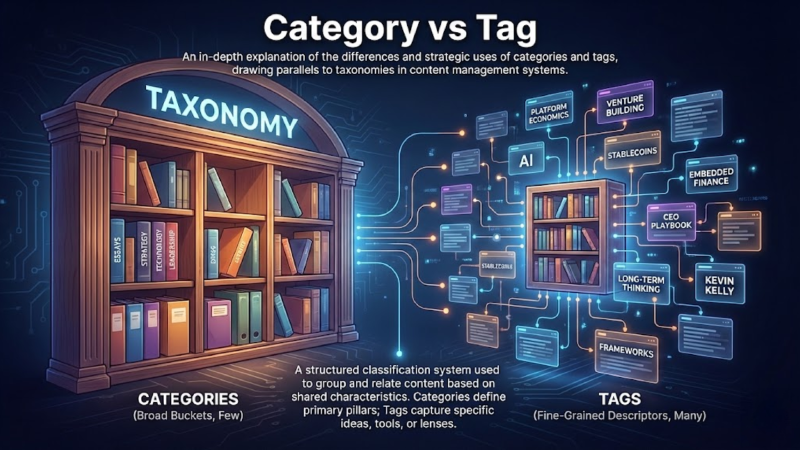
Both are taxonomies, which are classification systems for expressing relationships between content. Hugo (the site generator I use) makes that explicit: a taxonomy groups content under terms and automatically creates pages for those terms.
The mechanics are straightforward. The editorial decision is harder. A taxonomy only helps when its terms remain stable enough to mean something, and specific enough to guide a reader to the next useful piece of work.
For this site, the division is deliberate:
- Categories describe my role and the durable pillars of the work.
- Tags describe the concepts, domains, practices, and sources that recur across those pillars.
That distinction keeps the navigation legible while giving the archive a real semantic graph (which is a fancy way of saying a web of connected ideas based on what they mean).
Why should categories stay broad and stable?#
Categories are the macro-structure. A reader should be able to see them in a navigation bar and immediately understand the kind of work I do.
This site uses a single approved category per post. Strategy, Technology, Fintech, and Venture Building are useful because they can hold years of writing without becoming vague. AI, Innovation, and Blog are not categories. They are topics, claims, or empty labels.
If I need a new category every month, I have not discovered a new pillar. I have avoided making a classification decision.
categories:
  - Technology
How should tags build a useful knowledge graph?#
Tags do the connective work. They should cross category boundaries and reflect concepts I expect to return to, such as systems-thinking, knowledge-management, platform-economics, or board-governance.
The test is practical: would I want a landing page for this tag, and can I credibly use it across at least ten posts? If not, it is probably a detail, not a tag.
For example, hugo is useful when a post is materially about the platform. taxonomy is useful when a post examines how knowledge is organized. A tag such as publishing-thoughts-2026 is not useful. It creates an archive page with no future.
tags:
  - systems-thinking
  - taxonomy
  - hugo
  - knowledge-management
  - digital-transformation
This is also why I avoid treating every keyword as a tag. A tag is an editorial commitment to an intellectual thread, not a search index.
What does the decision look like on a real post?#
Take a post about a new Hugo capability that lets readers carry clean Markdown into their own working context. Its category is Technology because that states the role of the work. Its tags could include hugo, knowledge-management, and software-engineering because those threads recur elsewhere on the site.
The Copy Page feature is a concrete example. The implementation is small, but the editorial point is larger: structured source material becomes more useful when readers and their agents can work with it directly.
When should I create a new taxonomy instead?#
Do not create a new taxonomy because the existing ones feel inconvenient. Create one only when the site needs a genuinely different browsing lens with its own rules and landing pages.
For example, a series taxonomy can make sense for a deliberate multi-part body of work. A role taxonomy could make sense if executives, operators, and investors need distinct paths through the archive. A redundant topics taxonomy usually does not. It often duplicates tags without solving a reader problem.
Many content management systems (like Hugo) support custom taxonomies, but the framework does not supply the governance. That is the editorial work. The same principle applies to the wider platform: the architecture of attention matters because structure determines what readers can discover, connect, and act on.
What are the common mistakes?#
- Creating categories that describe a passing topic rather than a durable role.
- Adding tags that appear once and never build a reader path.
- Using categories and tags interchangeably because the CMS permits both.
- Creating a custom taxonomy before proving that categories and tags cannot do the job.
- Letting front matter drift away from the site’s published governance.
The last mistake is the most expensive. Weak labels do not fail loudly. They quietly turn an archive into a pile of isolated pages.
How do I keep the system useful as the site grows?#
Review the taxonomy periodically. Retire labels that never gained a body of work. Do not invent replacements merely to make a dashboard look complete. Keep the categories narrow and durable; use tags only where there is a real recurring thread.
That discipline is the difference between discovery and knowledge. From Discovery to Knowledge makes the same point in a different context: more information does not create understanding until someone imposes judgment, context, and accountability.
Frequently Asked Questions
? Can a post have more than one category?
? How many tags should a post have?
? When is a new tag justified?
Is there a video associated with this article?#
If you enjoy watching more than reading, check this out: