
From Meta’s “Founder Mode” to Lockheed’s Skunk Works: the definitive list of business lessons from the year in podcasts. These episodes from 2025 featured deep dives into tech giants, historical epics, and masterclasses in business building. These episodes explain how the world’s best companies are reinventing themselves.
Meta: The “Founder Mode” Pivot at Scale#
This episode offers a comprehensive history of Facebook’s evolution into Meta. It traces Mark Zuckerberg’s journey from the Harvard dorm room to leading one of the world’s most valuable companies. The hosts break down the brilliance behind the acquisitions of Instagram and WhatsApp, the company’s aggressive pivot to AI and the Metaverse, and the unique “founder mode” leadership style that allows Zuckerberg to bet the company on the next big technology shift.
I am not a Facebook user, but I am a Meta user (WhatsApp). Apparently, I am one of four billion monthly active users of Meta products, almost half of the entire world’s population! It also made for a great movie. Hard to believe that the movie about Facebook is already 15 years old:
The Innovation Lesson: Constraint as a Growth Engine#
My fascination with their early engineering isn’t just nostalgia; it’s a lesson in strategic friction. By strictly limiting access (one school at a time), Facebook didn’t just solve a technical scaling problem; they solved the “cold start” problem that kills most networks. In the age of AI, where everyone is rushing to be “open” to everyone immediately, Meta’s history proves that density beats breadth. A small, highly engaged network is infinitely more valuable than a massive, shallow one:
- School-by-School Rollout wasn’t just a technical necessity; it was a massive product and engagement advantage. By launching one school at a time (e.g., Harvard, then Stanford, then Yale), they ensured that even with a small total number of users, the local density was 100%. If you were a student at that school, everyone you knew was on it. The site immediately felt “alive” and addictive because the content was relevant to your actual real-world social life. This also created FOMO and demand at schools yet to be covered. On the technical side it solved for identity. Because every user was verified as a real student at your specific school, there was an implicit barrier to entry that kept out anonymous trolls and strangers.
- One Server Per School (Sharding): In the very early days, Facebook’s architecture was effectively “sharded” by university. This meant that each school effectively had its own server (or set of servers) and database. This architecture allowed them to scale linearly; to launch a new school, they simply added a new server for that specific university. This physical separation meant that if traffic spiked at Harvard, it wouldn’t crash the site for students at Stanford.
- The “LAMP” Stack: They utilized the standard LAMP stack (Linux, Apache, MySQL, PHP), which was simple, cheap, and allowed for rapid iteration. They prioritized shipping features quickly over code perfection, famously pushing code that was “good enough” to keep the site running.
- Performance via Isolation: By isolating user bases (you could initially only see profiles within your own school), they avoided the complex engineering challenges of a massive, globally interconnected graph. This bought them time to build the more complex, unified architecture later as they opened up to high schools and eventually the general public.
Listen to the episode:
Google: Managing the Innovator’s Dilemma in Real-Time#
A massive, multi-part saga covering the complete history of Google.
- The Origin of Search: Chronicles the early days of Larry Page and Sergey Brin at Stanford, the development of the PageRank algorithm, and the business model innovation that turned search into a money-printing machine.
- Alphabet: Covers the explosion of products beyond search: Gmail, Google Maps, Chrome, Android, and YouTube, and the restructuring into Alphabet to manage this sprawling empire.
- The AI Company: Focuses on Google’s deep roots in artificial intelligence (including the acquisition of DeepMind and the invention of the Transformer), its “innovator’s dilemma” in the face of OpenAI, and its current all-out push to win the generative AI war.
The Strategy Lesson: The Incumbent’s Trap#
Having used Google tools from Writely to Gemini, the pattern is clear: Google is rarely the first to invent (search existed before them; cloud docs existed before them), but they are usually the best at scaling it. However, the AI shift is different. This isn’t just a technology shift; it’s a business model conflict. Their 2022 “Code Red” wasn’t about technology, afterall, Google invented the Transformer. It was about the Innovator’s Dilemma. The lesson for 2026: You cannot defensive-moat your way to victory when the underlying unit of economics (ads vs. answers) is changing.
The episodes:
Magnolia: The Power of Authenticity Over Scale#
Guy Raz interviews the power couple (Chip & Joanna Gaines) behind the Fixer Upper phenomenon. The episode details how they transformed a small remodeling business in Waco, Texas, into a media and retail empire. They discuss the challenges of sudden fame, the decision to walk away from their hit TV show at its peak to focus on their family and business health, and how they built the Magnolia brand on authenticity and faith.
The Brand Lesson: Vertical Integration of Attention#
I never thought about it this way, but home renovation and construction was a big part of my formative years. When I was young, my family built a sizable addition to our house, and my father did much of the work himself to save money! I learned so much about the whole process: from framing and insulation to plumbing, electrical, drywall, and tiling.
My appreciation for the “craft” of building mirrors what the Gaineses did with their business. Most media personalities rent their audience to networks. Chip and Joanna vertically integrated their attention economy, moving from being talent on a TV network to owning the network, the retail experience, and the product lines. In a creator economy, the ultimate strategic move isn’t getting famous; it’s converting fame into a proprietary distribution channel that you control.
Listen to the episode:
Stratechery: Aggregation Theory & The Business of Insight#
Ben Thompson, the author of the influential tech newsletter Stratechery, joins the show to discuss his own business journey. They explore the “Aggregation Theory” framework he popularized, the history of the subscription media model he pioneered, and his analysis of the tech industry’s shifting landscape. It is a meta-conversation about the business of analyzing business.
The Media Lesson: The Unbundling of Expertise#
As a long-time reader of Stratechery, I’ve always appreciated its deep focus on tech strategy and highly recommend it as a resource. But what was truly fascinating was learning about the business of Stratechery: how Ben built his own newsletter tech before viable off-the-shelf solutions existed, the evolution of his platform, and how he successfully monetized it.
As a publisher, Ben Thompson’s story resonates because it validates the “N of 1” company. Stratechery proves that in the digital age, you don’t need a newsroom to build a media empire; you need a unique viewpoint and a direct billing relationship. The strategic takeaway here is about Sovereign Writing: owning the tech stack means owning the customer relationship, which protects you from the algorithm changes that decimated traditional media.
Listen to the episode:
And speaking of the “business” behind these creators, the Acquired team (whose episodes are heavily featured in this top 10 list for 2025) just dropped their Holiday special: 10 Years of Acquired. It’s an equally compelling look at the fascinating business of Acquired, as well as the phenomenal content we all love to consume:
Bill Gurley: Why “Staying Private” Is Killing Innovation#
The Gift and The Curse of Staying Private
Legendary venture capitalist Bill Gurley (Benchmark) returns to discuss the state of the venture capital markets. He argues that the trend of companies staying private for too long has created “zombie unicorns” and reduced accountability. He also touches on the impact of AI, the regulatory environment, and why liquidity is essential for a healthy startup ecosystem.
The Venture Lesson: Liquidity is the Truth Serum#
Living and investing in Southeast Asia, Gurley’s warning about “Zombie Unicorns” is the reality we face daily. In markets with less developed capital, the possibility of exiting through an IPO feels even more distant. That’s why we focus so heavily on Distributed to Paid-in (DPI), sometimes even more than Total Value to Paid-in (TVPI), given the real challenges in securing an exit. This episode sparked a thought in my mind about the potential of tokenization to create secondary markets for companies that would otherwise remain strictly private. Until then, we are artificially inflating valuations without proving real value. Liquidity is the only honest metric.
Listen to the episode:
Lockheed Martin: How to Operationalize Radical Innovation#
This episode tells the incredible story of the Skunk Works division and its legendary leader, Kelly Johnson. It covers the development of aviation icons like the U-2 spy plane and the SR-71 Blackbird (the fastest plane ever built). The hosts also discuss the massive 1995 merger with Martin Marietta and the unique dynamics of the defense industry, blending engineering marvels with complex government strategy.
The Innovation Lesson: Structural Separation#
Listening to this episode was a perfect follow-up to having read Ben Rich’s Skunk Works: A Personal Memoir of My Years of Lockheed earlier this year. As a designer and operator of corporate innovation programs, I find this story is even more relevant today than it was when Lockheed started the Skunk Works division in 1943. The author’s own words resonate:
“Any company whose fortune depends on developing new technologies should have a Skunk Works in operation.”
This is the core of my philosophy on corporate innovation. You cannot ask the same team optimizing for quarterly efficiency to also invent the future—the incentives are too aligned against risk. Lockheed proves that radical innovation requires structural separation: a physical and bureaucratic air-gap between the “exploit” (core business) and “explore” (Skunk Works) teams.
Listen to the episode:
Nasdaq: A Masterclass in Tech Transformation#
Tech Innovation, Leadership and Fighting Financial Crime
Nicolai Tangen interviews Adena Friedman, the President and CEO of Nasdaq. She explains how Nasdaq transformed from a traditional exchange into a global technology company providing software to capital markets. The conversation highlights her leadership style, the role of cloud technology in modern finance, and Nasdaq’s efforts to use AI to detect and fight financial crime in real-time.
The Pivot Lesson: From Operator to Platform#
My meeting with Nasdaq President Tal Cohen in Manila earlier this year clarified a massive strategic shift: Nasdaq stopped trying to just be the market and started selling the market infrastructure. This is the ultimate SaaS pivot. If you are an operator in a complex, regulated industry (like finance or healthcare), the biggest growth opportunity might not be serving more customers, but software-izing your internal tools and selling them to your competitors. Don’t just dig for gold; sell the shovels.
Nasdaq today:
- Financial technology powers 35% of its business.
- Capital access platforms lead with 41%.
- Only 23% is traditional market services.
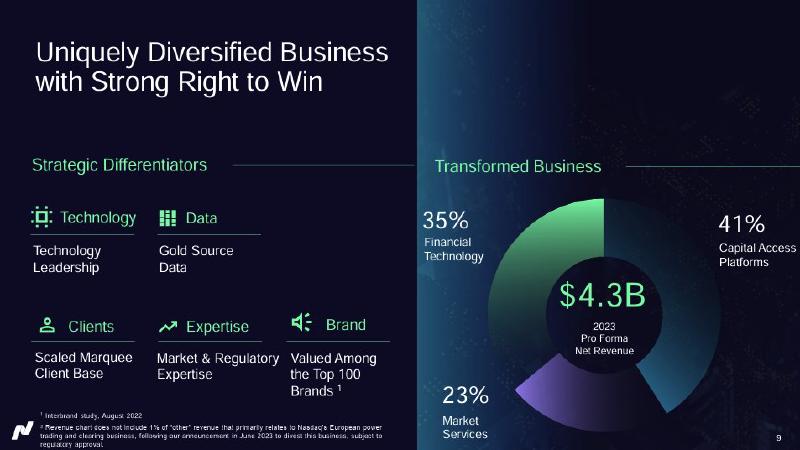
This isn’t evolution. This is transformation. It was great to hear more about how Nasdaq discovered that while they had technology assets, they were not a scaled player in that space. So they scaled up their tech and made some strategic technology acquisitions. Today most of their revenue comes from outside of being a market operator.
Listen to the episode:
The Last Viking: Strategic Risk & The Mercenary Mindset#
The Rest is History: The Last Viking (Parts 1-3)
A thrilling historical series on the life of Harald Hardrada, the “Last Viking.” The episodes follow his exile from Norway, his time as a mercenary commander in the elite Varangian Guard protecting the Emperor in Constantinople, and his accumulation of vast wealth. The saga culminates in his return to the North to claim the Norwegian throne and his fateful invasion of England in 1066, ending at the Battle of Stamford Bridge.
It cannot all be technology, venture capital and innovation! In high school, I remember voting in English class not to do another Shakespeare play. What we got instead was The Canterbury Tales. In hindsight, this middle English classic was much tougher than the relatively more modern Shakespeare. But it took us back a lot closer to the Norman invasion and that major pivot in English history. I have been fascinated ever since, and this was simply a very entertaining story on the lead up to that pivotal event.
The Leadership Lesson: Resource Staging for the Big Bet#
While this is history, it reads like a startup post-mortem. Harald Hardrada didn’t just invade England on a whim; he spent decades as a mercenary in Constantinople explicitly to accumulate the “Series C” capital required to launch his bid for the throne. It’s a lesson in strategic patience: sometimes you have to go abroad and grind in a high-risk environment (the Varangian Guard) to build the war chest needed for your ultimate vision.
The episodes:
PayPal: Surviving the Fraud Wars & Building the “Mafia”#
Max Levchin shares the gritty origin story of PayPal. He discusses his childhood in the Soviet Union, his move to the US, and the intense early days of Confinity (PayPal’s predecessor). The episode covers the fierce competition-turned-merger with Elon Musk’s X.com, the battle against fraudulent transactions which led to the invention of the Captcha, and the company’s eventual sale to eBay that birthed the famous “PayPal Mafia.”
The Talent Lesson: Friction Forges Excellence#
The PayPal Mafia, comprising founders and early employees of PayPal such as Peter Thiel, Elon Musk, Max Levchin, Reid Hoffman, David Sacks, and others, has had a significant impact on the venture capital landscape through the firms they’ve established or led. This includes VC firms directly founded by Mafia members (e.g. Founders Fund, SciFi, etc.) and larger firms where Mafia members are partners but not sole founders (e.g., Sequoia Capital or Greylock Partners).
The “PayPal Mafia” didn’t happen by accident. It happened because the problems they faced (global fraud, regulatory existential threats) were so hard that they repelled average talent and attracted only the obsessive problem solvers. The lesson for founders: don’t hide the difficulty of your mission. The hardness of the problem is your best recruiting filter for high-agency talent.
Listen to the episode:
AriZona: Pricing Constraints as a Competitive Advantage#
Don Vultaggio recounts how he built AriZona Iced Tea into a powerhouse by taking on giants like Snapple and Lipton with a distinct strategy: big 23oz cans and a fixed 99-cent price point. He discusses the importance of package design, his fight to keep the company private and family-owned, and the decade-long legal battle with a co-founder that nearly cost him the business.
The Strategy Lesson: Price as a Forcing Function#
Jeff Bezos once said (on the a16z podcast!) “There are two kinds of companies, those that work to try to charge more and those that work to charge less.” One model maximizes margins, squeezing as much as it can from each customer. The other minimizes margins, driving scale by charging as little as possible. Don chose the second path, trying to keep the 24oz can under a dollar no matter what. By committing to the 99-cent price point for 30 years, AriZona forced itself to be operationally superior to Snapple and Coke. They couldn’t rely on marketing; they had to rely on supply chain efficiency. The “So What?”: Sometimes, imposing a rigid constraint on your business model is the best way to force innovation in your operating model.

Listen to the episode:
Bonus: Jamie Dimon on Leadership Through the “Fortress Balance Sheet”#
Live from Radio City Music Hall with Acquired!
Recorded live in New York City, this rare long-form interview with the JPMorgan Chase CEO and Chairman covers his storied career. Dimon discusses his early days, being fired from Citigroup, turning around Bank One, and the “fortress balance sheet” philosophy that helped JPMorgan survive and thrive during the 2008 financial crisis. It is a masterclass in leadership, risk management, and patriotism in business.
The Finance Lesson: Resilience is an Offensive Weapon#
The “Fortress Balance Sheet” isn’t just about safety; it’s about optionality. JPMorgan won 2008 (and subsequent crises) because while everyone else was playing defense, their balance sheet allowed them to play offense (buying Bear Stearns, etc.). In a volatile 2025 economy, cash reserves aren’t “lazy capital”, they are strategic call options on distressed assets.
Listen to the interview:
Double Bonus: Do NOT Pass GO!#
Was Lizzie J. Magie, the true inventor of Monopoly? Was she robbed of credit & profit? How many other women’s groundbreaking ideas have been lost to history due to Innovation Bias?
Cautionary Tales podcast dives deep into this story & the implications for today’s innovators in this episode.
I did not know about the history behind the board game Monopoly. Tim Harford did a great job sharing it. It Feels like this story could be made into a movie.
The facts back up what this story exposes: women are named as inventors on only a small fraction of patents issued by the U.S. Patent and Trademark Office (USPTO). All-women and women led teams receive a small percentage of total venture capital funding.
I read that women represent approximately 16% of first-time venture capital-backed entrepreneurs. This percentage declines with subsequent ventures, with only 9% of women securing funding for a second venture and a mere 4% starting three or more venture capital-backed businesses. Even though backing repeat founders is a proven strategy: data from Harvard Business School suggests that entrepreneurs with a track record have an almost double success rate in their next venture, compared to the rate for first-time founders.
Listen to the episode:
The Question for 2026: Optimization or Reinvention?#
Consumption is easy; application is hard. As we look toward the new year, these stories present two distinct, yet equally successful, archetypes for growth.
On one side, you have the Efficient Operator (AriZona), proving that rigid constraints and operational excellence can build a moat that lasts decades. On the other, you have the Aggressive Reinventor (Meta), proving that survival sometimes requires betting the entire company on a future that hasn’t happened yet.
As you finalize your own roadmap, I leave you with this question: Which model is your business mirroring in 2026? Are you locking in your “$0.99 price point” to out-execute the market, or are you entering “Founder Mode” to force a radical pivot?
Let me know your thoughts on LinkedIn or X (or reach out via this site). I’d love to hear how you’re applying these lessons.
Playlists#
If you are on Spotify you can grab the entire playlist here:
I have done this in previous years too! Here are my top podcast episodes from 2024:
And here are my top episodes from 2023:
If you are not on spotify, many of the episodes can be found on YouTube or the podcast shows’ websites.
Carve Outs#
The importantce of owning the tech stack for media and how the algorithm decimated the original creators reminded me of Jack Conte’s SXSW 2024 Keynote: Death of the Follower & the Future of Creativity on the Web. Fantastic talk. Watch it:
Ironically, Writely was covered in Season 1 of Acquired, which fits nicely into the recent Acquired Holiday Special: 10 Years of Acquired where Michael Lewis speaks directly to how different the show was in the first season, focusing on successful acquisitions. It is therefore especially fitting to review it!
Secondly, Benchmark (Bill Gurley’s firm) was also featured in 11th season of Acquired. Not a bad way to get you in the mood for the episode in the list above!
Lastly, a bit of a technical one. I created a shortcode for embedding the Spotify episodes and playlists in this article by forking and adding to one on GitHub in case anyone is interested in using it.