
The Math of Responsiveness: Why Speed is a Strategy
In over 25 years of leading transformation across banking, fintech, and insurance, I have observed a distinct correlation between high-performance teams and the speed of their communication.
Too often, organizations tolerate a “laissez-faire” culture regarding responsiveness under the guise of productivity. We tell ourselves we are too busy “doing the work” to reply. But how we close sales, how we build loyalty, and how we show respect to our partners (and each other!) are all predicated on how responsive we are.
I have long argued that high-touch service is a precursor to scale. Responsiveness is often the only safety net that exists when other systems and processes fail.
The Misconception: Value vs. Speed#
Most professionals misunderstand responsiveness. We think it is purely dependent on delivering value: the completed analysis, the full proposal, or the final answer. Consequently, we wait until we have the “whole thing” before hitting reply.
However, the hidden component of responsiveness is simply speed.
Ideally, you provide both speed and value. But when you cannot, you must always err on the side of speed. It is perfectly acceptable not to know the answer immediately; it is not acceptable to leave a stakeholder hanging while you search for it.
Here is the math:
Responsiveness = Speed + Value (Where Speed > Delayed Value)
The Responsiveness Recipe#
To operationalize this, I recommend a simple three-step protocol that works for executives, developers, sales teams, and all teams alike:
1. The Immediate Solve (The Ideal) Ideally, you respond immediately with the value requested. In customer experience, we call this “First Contact Resolution.” This includes providing the proposal, the opinion, or the document right then and there.
2. The Commitment (The Reality) If you cannot provide the value immediately, you must acknowledge the request instantly and provide a commitment to a timeline.
- Don’t say: “Let me get back to you.”
- Do say: “I need time to process this properly. I will revert by the end of the week.”
This step is critically important. By replying right away with a date and time, you are managing expectations and preventing the counterparty from feeling ignored.
3. The Reset (The Safety Net) If you cannot meet the deadline you committed to in Step 2, you must reset expectations before the deadline passes. Because you set a timeline, you can set a reminder for yourself. If you are running behind, reach out proactively: “I promised this analysis by tomorrow. I need more time to do this properly. I will provide it three days from now.”.
I illustrate the protocol below: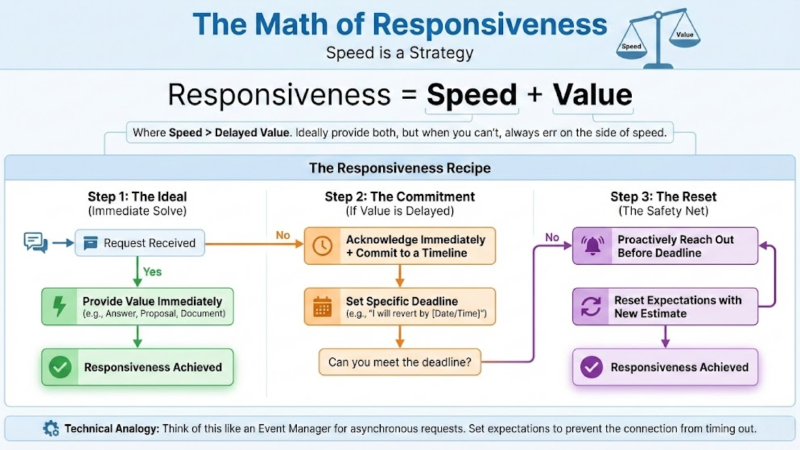
A Note for the Technical Mind#
For those with a background in technology or systems integration, this concept should sound familiar.
This protocol is essentially the human equivalent of an Event Manager handling long-running web requests. You use asynchronous request processing to set expectations and communicate updates to the client application, rather than letting the connection time out.
The Bottom Line#
Responsiveness does not require a budget, a support team, or complex software. It requires only personal commitment.
Whether you are building a venture from zero to scale or managing a complex corporate ecosystem, your future is in your hands. Confront the urge to delay. Prioritize speed.