In 2022, Pushkin Industries attempted to launch 11 new podcasts and 4 books in a single year: a “growth at all costs” gamble that nearly silenced one of the most prestigious voices in media. For any executive building a venture from zero to scale, the Pushkin saga is a cautionary masterclass (cautionary tale?) in the thin line between aggressive expansion and operational collapse.
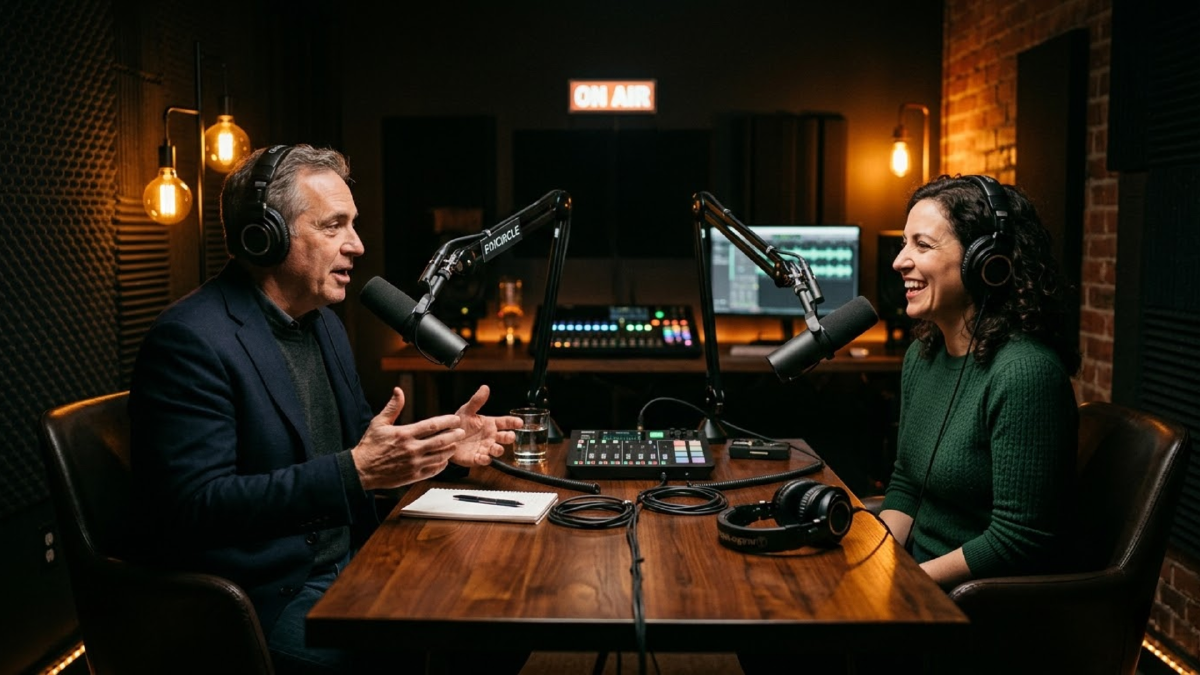
When I sat down recently for my appearance on the FINCIRCLE podcast to discuss scaling innovation, my focus, as always, was on the “how”: how we took UBX from a white-paper concept to 22% fintech market share and >100B GTV.
But as any seasoned executive knows, you never stop being an operator. Even as the “talent” in the chair, I found myself analyzing the room: the distribution model, the production workflow, and the unit economics of the podcasting medium itself. I wasn’t just there to share my story; I was there to understand the business behind the broadcast.
This curiosity followed me home. As I listened to my personal favorites, shows like Cautionary Tales and a new series I just downloaded The Chinatown Sting, I realized they were the products of a single powerhouse: Pushkin Industries.
At first glance, Pushkin is a “creator’s paradise” co-founded by best-selling author Malcolm Gladwell. But look deeper through the lens of a venture builder, and you find something far more interesting. Pushkin isn’t just a content house; it is a transformation story. It is a company that flew too close to the “growth at all costs” sun, faced a brutal financial reckoning, and emerged as a masterclass in operational discipline and “capital-light” scaling.
If you are currently navigating the transition from a boutique venture to a high-scale enterprise, the Pushkin saga offers three critical lessons in protecting your “soul” while fixing your balance sheet.
The Origins: A “Creator-First” Vision#
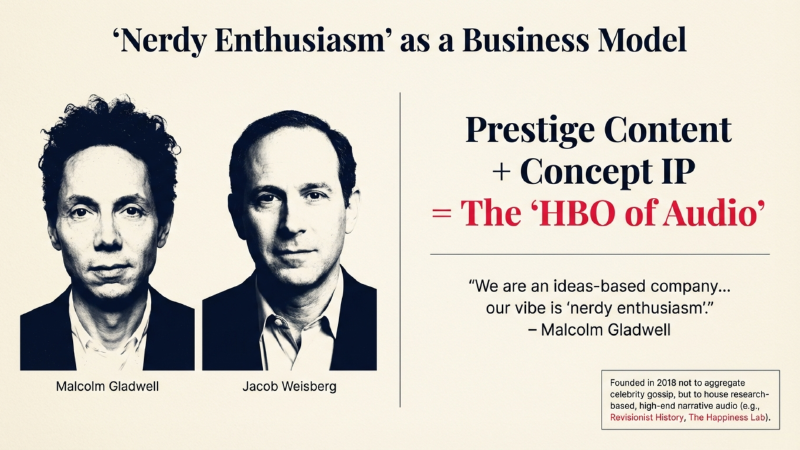
Pushkin Industries was co-founded in 2018 by journalist Malcolm Gladwell and former Slate editor-in-chief Jacob Weisberg. The idea was sparked when Panoply Media, which hosted Gladwell’s hit podcast Revisionist History, decided to exit the content business to focus on technology. Weisberg and Gladwell launched Pushkin with a lean four-person team, intending to build a boutique, “creator-first” production company. Their foundational vision was to specialize in highly produced, authorial, and narrative-driven audio that challenged listeners while inspiring joy.
The Challenges: Hyper-Growth and Financial Reckoning#
Despite early successes, Pushkin fell victim to the podcast industry’s “growth at all costs” mentality. During a September 2021 staff retreat at Mohonk Mountain House, the business team presented an aggressive expansion strategy focused on producing significantly more podcasts, books, and profits.
In 2022 alone, the company attempted to juggle its 14 existing shows while launching 11 new original podcasts, two branded shows, and four books, adding 17 new staff members in the process. This unsustainable pace severely strained the company’s resources. The finance department mandated that production teams shave costs, work faster, and create bonus content for subscribers with fewer resources.
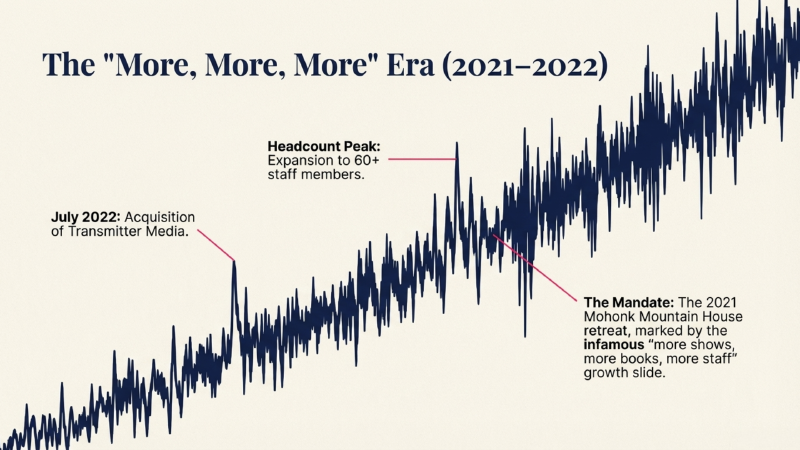
This aggressive scaling, combined with a broader economic downturn in the podcast ad market, led to a severe financial crisis for the company. Internal morale plummeted as some creators felt the original boutique vision had been hijacked by executives disconnected from the realities of audio production. Ultimately, in September 2023, Pushkin was forced to lay off 17 employees—amounting to over 30% of its total staff and sunset several beloved but unprofitable shows.
Hyper-growth is a siren song. Pushkin’s ‘Hyper-Growth’ phase was a classic case of scaling horizontally before the vertical unit economics were proven. Adding 17 staff members and 11 shows simultaneously created a ‘complexity tax’ that the existing operational infrastructure wasn’t built to pay. In my experience scaling UBX, I’ve seen how easy it is for ‘spreadsheet ambition’ to decouple from ’execution reality.’ Pushkin’s mistake wasn’t ambition; it was failing to align their production ‘unit economics’ with their speed of delivery.
The Turnaround: Strategic Restructuring and Profitability#
Following the 2023 layoffs, Pushkin executed a massive strategic pivot to stabilize the business by defining a pathway to EBITDA-positive operations and ensure long-term viability:
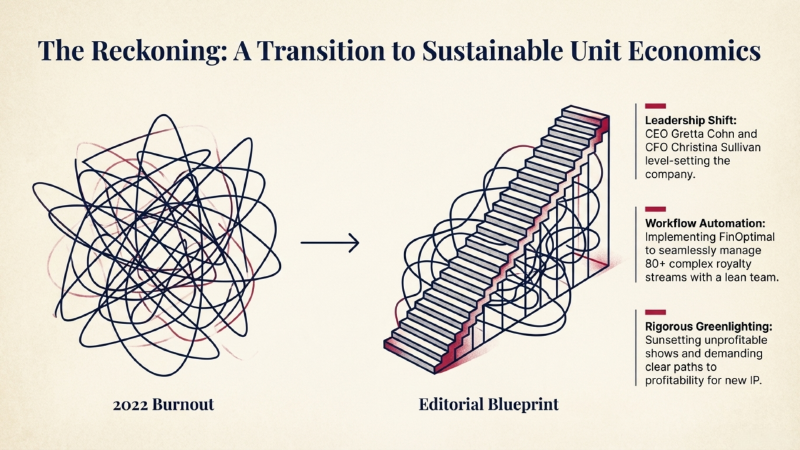
- Leadership Restructuring: As part of the reorganization, Gretta Cohn was promoted to CEO. Cohn had joined Pushkin in 2022 when the network acquired her production company, Transmitter Media. Meanwhile, co-founder Jacob Weisberg transitioned to the role of Executive Chair to focus on complex business decisions and future strategy.
- Focusing on Sustainable Operations: Under Cohn’s leadership, Pushkin completely pivoted to unit-economic viability. The company became highly disciplined, reducing production costs, and only greenlighting new projects that demonstrated a clear, realistic path to profitability.
- Revenue Diversification via Audiobooks and DTC: Pushkin realized that podcasts and audiobooks exist on a continuum and aggressively expanded its “Original Audiobook” program. By producing titles like Gladwell’s The Bomber Mafia and an audio edition of Michael Lewis’s The Big Short, Pushkin created a high-margin retail business that offsets the volatile podcast ad market. Additionally, they grew Pushkin+, a direct-to-consumer (DTC) subscription service offering ad-free listening and early access, creating a stabilized revenue floor. The move into Audiobooks wasn’t just “diversification”: it was also a move toward high-LTV (Lifetime Value) products that reduced their “Platform Dependency” on Apple and Spotify.
- A “Capital-Light” Distribution Model: Pushkin renewed its exclusive sales and distribution partnership with iHeartMedia. This alliance allowed Pushkin to offload the massive overhead of an in-house national ad-sales team while leveraging iHeart’s unmatched reach to monetize its content efficiently.
With my own deep expertise in digital ecosystems and partnerships, the iHeartMedia partnership is really a “Strategic Alliance” rather than just a distribution deal. This mirrors my own experience in securing strategic investments (like SBI Holdings) to fuel growth without bloating internal overhead.
Conclusion#
By prioritizing operational efficiency and diversifying revenue streams, Pushkin successfully navigated the podcasting industry’s bubble bursting. Today, the company is positioned as a highly defensible, premium IP house, capable of acquiring elite properties such as the cult-favorite show Heavyweight, and standing out as a profitable, brand-safe leader in the maturing audio market.
I understand the value of “moats”: from blockchain-based systems to 3.0x TVPI venture funds. Pushkin’s ultimate victory was protecting the Intellectual Property that makes them an attractive M&A target for the 2026 market.
Further Reading & Resources#
Margin Notes
My own comments, annotations, or summaries I would be adding to the margins of this article, to highlight key ideas, content, or add personal reflections.
Pushkin Industries:
- The Vision: Boutique excellence meets the “Creator-First” era.
- The Strategic Trap: “Growth at All Costs” (The September 2023 Reckoning).
The Januszczak Playbook: How Pushkin applied the three pillars of a successful turnaround:
- Leadership Realignment: Cohn’s operational discipline.
- Revenue Diversification: DTC and high-margin retail.
- Ecosystem Leverage: The “Capital-Light” distribution model.
Final Word: “Prestige” is the ultimate defensible asset in a commoditized, AI saturated market.
Links
Sources
- Broken Record Podcast - Rick Rubin and Malcolm Gladwell Music Podcast
- Malcolm Gladwell - Wikipedia
- Malcolm Gladwell Podcast Company - About Pushkin Industries
- Pushkin Industries - Wikipedia
- Pushkin Industries Announces PushNik, A Premium Subscription Program Debuting May 2021 - Podnews
- Pushkin Industries Pushes Audiobook Conventions
- Pushkin Industries Revs Up Fall Slate with ‘The Big Short’ Audiobook and Companion Podcast
- Pushkin Industries: Podcast & Audiobook Production Company
- Pushkin industries unveils Fall 2025 content slate - Podnews
- Revisionist History (podcast) - Wikipedia
- The Happiness Lab with Dr. Laurie Santos | Pushkin Industries
- The Journey to CEO: Podcast Perspectives with Pushkin Industries’ Gretta Cohn
- iHeartMedia Investor Presentations
- Want to Start a Podcast_ Pushkin’s Co-Founder Has Advice
- Why I left… - by Mia Lobel - Freelance Cafe - Substack