
In 2014, an internal document leaked from The New York Times that read less like a strategy memo and more like an institutional autopsy. It was the now-famous Innovation Report, and it was defined by what I like to call radical candor. At a time when they were still winning Pulitzers, their own people were admitting that the “Grey Lady” was failing at being digital because it couldn’t stop acting like a print newspaper.
Fast forward to today: the Times has blown past $2 billion in annual digital revenue . They didn’t get there by just “tweaking” the website. They got there by blowing up 100-year-old silos and rebuilding their technical stack for high-velocity experimentation.
Whether you are in fintech, insurance, or any legacy enterprise, the Times’ evolution is the ultimate blueprint for managing the “gravitational pull” of a traditional business while building a high-growth digital ecosystem.
The “Church and State” Problem#
For decades, the Times lived by a strict “Church and State” separation between editorial and business teams. In a digital world, that separation became a bottleneck. Product development was a bolt-on afterthought, and engineering was treated like an “order-taker” rather than a strategic partner.
The transformation began when they started thinking like a product company. They created cross-functional “pods”: editorial, product, and engineering teams aligned around a single metric: reader retention.
Technical Velocity as a Competitive Advantage#
One lesson I’ve learned in my career is that you have to lean on your tools. In 2016, the Times realized that treating AWS as just “someone else’s data center” wasn’t enough . They moved to a cloud-native, Kubernetes-driven architecture that slashed deployment times from 45 minutes to just seconds.
This wasn’t just a tech upgrade; it was a culture shift. By giving product teams their own clusters and self-service APIs, they enabled the autonomy needed to launch hits like The Daily and the NYT Cooking app without getting stuck in a centralized infrastructure ticket queue.
From Binary Paywalls to Behavioral Funnels#
If you’re still using “crude mechanical mechanisms” to acquire customers, you’re leaving money on the table. The Times moved away from a simple binary paywall, where you hit a limit and get blocked, to a sophisticated, data-driven behavioral funnel.
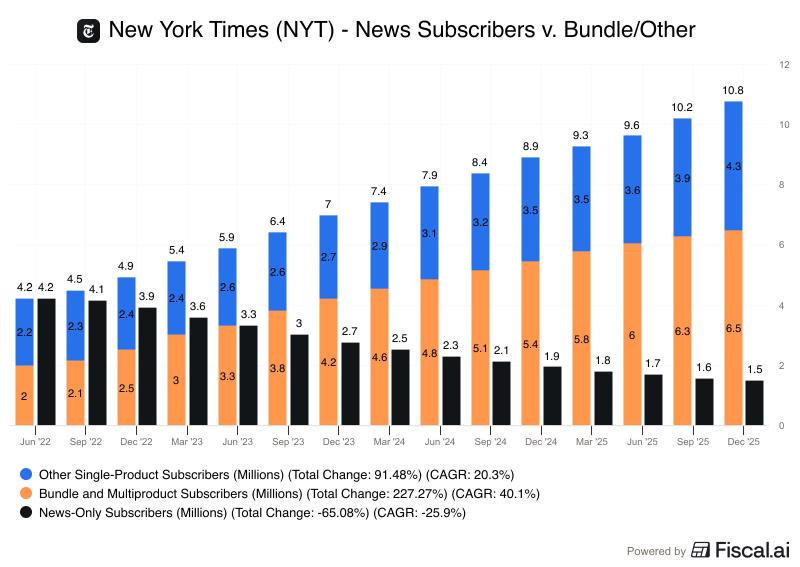
By leveraging first-party data and machine learning, they now understand the “next action” required for every unique user profile. It’s a personalized journey that has driven their “All Access” bundle including The Athletic, Wordle, and Wirecutter, to become the primary engine of their growth, accounting for over 50% of their digital subscriber base.
Download the Case Study: The NYT Strategic Blueprint#
I’ve put together an expert-level research report that deep-dives into this transformation. It covers the technical re-engineering, the M&A strategy behind The Athletic and Wordle, and the specific data frameworks they used to move from $500 million to $2 billion in digital revenue.
If you’re leading a legacy business through a digital pivot, this is essential reading.
Get the Case StudyI’ve added this report to the resources area to help our community of executives and digital leaders navigate the complexities of institutional change. Let me know your thoughts on the “Bundle” strategy!
Featured image by Wally Gobetz is licensed under CC BY-NC-ND 2.0