
In the world of technology, we often suffer from a peculiar form of amnesia. We treat the arrival of Generative AI as a sudden lightning bolt, forgetting that the intellectual scaffolding for this moment was being built decades ago.
Recently, I revisited a transcript of a lecture given by James Burke in Portland, Oregon. The date was October 5, 2001.
To set the scene: the dotcom bubble had burst, the world was still reeling from the tragedy of 9/11, and the “Information Superhighway” was being dismissed by many as an overhyped repository for retail and email. Yet Burke, the legendary science historian and creator of the BBC series Connections, stood on the stage of the Arlene Schnitzer Concert Hall and described a world that looks remarkably like the one we are just now entering with Generative AI and Agentic systems.
The Man Who Saw the Links#
James Burke is perhaps the greatest living cartographer of human innovation. His career has been dedicated to showing how a 12th-century change in the climate can lead to the invention of the printing press, or how a discovery in vacuum pumps leads to the internal combustion engine.
In 2001, while most were focused on e-commerce, Burke was focused on the end of reductionism. He argued that for 400 years, humans had been forced to specialize: to know “more and more about less and less.” He saw the internet not as a library, but as a “Knowledge Web” that would finally allow us to see the connections between all things again.
The Original LLM: The Human Brain as a Predictive Engine#
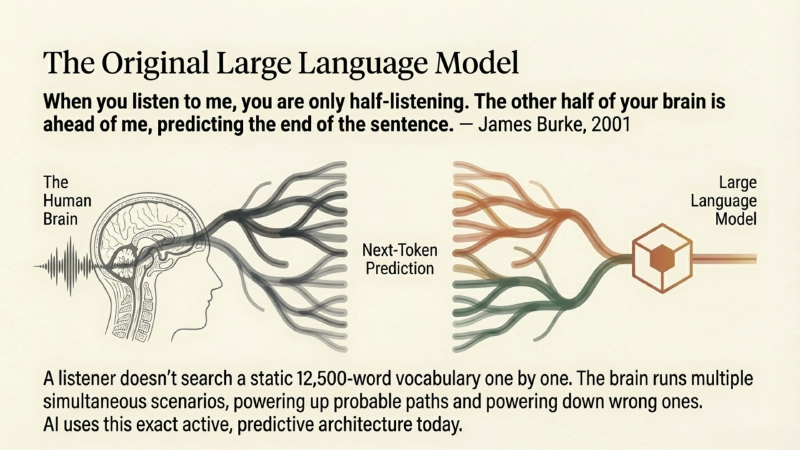
One of the most striking moments in Burke’s lecture is his description of human communication. He notes that as a listener, your brain isn’t just passively receiving words; it is actively pre-processing and predicting the next word or phrase based on the context of what has already been said.
“When you listen to me, you are only half-listening to what I’m saying. The other half of your brain is ahead of me, predicting the end of the sentence.” — James Burke, 2001.
In 2024, we call this Large Language Models (LLMs). The “Next-Token Prediction” architecture that powers ChatGPT and Claude is essentially the digital manifestation of the cognitive process Burke described 23 years ago. He understood that knowledge isn’t a static database; it’s a probabilistic web of relationships.
From Search to Agency: The “Knowledge Web”#
Burke’s vision for the “Knowledge Web” went far beyond the Google search bar. He envisioned a system where information wasn’t just “found,” but “mapped.” He described a world where you could start at a point of interest—say, a specific medical condition—and the technology would autonomously navigate the web of related history, chemistry, and economics to provide a holistic view.
This is exactly where we are heading with Agentic AI. We are moving away from “searching” for links and toward “agents” that navigate complex ecosystems to execute tasks and synthesize insights. Burke’s 2001 vision was the blueprint for the transition from the Information Age to the Intelligence Age.
The Executive Takeaway: Winning on the New Battlefield#
As a leader who has spent decades scaling fintech ventures and navigating digital transformation in Southeast Asia, I see three critical lessons in Burke’s foresight for today’s business landscape:
- The Death of the Silo: Burke predicted that the internet would break down the walls between disciplines. In fintech, this is the reality of Embedded Finance. We no longer view “banking” as a standalone industry; it is a connective tissue woven into the fabric of every other digital interaction. The same can be said of the energy transition, where the future also looks more an more decentralized. In general, the forces of decentralization are ultimately unstoppable in the face of democratized access to knowledge and technology.
- The Shift from “What” to “How”: In a world of Generative AI, the “what” (the data) is a commodity. The “how” (the connections, the strategy, and the execution) is where the value lies. Like Burke’s Connections, the winners will be those who can map the relationship between disparate technologies and market needs.
- Navigating “Transitional Confusion”: Burke spoke of the “scary” nature of this transition. When the old rules of “reductionist” business stop working, leaders feel a sense of vertigo. My role as an advisor is to provide the “situational awareness” Burke alluded to, helping organizations move through the confusion of AI adoption toward a vision that is both inspirational and pragmatically grounded.
Closing Thoughts#
James Burke concluded his lecture by noting that “information gives you the ability to choose.” In 2001, he was worried about the “information poor” being left behind.
Today, as we parachute “intelligence” into the world via cheap smartphones and AI agents, the stakes are even higher. The Knowledge Web is finally here. The question for leaders is no longer whether we can access information, but whether we have the intuition and the strategic discipline to use these connections to build a more inclusive and innovative future.
The future isn’t a straight line; it’s a web. It’s time we started leading like it.
Watch the Lecture#
You can watch the lecture here: