I have often said that the three critical characterisitics of a successful founder are the ability to: (1) build an audience, (2) sell, and (3) build a product.
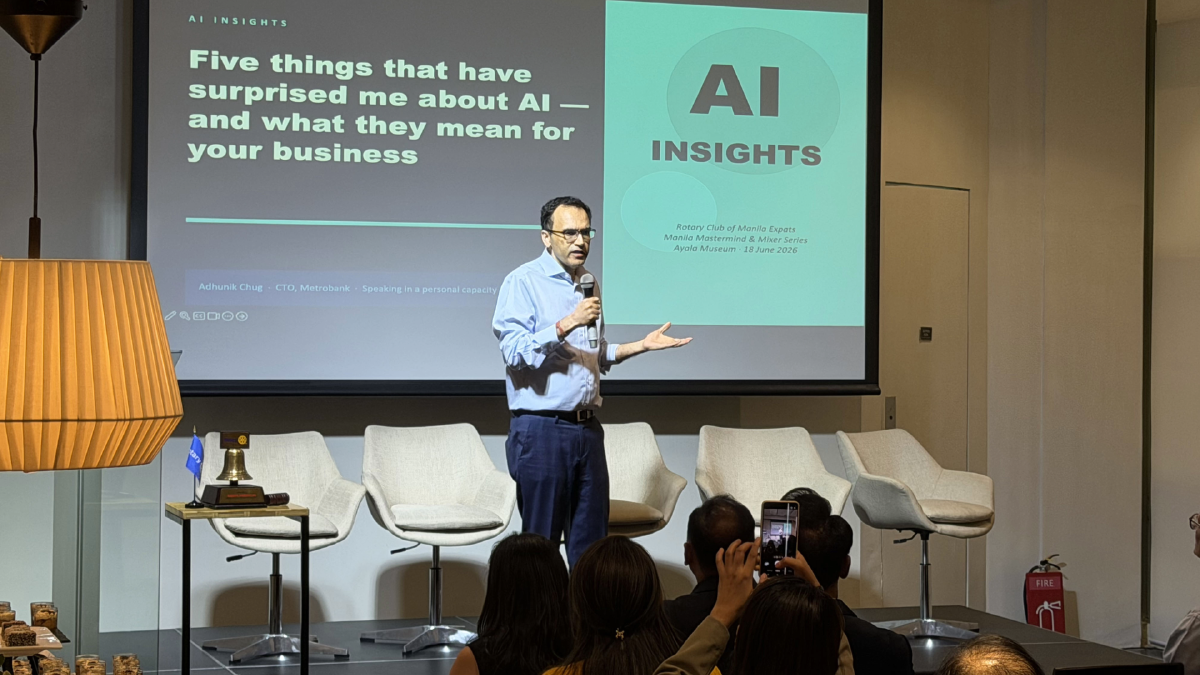
Last year, I ran an experiment in audience-building: a professional speaking series for expatriates in the Philippines.
It did not begin as a media brand. It did not begin with a funnel. It began with a simpler question: could we create a serious forum where internationally minded professionals could meet one another, hear useful ideas, and connect with a local service movement?
That framing mattered more than I expected.
People rarely join a new community because someone announces an event. They join because the event gives them a credible reason to belong. In our case, the Rotary brand and its professional and social mission made the series feel less like a networking scheme and more like a legitimate venue for people building a life, career, and network in the Philippines.
The experiment went from fewer than 20 people at early events to well over 100 at one of the latest events. Our latest event having multiple sponsors and a premier venue:
Here is what I learned.
Why does legitimacy come before promotion?#
The first problem in building an audience is not reach. It is legitimacy.
Nobody owes a new organizer their time, particularly an executive, founder, academic, or experienced operator. A recognizable institution, a clear mission, and a defined audience give people enough confidence to take the first meeting.
Rotary helped because it did three things at once:
- It gave the series a professional identity.
- It gave expatriates a social purpose beyond self-promotion.
- It connected new people to an established local network.
The lesson is not that you need a famous brand. You need a credible answer to a basic question: why does this group exist, and why should I spend an evening with these people?
A good brand and mission can provide the cover to create a forum before the forum has earned its own reputation. That is not cosmetic. It is the operating permission to convene.
How does a small core become a qualified audience?#
We began with a core group of members, but we did not treat them as a captive audience. We asked them to invite people. We promoted sessions through LinkedIn and Facebook. Over time, the event registrations became a qualified mailing list that could be invited to later events.
That is the compounding asset.
The room matters, but the contact record matters more. Each event should leave you with three things: a better understanding of who responds, permission to contact them again, and a stronger reason for the right people to bring someone new next time.
This is also why events should not be measured only by who was in the room. LinkedIn’s B2B Institute makes a similar argument: events can work as reach multipliers, content engines, and customer-access mechanisms when the organizer uses them beyond the event moment itself. That fits my experience. The event is not just the room. It is the next invitation, the next conversation, and the next person a member decides to bring.
For us, the loop was simple:
graph TD;
  A[strong Topic] --> B[credible event]
  B --> C[member invitations and social promotion]
  C --> D[qualified registrations]
  D --> E[follow-up list]
  E --> F[stronger next event]
  F --> A
You do not need a huge mailing list. You need a list built around a real common interest.
That same logic shows up in venture building. Early growth depends on doing the work close enough to the customer that you can learn what actually creates pull. I have written before about why the path to scale requires unscalable work. An event series is no different.
Why should you do the work manually first?#
We resisted the urge to put the series immediately onto Eventbrite or another event platform.
In the early days, we made the promotional materials ourselves. We posted from personal LinkedIn and Facebook accounts. We used mail merge, but wrote the emails carefully and sent them from personal accounts. It was manual and clearly not sustainable.
That was the point.
Before automating a process, you need to understand the process. Manual work exposed the real questions: Which message gets a response? Who actually attends? How much reminder does someone need? Which people bring others? Where does registration break down?
Automation is useful once you know what deserves to be automated. If you automate too early, you scale a set of assumptions and lose the feedback that would have fixed them.
We eventually built our own membership and registration tool, but only after learning the operating model the hard way. That is a story for another day.
One practical rule still holds: if a core group really needs to be in the room, someone has to call them.
A personal call does more than remind people. It asks for a decision. “Will you be there?” creates a commitment that an automated confirmation email rarely does. It does not scale forever, but early on, neither does anything worth building. This is the same operating logic behind responsiveness as a leadership discipline: when the system is still young, speed and direct contact carry trust.
Why is registration not attendance?#
One of the early surprises was the gap between signing up and showing up.
For virtual events, roughly half of registrants did not attend live. That initially felt disappointing. It should not have. ON24’s 2025 Webinar Benchmarks report, based on 2024 platform data, reported a 57% registration-to-attendance conversion rate. ON24 also reported that 45% of attendees watched on demand, which reinforces the point that live attendance is not the whole outcome.
A free virtual registration is a low-commitment action. Someone may intend to attend, then receive a call, hit traffic, get dragged into a family obligation, or simply decide the topic is not worth protecting an hour for.
For face-to-face events, we charged a nominal fee. It helped cover costs, but it was never a profit center. We still had roughly 30 to 35% of registrants fail to show up on the day, and we absorbed some cost overruns ourselves.
That experience changed how I think about event planning. Registration is demand. Attendance is capacity planning. They are not the same number.
Build the economics around expected attendance, not the optimistic registration total. Keep an explicit budget for no-shows, last-minute venue changes, and sponsor timing. If the event works, sponsors can eventually reduce that risk. They should not be the initial assumption.
What makes a speaker worth booking?#
We deliberately avoided the usual hunt for VIPs and influencers.
Instead, we looked for speakers and subjects that were unusually relevant to expatriates in the Philippines. One of our strongest virtual sessions featured a young academic and historian discussing the role of specific expatriates in Philippine history.
He had a thoughtful YouTube channel, but he was not a celebrity. That was not a weakness. The topic was specific, surprising, and directly connected to the audience’s lived experience. He delivered an excellent product.
Bonus
This speaker also left us with an unforgettable tagline for the group: “as an expat in the Philippines, will you be a chronicler or a contributor?”
This is the part many event organizers get wrong. They borrow a famous name, then hope the audience will find a reason to care. We started with the group’s real interests, then found someone who could satisfy them.
Research on convention attendees has long treated education and networking as core attendance motivations, not incidental extras. A regional-conference study in Tourism Management found attendee motivation included networking and educational benefits, and that educational activities were linked to satisfaction, word of mouth, and intent to return. The practical version is simpler: do not book someone because they are important. Book someone because the audience will repeat the idea from the session to someone else the next day.
When do sponsors arrive?#
The series became more attractive to sponsors as the audience grew.
That is the natural order. Early on, we invested to cover losses because we were buying learning: Which topics travel? Which distribution channels work? Who actually attends? How much capacity do we need? What kind of room creates the right conversations?
By the time we could attract more than 100 people, sponsorship became easier to discuss. The sponsor was no longer taking a bet on a concept. They could see the audience, the venue, the speakers, and the quality of the people in the room.
You earn sponsorship by first proving that the room is worth sponsoring.
This is also a structural choice. In corporate venture building, capital should follow proof of a repeatable operating model, not just the ambition to scale. A recurring event series has the same discipline. First prove the room. Then sell the sponsorship.
What is the real operating model?#
An audience is not built through promotion alone. It is built by repeatedly creating a setting that makes the right people think: this was made for me.
For our series, that meant:
- A credible professional and social mission.
- A defined audience: expatriates building a life and network in the Philippines.
- Member-led distribution, supported by LinkedIn and Facebook.
- A growing permission-based mailing list.
- Realistic expectations about no-shows.
- Specific speakers and topics with genuine audience fit.
- Early willingness to fund the learning before asking sponsors to fund the scale.
The series did not grow because we discovered a clever event-marketing trick. It grew because people found a forum that was relevant to them, and then had a reason to bring someone else.
That is how audiences compound.
Before the Crowd: The People Who Transformed this Series#
As famously shared by Derek Sivers on TED, ideas are often over-glorified. The real power lies in the courageous first followers who show everyone else how to join. I want to acknowledge and thank Curtis Forbes (absolutely awesome website btw!), Jon Engalla and Urs Bolt for being the early recruits who helped make all of this possible. Maraming salamat po!
Are you an Expat in the Philippines?#
Are you ready to make an impact? If you’re a professional or corporate sponsor who wants elite networking and real community impact in the Philippines, backed by Rotary’s global legacy while locally focused on economic development, social impact, and cultural exchange: join a community of leaders and doers making a difference!