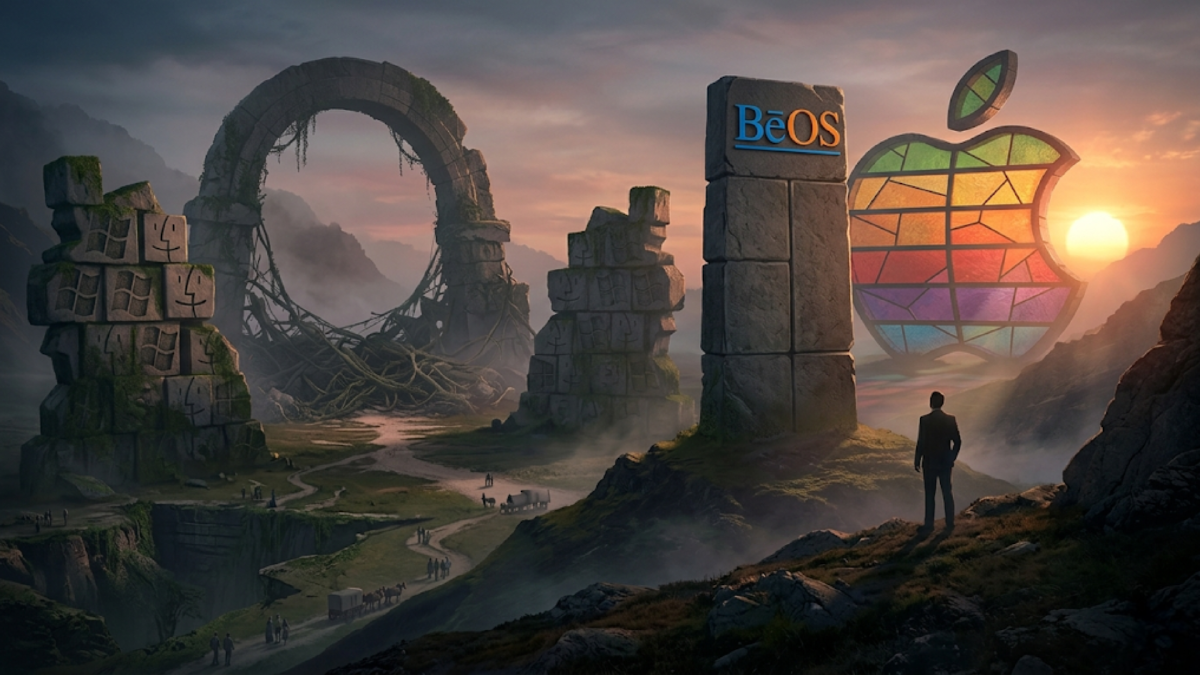
In 1996, Apple was dying.
The company was months away from bankruptcy, and their flagship operating system was a crumbling relic of the 80s. They needed a miracle. They needed a new “soul” for the Mac.
The frontrunner wasn’t Steve Jobs. It was a sleek, lightning-fast newcomer called BeOS.
If you were around tech in the mid-90s, seeing BeOS in action felt like stepping into the future. While Windows 95 struggled to play a single video without stuttering, BeOS could play eight videos simultaneously, render 3D graphics in real-time, and boot in ten seconds. All on hardware that should have been too weak to handle it.
It was, by all accounts, the “best” product. Yet, today, almost no one uses it.
The story of BeOS isn’t just a piece of Silicon Valley trivia; it is one of the most instructive case studies in business history. It’s a story about why “better” isn’t always “enough,” and why your ecosystem is often more important than your engineering.
The Rise: Engineering Without Baggage#
BeOS was founded by Jean-Louis Gassée, a former Apple executive with a vision for the “Media OS.”
Unlike Windows or the classic Mac OS, which were weighed down by decades of “legacy code” (old instructions kept around so old apps wouldn’t break), BeOS was built from a clean sheet. It was designed specifically for the multi-core, high-bandwidth world we live in today, long before that world actually existed.
It was the first OS to truly embrace “multithreading”: the ability for a computer to do many things at the exact same time without the user seeing a spinning hourglass. It was elegant, it was fast, and it was revolutionary.
The “Almost” Moment: Apple’s Great Pivot#
By late 1996, Apple was in deep negotiations to buy Be Inc. for $125 million.
Gassée, knowing he held the “superior” tech, played hardball. He held out for $300 million. In that moment of hesitation, Steve Jobs made his move. He pitched his own company, NeXT, to Apple’s board.
Jobs didn’t just sell code; he sold a vision, a leadership team, and a pathway to the future. Apple chose NeXT for $429 million, Steve Jobs returned, and the bones of NeXT became what we now know as macOS.
BeOS was left at the altar.
The Fall: The Ecosystem Wall#
BeOS tried to pivot. They ported their software to Intel-based PCs, hoping to compete directly with Microsoft. But they hit a wall that every executive should recognize: The Network Effect.
It didn’t matter how fast BeOS was. If Microsoft Office didn’t run on it, businesses wouldn’t buy it. If developers didn’t see millions of users, they wouldn’t build the apps.
Be Inc. eventually sued Microsoft for anti-competitive practices, claiming Microsoft pressured PC makers like Hitachi to stay away from BeOS. They won a $23 million settlement in 2003, but it was too late. The company was already gone, its assets sold to Palm for a fraction of their peak value (I understand around $11 million?).
The Executive Lessons: Why the “Best” Often Loses#
What can we take away from the ghost of BeOS?
- Ecosystem Trumps Feature Sets: In a platform war, your product is only as good as the partners standing next to you. BeOS had the best engine, but no “gas stations” (apps) or “roads” (OEM partnerships). As a leader, never confuse your product’s performance with its market viability.
- The Cost of Hubris: Had Jean-Louis Gassée accepted Apple’s initial offer, BeOS would likely be the foundation of every iPhone and Mac in the world today. Instead, he held out for a higher valuation and lost the entire board game. Valuation is vanity; alignment and market-fit are sanity.
- Legacy is a Moat, Not Just a Burden: We often mock “legacy systems” for being slow. But legacy also means “installed base.” Microsoft and Apple’s greatest weakness, backward compatibility, was their greatest strength. It kept their users locked in. If you are building the “new and improved” version of a category, you must give users a bridge from their past, not just a leap into the future.
The Afterlife: Haiku and the Vision#
BeOS didn’t entirely disappear. A community of enthusiasts eventually began a project called Haiku, an open-source recreation of BeOS that is still being updated today.
But its true legacy is in our pockets. The focus on responsiveness, the way your phone handles high-definition video without lag, and the “clean sheet” thinking of modern mobile OSs all trace their spiritual lineage back to that mid-90s miracle.
BeOS taught us that the future is easy to imagine, but incredibly hard to distribute. As you scale your own brand or company, ask yourself: Am I building the best engine, or am I building the world that the engine needs to run in?
Frequently Asked Questions
? Why did BeOS fail despite being technically superior?
? What strategic lesson should executives take from the Be Inc. acquisition battle?
? How can modern leaders build a 'moat' around their products?
BeOS Demo Video#
Directly from the orginal BeOS team: