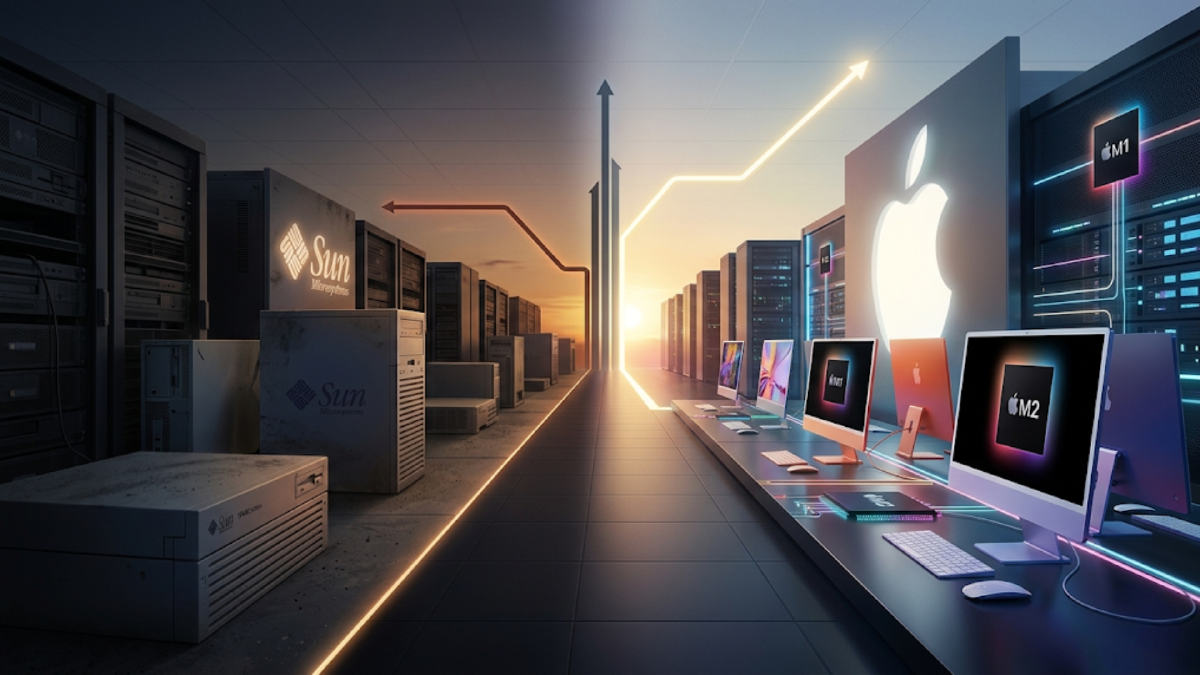

Imagine a company that doesn’t just sell computers.
It designs its own high-performance RISC processor from scratch.
It builds the hardware around that chip.
It writes its own Unix-based operating system, tuned to every last transistor.
It sells premium machines directly into a high-margin market where customers pay for speed, reliability, and a seamless experience.
Vertical integration at its purest. Silicon-to-software control. A bet that owning the entire stack would deliver unbeatable performance and customer lock-in.
Apple in 2024?
Nope.
That was Sun Microsystems in 1987.
Sun’s SPARC processor, SPARCstation workstations, and Solaris OS were the original vertically integrated powerhouse. They dominated technical computing and early internet infrastructure. Then the company slowly bled out, got acquired by Oracle in 2010, and essentially disappeared.
Apple just did the exact same thing with its M-series Apple Silicon chips, unified memory architecture, and macOS. The market rewarded it with record profits and the fastest platform transition in tech history.
So what changed? Why did the identical strategy fail spectacularly for Sun but work brilliantly for Apple?
The answer isn’t technology. It’s strategy sitting inside three things that actually matter: market, scale, and priorities. Everything else is noise.
Sun’s Bet: Vertical Integration in the Workstation Era#
In the mid-1980s, Sun saw the same opportunity Apple later seized. Intel’s x86 chips were CISC dinosaurs: clunky, power-hungry, and held back by backward compatibility. Sun bet on a clean-sheet RISC design (SPARC) that could run circles around them. They controlled the CPU, the systems, the OS, and the compiler toolchain. Performance was insane for the era. Engineers loved the machines. Sun rode the workstation boom and became the “arms dealer” of the dot-com explosion.
It looked unstoppable.
Then the market shifted under their feet.
What Went Wrong: The Three Forces That Killed Sun#
1. Market: Commoditization Ate Their Lunch#
Sun was playing in the enterprise and technical workstation market. That market was about to be devoured by cheap x86 servers running Linux (or Windows). A rack of $2,000 Intel boxes plus open-source software delivered “good enough” performance for 90% of workloads at one-tenth the price.
Sun’s beautifully engineered SPARC systems were premium products in a market that no longer wanted to pay premium prices. Customers didn’t need the last 20% of performance if they could get 80% for pennies on the dollar and scale horizontally instead of vertically.
Apple, by contrast, plays in the premium consumer device market. People happily pay $1,500+ for a MacBook that lasts 18 hours on a charge and feels magical. The iPhone already proved consumers would pay for a tightly integrated, battery-efficient experience. Apple wasn’t fighting commoditization; it created the category.
2. Scale: Intel Had an Order-of-Magnitude Advantage#
Sun designed great chips, but they couldn’t match Intel’s manufacturing scale or R&D budget. Even with manufacturing partners like Fujitsu, Sun was shipping in the hundreds of thousands of units. Intel was shipping in the hundreds of millions. Process technology, yields, and cost curves all favored the giant.
By the early 2000s, x86 had closed the performance gap while staying dramatically cheaper. Sun’s vertical integration became a cost disadvantage, not an advantage.
Apple’s scale is the mirror image. The iPhone alone ships ~200 million units a year. That volume funds the world’s most advanced custom silicon program. Apple designs its own CPU, GPU, and neural engine cores, then has TSMC fab them on the latest nodes. The Mac is basically riding the coattails of iPhone R&D. Vertical integration only works when your volume is high enough to amortize the enormous fixed cost of chip design.
3. Priorities: The World Changed What “Winning” Meant#
In the 1980s and 1990s, the dominant metric was raw clock speed and single-threaded performance. Power efficiency barely mattered—servers lived in air-conditioned rooms and laptops were niche. SPARC was optimized for that world.
By 2020, the world had flipped. Mobile devices, laptops, and even data centers cared about performance per watt, thermals, and battery life more than peak GHz. Apple had spent a decade mastering exactly that on the iPhone with its A-series ARM chips. The M1 wasn’t a leap of faith; it was a scaled-up phone chip with years of real-world validation.
ARM itself had been around since the 1980s, but it took 35 years for the industry to value what ARM was always good at: efficiency. Sun bet on the wrong architecture for the wrong era. Apple bet on the right architecture after the market had finally caught up to it.
Why ARM “Suddenly” Won (It Didn’t)#
People say “ARM took forever to beat x86.” That’s the wrong framing.
ARM was never trying to beat x86 on 1990s desktop workloads. It was designed for low-power embedded devices. The performance gap only closed because:
- Process technology advanced dramatically (7nm, 5nm, 3nm nodes).
- Microarchitecture improved (Apple’s Firestorm cores, big.LITTLE designs, massive vector units).
- The use case changed. Phones and thin laptops made efficiency the new king.
Sun couldn’t wait for that shift. Apple timed its move perfectly—right when the physics and the market aligned.
The Strategic Lesson: Context Is Everything#
Vertical integration isn’t a strategy. It’s a tactic that only works when the surrounding conditions are right.
Sun had the vision in 1987. They just had the wrong market (commoditizing enterprise), the wrong scale (dwarfed by Intel), and the wrong priorities (raw speed in an era about to obsess over efficiency).
Apple has the same vision in 2024—but the market rewards premium consumer experiences, their scale is unmatched, and efficiency is now the decisive competitive advantage.
The same playbook. Completely different outcomes.
Because strategy doesn’t live in isolation. It lives inside market, scale, and priorities. Get those three right, and vertical integration looks like genius. Get even one wrong, and you become a cautionary tale.
Sun proved it first. Apple is proving it now.
The next company that tries this playbook? Make sure you’re playing in the right decade.
Sun Microsystems: The Fastest Computer of 1987#
I was reminded of a lot of this when watching this video on rise and fall of Sun Microsystems. Worth a watch: